We use cookies

Our website uses essential cookies and, with your consent, additional cookies to measure performance and improve our services. Cookie Policy.

You can change your choice at any time.

MMedXYNews
HomeVideos
© 2026 MedXY
Contact usAbout usPrivacy PolicyMedXY story
MedXY AI/MedXY News/Tag: septic shock
MedXY News
EnglishTag

septic shock

Ask MedXY AI
type 2 diabetesclinical trialheart failureimmunotherapyobesitycardiovascular riskatrial fibrillationbiomarkerscritical careclinical trialsHypertensionartificial intelligenceCardiologyoncologypublic healthtype 1 diabetesdiabetesMortalityAlzheimer's diseasecardiovascular diseasebreast cancerepidemiology

Latest news

Tag

Septic Shock in Allogeneic Hematopoietic Stem-Cell Transplant Recipients: Outcomes, Prognostic Factors, and Clinical Implications from a Multicenter ICU Cohort
Critical Careseptic shockAllogeneic Hematopoietic Stem Cell Transplantation

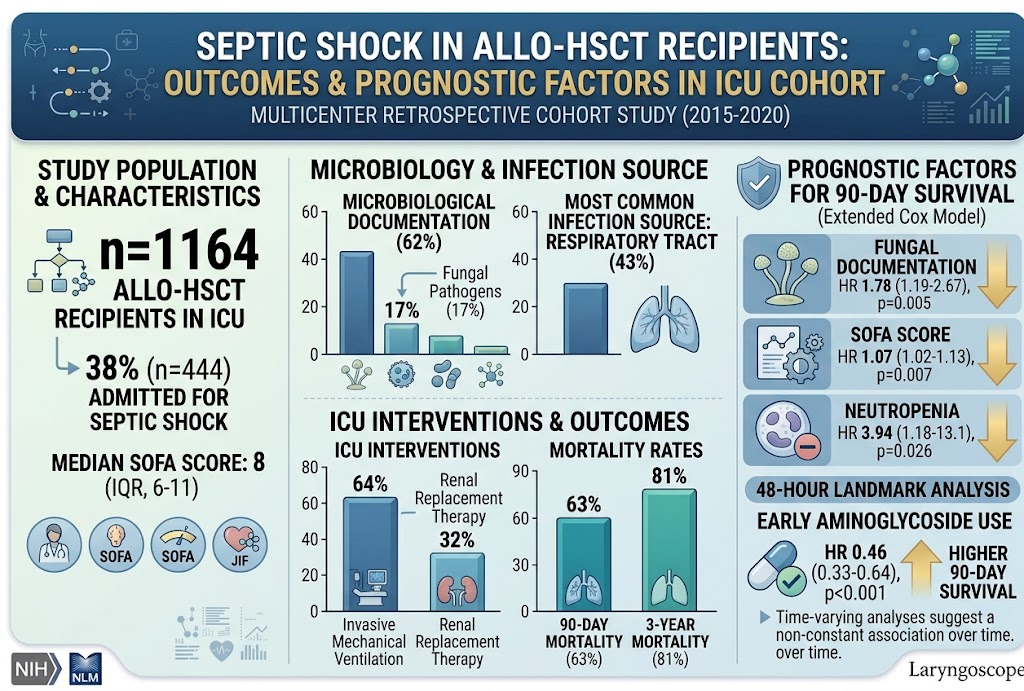
Septic Shock in Allogeneic Hematopoietic Stem-Cell Transplant Recipients: Outcomes, Prognostic Factors, and Clinical Implications from a Multicenter ICU Cohort

By MedXY|Sep 3, 2026

Septic shock following allogeneic hematopoietic stem-cell transplantation has a high 90-day mortality rate of 63%, strongly influenced by illness severity, fungal infection, and neutropenia. Early aminoglycoside use shows complex associatio
Early Red Blood Cell Transfusion Strategy in Septic Shock Among Cancer Patients: Insights from the TRANSPORT Randomized Controlled Trial
Clinical Updates
Red Blood Cell Transfusion
septic shock

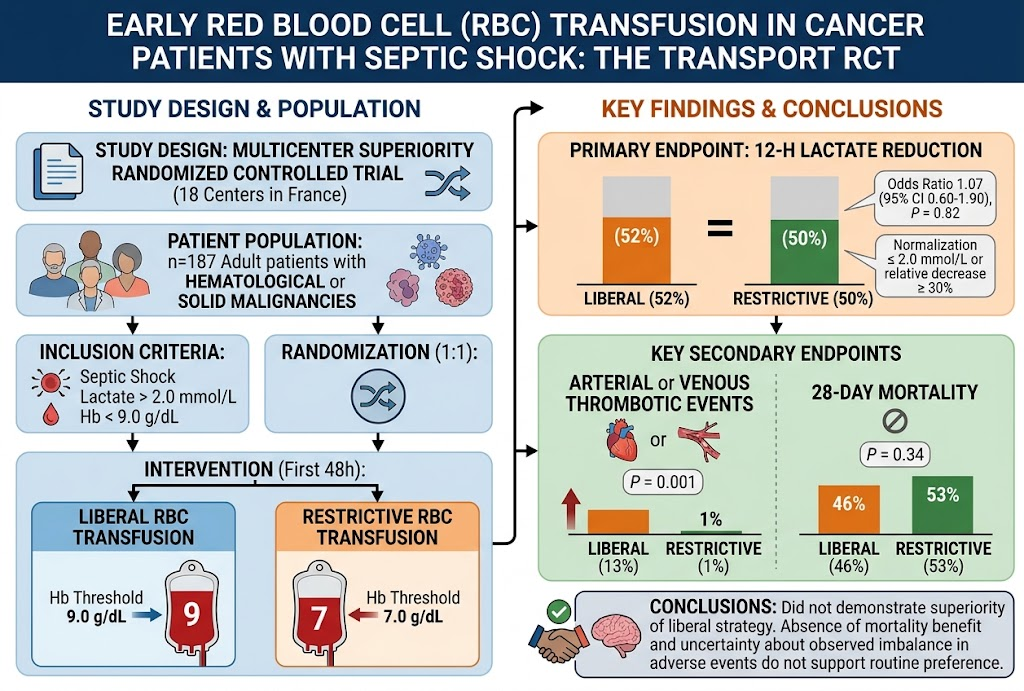
Early Red Blood Cell Transfusion Strategy in Septic Shock Among Cancer Patients: Insights from the TRANSPORT Randomized Controlled Trial

By MedXY|Aug 27, 2026

The TRANSPORT trial showed no superiority of liberal versus restrictive RBC transfusion in septic shock patients with cancer, highlighting no mortality benefit and increased thrombotic events with liberal strategy, underscoring the need for

Post-ICU Frailty in Older Adults Following Septic Shock: Key Predictors and Clinical Implications
Critical Careseptic shockolder adults

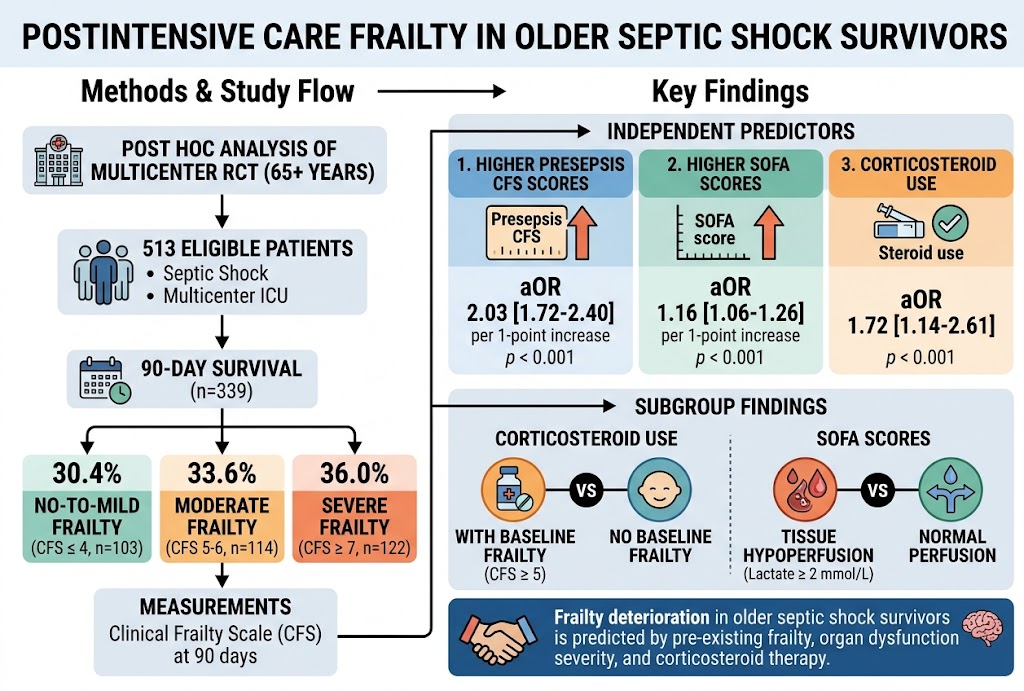
Post-ICU Frailty in Older Adults Following Septic Shock: Key Predictors and Clinical Implications

By MedXY|Aug 26, 2026

This study identifies baseline frailty, organ dysfunction severity, and corticosteroid use as independent predictors of severe post-intensive care frailty in older septic shock survivors, highlighting critical factors for targeted post-ICU

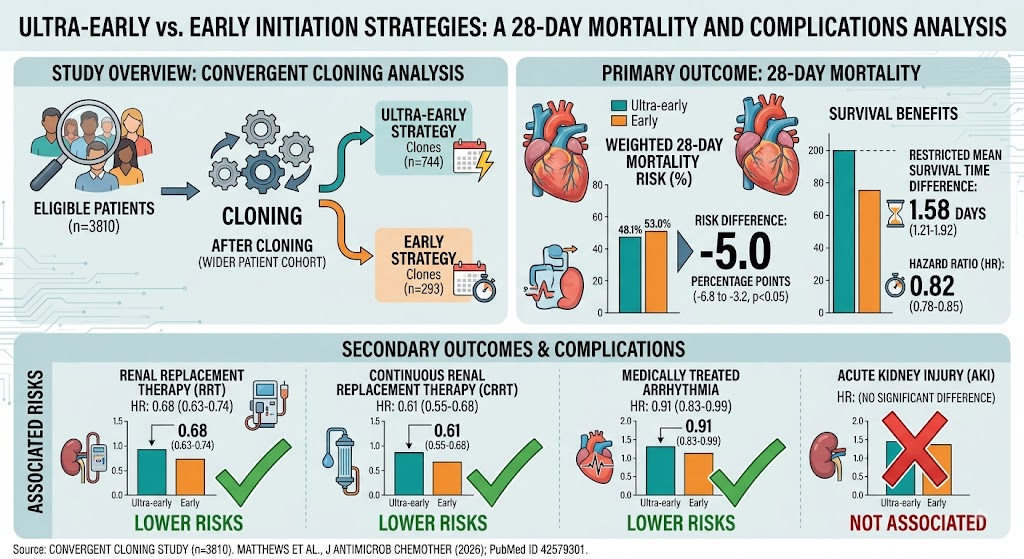
Ultra-Early Versus Early Vasopressin Initiation After Norepinephrine Escalation in Septic Shock: Insights from a Target Trial Emulation
Critical Carecritical careseptic shock

Ultra-Early Versus Early Vasopressin Initiation After Norepinephrine Escalation in Septic Shock: Insights from a Target Trial Emulation

By MedXY|Aug 12, 2026

This study emulated a target trial to compare ultra-early (0-3h) versus early (>3-6h) vasopressin initiation after norepinephrine escalation in septic shock, revealing significant mortality and renal therapy benefits with ultra-early use

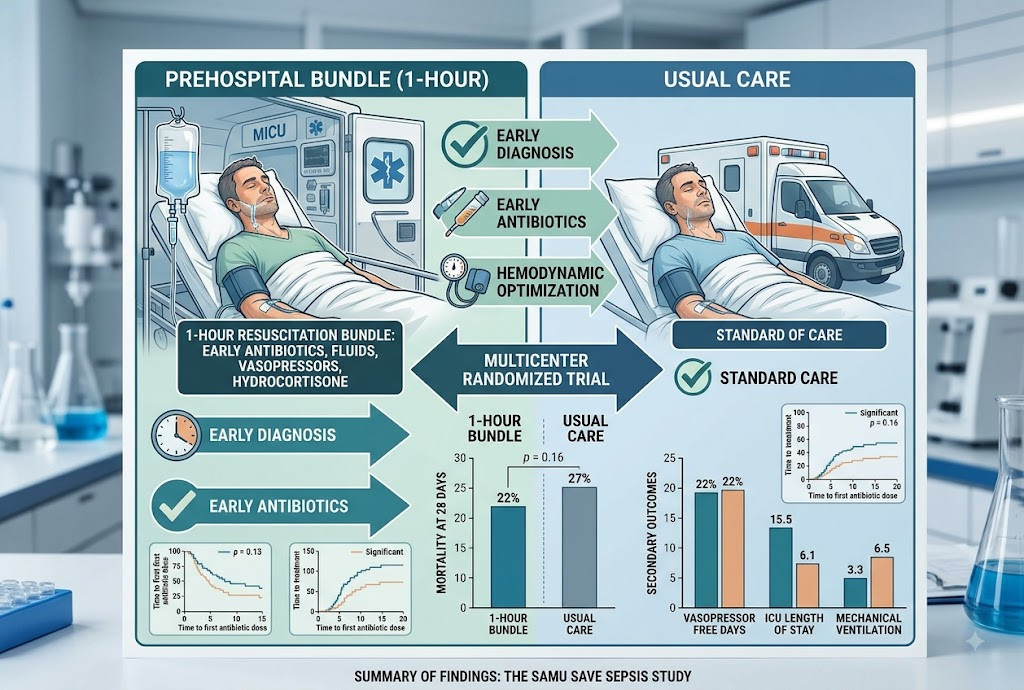
Evaluating the Impact of a Prehospital 1-Hour Resuscitation Bundle on Septic Shock Mortality: Insights from the SAMU Save Sepsis Study
Allergy & Immunologyresuscitation bundleprehospital care

Evaluating the Impact of a Prehospital 1-Hour Resuscitation Bundle on Septic Shock Mortality: Insights from the SAMU Save Sepsis Study

By MedXY|Aug 11, 2026

A multicenter randomized trial found that initiating a 1-hour resuscitation bundle including early antibiotics, fluids, vasopressors, and hydrocortisone in the prehospital setting did not significantly reduce 28-day mortality in adults with

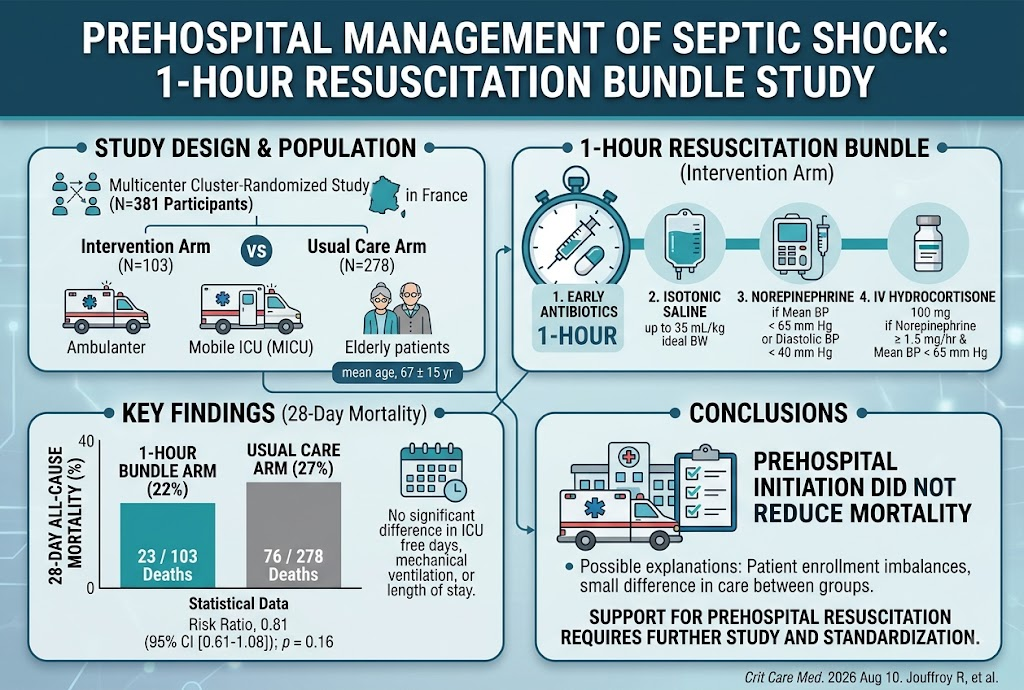
Evaluating the Impact of a 1-Hour Prehospital Resuscitation Bundle on Septic Shock Outcomes
Critical Careresuscitation bundlecritical care

Evaluating the Impact of a 1-Hour Prehospital Resuscitation Bundle on Septic Shock Outcomes

By MedXY|Aug 11, 2026

A multicenter study investigated whether initiating a 1-hour resuscitation bundle—including antibiotics, fluids, vasopressors, and hydrocortisone—in the prehospital setting influences 28-day mortality in septic shock, finding no significant

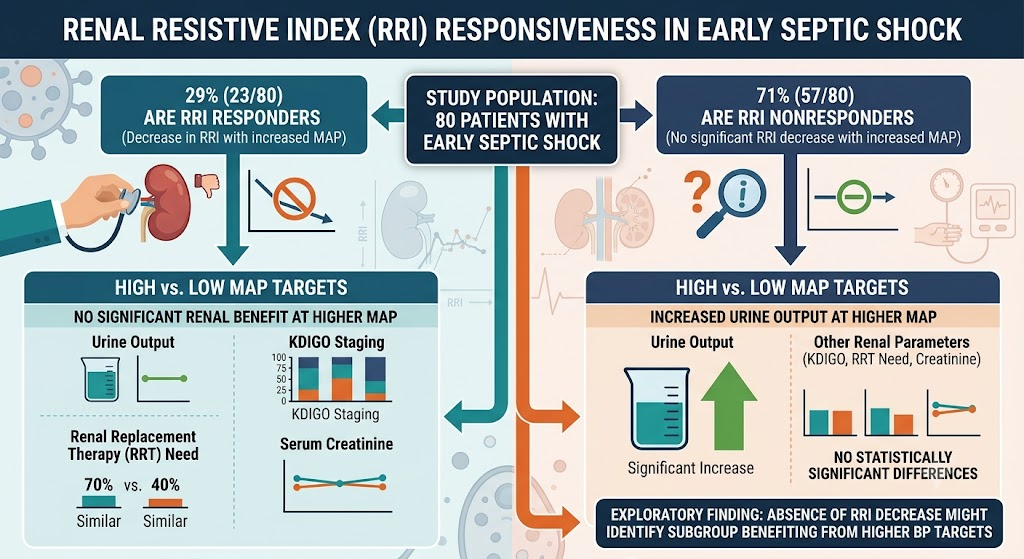
Evaluating Renal Resistive Index Responsiveness to MAP Targets in Early Septic Shock: Clinical Implications and Physiologic Insights
Critical Careseptic shockmean arterial pressure

Evaluating Renal Resistive Index Responsiveness to MAP Targets in Early Septic Shock: Clinical Implications and Physiologic Insights

By MedXY|Aug 5, 2026

This study explores whether renal resistive index (RRI) changes during a transient elevation of mean arterial pressure (MAP) can guide individualized MAP targets to optimize renal function in early septic shock, finding that RRI decrease do

Combining Tissue Hypoperfusion Markers with Vasopressor Dose Enhances Mortality Risk Stratification in Refractory Septic Shock
Critical Carerefractory shockrisk stratification

Combining Tissue Hypoperfusion Markers with Vasopressor Dose Enhances Mortality Risk Stratification in Refractory Septic Shock

By MedXY|Jul 21, 2026

Persistent tissue hypoperfusion alongside vasopressor dosing improves early risk stratification in refractory septic shock, identifying patients with markedly increased 28-day mortality beyond vasopressor dose alone, as shown in a secondary

New SCCM–ESICM Consensus Defines Refractory Septic Shock
Critical CareConsensuscritical care

New SCCM–ESICM Consensus Defines Refractory Septic Shock

By MedXY|May 15, 2026

A new SCCM–ESICM Delphi consensus standardizes clinical criteria for refractory septic shock, focusing on persistent hypoperfusion, fluid unresponsiveness, high vasopressor needs, and bedside ultrasound when mixed shock is suspected.

Albumin Replacement in Septic Shock: Safety Confirmed but Survival Benefit Remains Elusive
Critical CareAlbumincritical care

Albumin Replacement in Septic Shock: Safety Confirmed but Survival Benefit Remains Elusive

By MedXY|Feb 23, 2026

The ARISS randomized clinical trial found that 20% albumin supplementation to maintain serum levels ≥3.0 g/dL is safe in septic shock but does not significantly improve 90-day survival compared to standard crystalloids, though the study&#82

Higher Blood Pressure Targets in Septic Shock: When More Vasopressors Do More Harm than Good
Critical Carecritical carehemodynamics

Higher Blood Pressure Targets in Septic Shock: When More Vasopressors Do More Harm than Good

By MedXY|Dec 27, 2025

A post-hoc analysis of the SEPSIS-PAM trial reveals that while high MAP targets do not provide a universal survival benefit, they significantly increase mortality risk when requiring high norepinephrine doses or failing to resolve microcirc

Sepsis Survival in Australia and New Zealand: Analyzing Two Decades of Progress and the Recent Mortality Rebound
Critical Carecritical caremortality trends

Sepsis Survival in Australia and New Zealand: Analyzing Two Decades of Progress and the Recent Mortality Rebound

By MedXY|Dec 26, 2025

A large-scale study of over 300,000 ANZ ICU patients reveals that sepsis mortality plummeted from 28% to 11% between 2000 and 2020, followed by a concerning 0.9% annual increase through 2023, highlighting both clinical triumphs and emerging

Targeting Tissue Perfusion and Lower MAP in Septic Shock Did Not Improve 30‑Day Perfusion-Free Survival: Results from the TARTARE-2S Randomized Trial
Critical Caremean arterial pressureresuscitation

Targeting Tissue Perfusion and Lower MAP in Septic Shock Did Not Improve 30‑Day Perfusion-Free Survival: Results from the TARTARE-2S Randomized Trial

By MedXY|Dec 10, 2025

In the TARTARE-2S trial, a tissue-perfusion–guided resuscitation strategy that permitted lower MAP (50–65 mm Hg) did not increase days alive with normalized lactate and without vasopressors at 30 days versus standard-of-care MAP-guided trea

Targeting Capillary Refill Time in Early Septic Shock Reduced Duration of Organ Support: Key Findings from ANDROMEDA‑SHOCK‑2
Critical Carecritical careseptic shock

Targeting Capillary Refill Time in Early Septic Shock Reduced Duration of Organ Support: Key Findings from ANDROMEDA‑SHOCK‑2

By MedXY|Nov 7, 2025

ANDROMEDA‑SHOCK‑2 randomized 1,501 patients with early septic shock to a personalized CRT‑guided hemodynamic protocol versus usual care. A hierarchical composite outcome favored the CRT strategy (win ratio 1.16; 95% CI 1.02–1.33; P = .04),

Choice of Vasopressor in Septic Shock: Does It Change Kidney Outcomes? A Critical Appraisal of the Evidence
Critical Careacute kidney injuryrenal outcomes

Choice of Vasopressor in Septic Shock: Does It Change Kidney Outcomes? A Critical Appraisal of the Evidence

By MedXY|Nov 7, 2025

A systematic review of 17 randomized trials (n=4,259) found no consistent renoprotective effect from any vasopressor in septic shock. Heterogeneous definitions, underpowered studies, and reliance on RRT limit conclusions; standardized renal

Adjunctive Terlipressin in Refractory Septic Shock: Lowers High-Dose Catecholamine Need at 6 Hours but No Mortality Benefit
Critical Carecritical careseptic shock

Adjunctive Terlipressin in Refractory Septic Shock: Lowers High-Dose Catecholamine Need at 6 Hours but No Mortality Benefit

By MedXY|Nov 7, 2025

In a double-blind RCT of 130 patients with refractory septic shock, terlipressin increased the proportion achieving MAP ≥65 mmHg with low catecholamine exposure at 6 hours versus placebo but did not change 28-day mortality; digital ischemia

Iloprost in Severe Septic Shock with Persistent Hypoperfusion: Insights from a Rigorous Randomized Trial
Critical CareOrgan Failurerandomized controlled trial

Iloprost in Severe Septic Shock with Persistent Hypoperfusion: Insights from a Rigorous Randomized Trial

By MedXY|Oct 2, 2025

A recent double-blind RCT shows iloprost did not reduce organ failure severity in septic shock patients with persistent hypoperfusion, highlighting challenges in improving outcomes despite theoretical benefits in microcirculation.

Low-Dose Hydrocortisone in Cirrhotic Patients With Septic Shock: A Double-Blind Randomised Placebo-Controlled Trial
Clinical Updatescirrhosishydrocortisone

Low-Dose Hydrocortisone in Cirrhotic Patients With Septic Shock: A Double-Blind Randomised Placebo-Controlled Trial

By MedXY|Oct 1, 2025

This trial evaluated low-dose hydrocortisone in cirrhotic patients with septic shock, finding no improvement in 28-day mortality or shock resolution compared to placebo.

Ask MedXY AI

Most popular

Intimate Health
Five Benefits for Women Continuing Sexual Activity After Menopause
Intimate Health
Why Some Women Have a Strong Sex Drive—And Why Men Shouldn't Worry About It
Nursing & care
How often should a couple have sex?
Intimate Health
Classic Intimacy Recommendations: How to Help Women Reach Orgasm and Enjoy Mutual Pleasure
Intimate Health
What Makes a Woman "Physiologically Addicted" Is Never Money, But These Two Relationship Qualities