We use cookies

Our website uses essential cookies and, with your consent, additional cookies to measure performance and improve our services. Cookie Policy.

You can change your choice at any time.

MMedXYNews
HomeVideos
MedXY AI/MedXY News/Section: Critical Care

Evaluating the Impact of a 1-Hour Prehospital Resuscitation Bundle on Septic Shock Outcomes
MedXY Editorial Team•Aug 11, 2026•Critical Care
resuscitation bundlecritical careprehospital careseptic shockMortality

Highlight

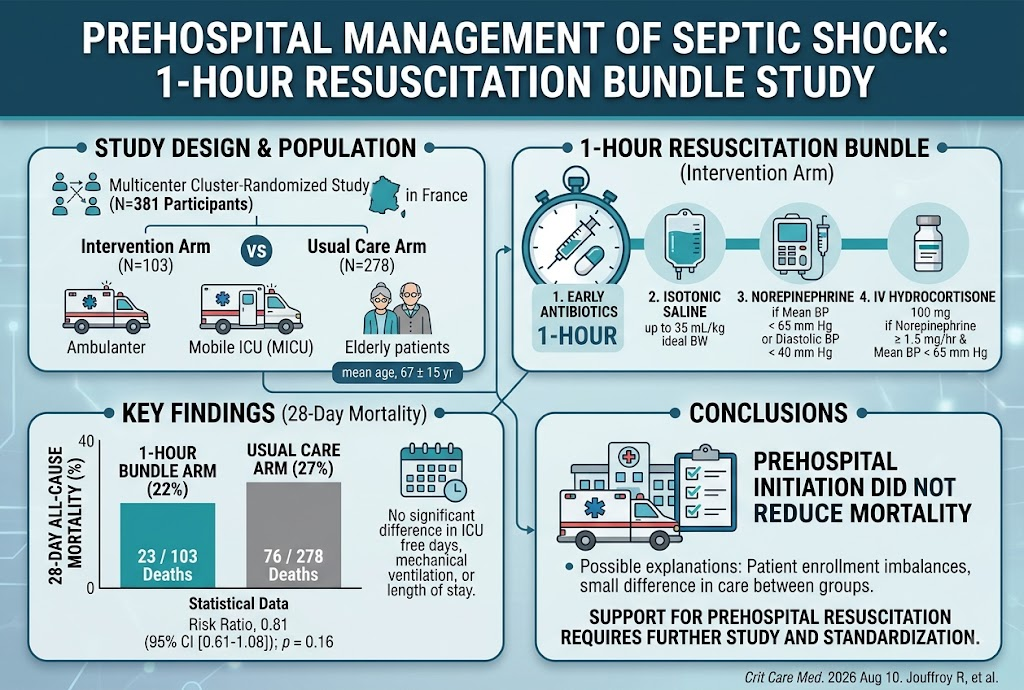
  • Implementation of a 1-hour resuscitation bundle in prehospital septic shock management by a mobile ICU (MICU) team was feasible but did not statistically reduce 28-day mortality compared to usual care.
  • The bundle included early administration of antibiotics, hemodynamic optimization with fluids and vasopressors, and hydrocortisone when indicated.
  • Secondary outcomes, including ICU/hospital mortality, vasopressor-free days, and lengths of stay, showed no significant differences between intervention and control groups.
  • Potential confounders included imbalances in center enrollment and marginal differences in treatment intensity between groups.

Study Background

MedXY registered readers

Sign in free to continue reading

Create or use your MedXY account to unlock the complete article.

This article was created using several editorial tools, including AI, as part of the process. Human editors reviewed this content before publication.

Related articles

Open language-specific specialty feeds and department pages.

Reducing Mortality in Cardiogenic Shock: The Impact of Hospital Capability and Transfer StrategiesHigher hospital cardiac capability correlates with lower mortality in cardiogenic shock patients, and regionalized hub-and-spoke models mitigate the transfer penalty associated with patient instability.Sep 19, 2026Unlocking the Potential of Novel Biomarkers for Acute Kidney Injury in the Critically Ill: A Comprehensive Evidence MappingThis article reviews over 1100 studies on novel biomarkers for acute kidney injury (AKI) in critically ill patients, highlighting their predictive, diagnostic, and management roles while identifying gaps for future clinical implementation.Sep 18, 2026Mortality and Morbidity After Below-Knee Amputation in Diabetes: Insights from a 25-Year English Cohort StudyThis large-scale England study reveals persistently high mortality after below-knee amputation in diabetes, with one-year mortality exceeding 23%, emphasizing the need for targeted interventions focused on older, female, and comorbid patienSep 17, 2026
Loading comments...
MedXY briefing

Get the free newsletter

Evidence-led clinical news, trends, and analysis—delivered to your inbox.

Ask MedXY AI

Most popular

Intimate Health
Five Benefits for Women Continuing Sexual Activity After Menopause
Intimate Health
Why Some Women Have a Strong Sex Drive—And Why Men Shouldn't Worry About It
Nursing & care
How often should a couple have sex?
Intimate Health
Classic Intimacy Recommendations: How to Help Women Reach Orgasm and Enjoy Mutual Pleasure
Intimate Health
What Makes a Woman "Physiologically Addicted" Is Never Money, But These Two Relationship Qualities
© 2026 MedXY
Contact usAbout usPrivacy PolicyMedXY story
Extracorporeal Membrane Oxygenation without Mechanical Ventilation in ARDS: Insights from an International Cohort Study
This study evaluates ECMO as a standalone respiratory support in ARDS patients avoiding invasive mechanical ventilation, highlighting outcomes, strategy failures, and mortality implications.
Sep 17, 2026
Evolving Critical Care Needs and Outcomes in Andes Virus-Associated Hantavirus Cardiopulmonary Syndrome: Insights from a National Chilean CohortThis study evaluates respiratory support and mortality trends in Andes virus-induced hantavirus cardiopulmonary syndrome (HCPS) across Chile, highlighting increased mortality during the COVID-19 pandemic period and a high requirement for inSep 13, 2026
Hemoglobin Levels and Mortality Risk: Insights from a Large UK Cohort StudyA UK prospective cohort study reveals a U-shaped association between hemoglobin concentration and mortality, with both low and high levels linked to increased death risk across age and sex groups.Sep 13, 2026