We use cookies

Our website uses essential cookies and, with your consent, additional cookies to measure performance and improve our services. Cookie Policy.

You can change your choice at any time.

MMedXYNews
HomeVideos
MedXY AI/MedXY News/Section: Critical Care

Septic Shock in Allogeneic Hematopoietic Stem-Cell Transplant Recipients: Outcomes, Prognostic Factors, and Clinical Implications from a Multicenter ICU Cohort
MedXY Editorial Team•Sep 3, 2026•Critical Care
septic shockAllogeneic Hematopoietic Stem Cell TransplantationICU outcomesprognostic factors

Highlight

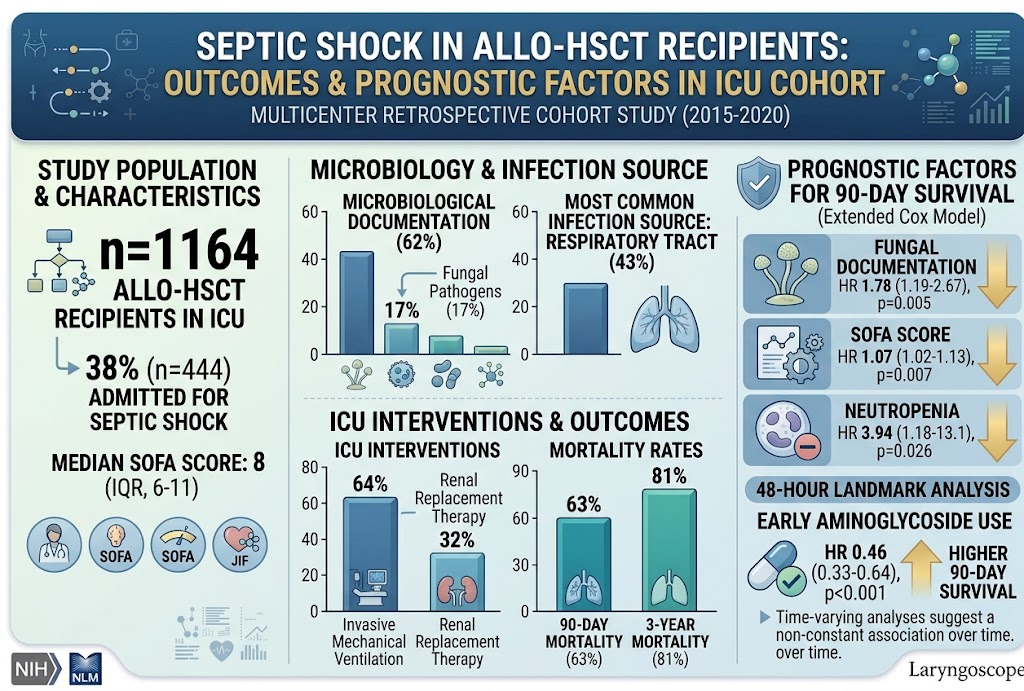
  • Septic shock is a leading cause of ICU admission among allo-HSCT recipients, with a 63% mortality at 90 days.
  • Higher SOFA scores, fungal infections, and neutropenia independently predict poorer 90-day survival after septic shock.
  • Early aminoglycoside therapy correlates with improved short-term survival, though its causal role remains uncertain.
  • Age, graft-versus-host disease type, and early bacterial documentation do not independently affect 90-day mortality.

Study Background and Disease Burden

MedXY registered readers

Sign in free to continue reading

Create or use your MedXY account to unlock the complete article.

This article was created using several editorial tools, including AI, as part of the process. Human editors reviewed this content before publication.

Related articles

Open language-specific specialty feeds and department pages.

Divergent Roles of IL-12p40 and IL-18 in Severe Fibrosing Chronic Graft-versus-Host Disease: Implications for Immunity and Post-Transplant OutcomesThis study reveals distinct clinical associations of IL-12p40 and IL-18 in severe fibrosing chronic graft-versus-host disease, highlighting their differing impacts on relapse risk, survival, and immune responses post-allogeneic stem cell trAug 28, 2026Tumor Size as a Prognostic Marker in Thymic Epithelial Tumors: Insights from a Large European CohortAn analysis of 2,556 thymic tumor cases highlights tumor size as a significant predictor of survival outcomes across thymoma, thymic carcinoma, and neuroendocrine thymic tumors.Aug 28, 2026Early Red Blood Cell Transfusion Strategy in Septic Shock Among Cancer Patients: Insights from the TRANSPORT Randomized Controlled TrialThe TRANSPORT trial showed no superiority of liberal versus restrictive RBC transfusion in septic shock patients with cancer, highlighting no mortality benefit and increased thrombotic events with liberal strategy, underscoring the need forAug 27, 2026
Loading comments...
MedXY briefing

Get the free newsletter

Evidence-led clinical news, trends, and analysis—delivered to your inbox.

Ask MedXY AI

Most popular

Intimate Health
Five Benefits for Women Continuing Sexual Activity After Menopause
Intimate Health
Why Some Women Have a Strong Sex Drive—And Why Men Shouldn't Worry About It
Nursing & care
How often should a couple have sex?
Intimate Health
Classic Intimacy Recommendations: How to Help Women Reach Orgasm and Enjoy Mutual Pleasure
Intimate Health
What Makes a Woman "Physiologically Addicted" Is Never Money, But These Two Relationship Qualities
© 2026 MedXY
Contact usAbout usPrivacy PolicyMedXY story
Post-ICU Frailty in Older Adults Following Septic Shock: Key Predictors and Clinical Implications
This study identifies baseline frailty, organ dysfunction severity, and corticosteroid use as independent predictors of severe post-intensive care frailty in older septic shock survivors, highlighting critical factors for targeted post-ICU
Aug 26, 2026
Reevaluating Age as a Prognostic Marker in Molecularly Defined Lower-Grade GliomasThis article examines how age, traditionally considered a high-risk factor in lower-grade gliomas, influences prognosis and treatment decisions in the molecular era, highlighting the importance of IDH mutation status.Aug 13, 2026
Ultra-Early Versus Early Vasopressin Initiation After Norepinephrine Escalation in Septic Shock: Insights from a Target Trial EmulationThis study emulated a target trial to compare ultra-early (0-3h) versus early (>3-6h) vasopressin initiation after norepinephrine escalation in septic shock, revealing significant mortality and renal therapy benefits with ultra-early useAug 12, 2026