We use cookies

Our website uses essential cookies and, with your consent, additional cookies to measure performance and improve our services. Cookie Policy.

You can change your choice at any time.

MMedXYNews
HomeVideos
MedXY AI/MedXY News/Section: Clinical Updates

Early Red Blood Cell Transfusion Strategy in Septic Shock Among Cancer Patients: Insights from the TRANSPORT Randomized Controlled Trial
MedXY Editorial Team•Aug 27, 2026•Clinical Updates
Red Blood Cell Transfusionseptic shockrandomized controlled trialcancer

Highlights

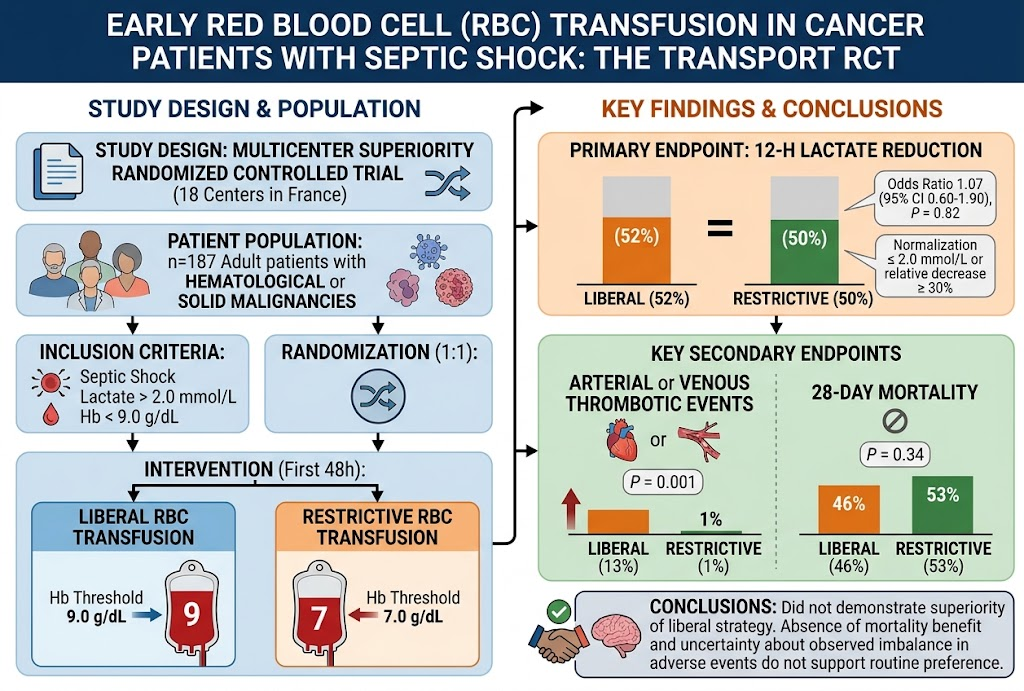
  • The TRANSPORT trial is a multicenter randomized controlled study focusing on red blood cell transfusion strategies in cancer patients with septic shock.
  • No superiority of liberal (hemoglobin threshold 9.0 g/dL) compared to restrictive (threshold 7.0 g/dL) transfusion was demonstrated in terms of 12-hour lactate reduction or 28-day mortality.
  • Liberal transfusion was associated with significantly increased arterial and venous thrombotic events.
  • Evidence supports no routine preference for either transfusion strategy; individualized clinical decisions are necessary.

Background

MedXY registered readers

Sign in free to continue reading

Create or use your MedXY account to unlock the complete article.

This article was created using several editorial tools, including AI, as part of the process. Human editors reviewed this content before publication.

Related articles

Open language-specific specialty feeds and department pages.

Optimizing Palliative Care for Effective Hospice Transitions in Cancer Patients: Insights from Multicenter Qualitative and Quantitative EvidenceThis review synthesizes evidence identifying critical programmatic factors, relational dynamics, and interventions enhancing hospice transitions in cancer palliative care, emphasizing collaborative oncology-palliative care relationships andSep 15, 2026Enhancing Survivorship: Multidisciplinary Rehabilitation Improves Cardiorespiratory Fitness in Upper Gastrointestinal Cancer Surgery PatientsRESTORE II RCT demonstrates that a 12-week multidisciplinary rehabilitation program significantly improves cardiorespiratory fitness in survivors of upper gastrointestinal cancer surgery, supporting its integration in post-oncologic care.Sep 17, 2026Harnessing Multidomain Baseline Metrics to Predict Attrition in Diabetic Foot Ulcer Offloading TrialsBaseline clinical, functional, and psychosocial metrics predict participant attrition in diabetic foot ulcer offloading device trials; integration via risk visualization enhances retention strategies and highlights technology benefits.Sep 8, 2026
Loading comments...
MedXY briefing

Get the free newsletter

Evidence-led clinical news, trends, and analysis—delivered to your inbox.

Ask MedXY AI

Most popular

Intimate Health
Five Benefits for Women Continuing Sexual Activity After Menopause
Intimate Health
Why Some Women Have a Strong Sex Drive—And Why Men Shouldn't Worry About It
Nursing & care
How often should a couple have sex?
Intimate Health
Classic Intimacy Recommendations: How to Help Women Reach Orgasm and Enjoy Mutual Pleasure
Intimate Health
What Makes a Woman "Physiologically Addicted" Is Never Money, But These Two Relationship Qualities
© 2026 MedXY
Contact usAbout usPrivacy PolicyMedXY story
Negative Pressure Therapy in Major Lower Extremity Amputation: A Critical Review of Current Randomized Controlled Trials
This review synthesizes evidence from recent randomized controlled trials assessing negative pressure therapy (NPT) for reducing wound complications after major lower extremity amputation, highlighting variable efficacy and potential benefi
Sep 5, 2026
Enhancing Sexual and Pelvic Health in Women: Efficacy of Scheduled Vibrator Use in a Randomized Controlled TrialScheduled vibrator use combined with educational support significantly improves sexual function in women with sexual dysfunction and pelvic floor disorders compared to education alone.Sep 5, 2026
Confocal Laser Endomicroscopy-Guided Exclusion Diet Fails to Improve IBS Symptoms in Controlled TrialA randomized controlled crossover trial found that individualized exclusion diets based on confocal laser endomicroscopy (CLE) findings do not significantly improve symptoms in irritable bowel syndrome (IBS) patients compared to sham diets.Sep 5, 2026