We use cookies

Our website uses essential cookies and, with your consent, additional cookies to measure performance and improve our services. Cookie Policy.

You can change your choice at any time.

MMedXYNews
HomeVideos
© 2026 MedXY
Contact usAbout usPrivacy PolicyMedXY story
MedXY AI/MedXY News/Ophthalmology

Ophthalmology

Ask MedXY AI
What is the latest evidence?Key clinical updatesGuideline changes

Latest news

No Clear Winner in Severe Congenital Ptosis Repair: AAO Review Finds Overlapping Efficacy but Distinct Surgical Risks in Children
newsexposure keratopathyfrontalis suspension

No Clear Winner in Severe Congenital Ptosis Repair: AAO Review Finds Overlapping Efficacy but Distinct Surgical Risks in Children

By MedXY|May 4, 2026

An American Academy of Ophthalmology review found that frontalis flap, frontalis suspension, and maximal levator resection show overlapping success and exposure rates in severe congenital ptosis, with surgical choice often guided more by co


Teprotumumab for Thyroid Eye Disease Carries a Measurable Long-Term Dysglycemia Risk
Diabetes & Endocrinologydiabeteshyperglycemia

Teprotumumab for Thyroid Eye Disease Carries a Measurable Long-Term Dysglycemia Risk

By MedXY|May 3, 2026

A large multinational cohort study found that teprotumumab use in thyroid eye disease was associated with higher risks of prediabetes, diabetes, and antidiabetes medication initiation over 5 years.

Glucagon-Like Peptide-1 Receptor Agonists and Vascular Protection: Mitigating Systemic and Ocular Risks in High-Risk Type 2 Diabetes
Clinical Updatescardiovascular riskGLP-1 RA

Glucagon-Like Peptide-1 Receptor Agonists and Vascular Protection: Mitigating Systemic and Ocular Risks in High-Risk Type 2 Diabetes

By MedXY|Apr 27, 2026

A large-scale cohort study demonstrates that GLP-1 RAs significantly reduce macrovascular and microvascular complications, including proliferative retinopathy and retinal vein occlusion, in patients with pre-existing diabetic retinopathy.

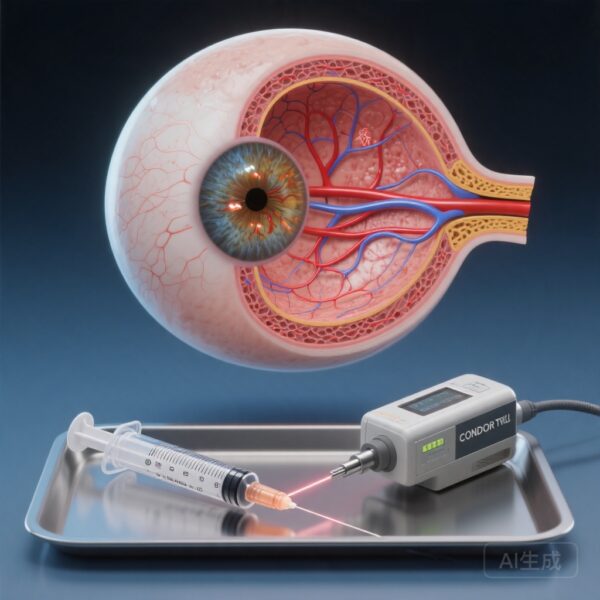
Brolucizumab Outperforms Laser Therapy in Proliferative Diabetic Retinopathy: Insights from the CONDOR Trial
Diabetes & EndocrinologyCONDOR trialproliferative diabetic retinopathy

Brolucizumab Outperforms Laser Therapy in Proliferative Diabetic Retinopathy: Insights from the CONDOR Trial

By MedXY|Apr 27, 2026

The CONDOR trial demonstrates brolucizumab’s superiority over panretinal photocoagulation in preserving vision and reducing disease progression in proliferative diabetic retinopathy, offering a potential shift in treatment paradigms.

DSDO Lenses Show Superior Axial Length Control in Pediatric Myopia Management: A Real-World Multicenter Study
newsaxial length controlDIMS lenses

DSDO Lenses Show Superior Axial Length Control in Pediatric Myopia Management: A Real-World Multicenter Study

By MedXY|Apr 27, 2026

DSDO lenses demonstrated significant efficacy in slowing axial elongation in myopic and non-myopic children, with pronounced effects in younger age groups and low myopia subgroups during the first 6 months of intervention.

Whole Genome Sequencing Outperforms Gene Panels in Diagnosing Congenital Cataracts
newsgenotype-phenotype correlations先天性白内障

Whole Genome Sequencing Outperforms Gene Panels in Diagnosing Congenital Cataracts

By MedXY|Apr 24, 2026

Whole genome sequencing (WGS) increases diagnostic yield by 10% compared to gene panels in congenital cataracts, aiding in prognosis, reproductive counseling, and management.

Personalized Glaucoma Coaching Boosts Medication Adherence by 20%: SEE Program Trial Results
newsglaucomarandomized clinical trial

Personalized Glaucoma Coaching Boosts Medication Adherence by 20%: SEE Program Trial Results

By MedXY|Apr 23, 2026

A 6-month personalized coaching program (SEE) significantly improved glaucoma medication adherence by 19.7% compared to standard education, reducing vision loss risk in a randomized trial of 235 patients.

High Glaucoma Risk in Pseudoexfoliation Syndrome: Age and Ocular Hypertension Drive Incidence
newsCataract surgeryglaucoma risk

High Glaucoma Risk in Pseudoexfoliation Syndrome: Age and Ocular Hypertension Drive Incidence

By MedXY|Apr 23, 2026

New study reveals 26.5-37.5% of eyes with pseudoexfoliation syndrome develop glaucoma within 4 years, with ocular hypertension doubling risk. Standalone lens extraction reduced IOP by 3 mmHg.

Association of Deep Optic Nerve Head Structural Remodeling with Choroidal Microvasculature Dropout in Glaucoma with and without Myopia
newschoroidal microvasculatureglaucoma

Association of Deep Optic Nerve Head Structural Remodeling with Choroidal Microvasculature Dropout in Glaucoma with and without Myopia

By MedXY|Apr 21, 2026

Study reveals significant links between optic nerve head structural changes and choroidal microvascular dropout in glaucomatous eyes, particularly in myopia. Deep structural parameters like neural canal geometry strongly correlate with micr

Open Globe Repair Carries the Highest Endophthalmitis Risk, and Pediatric Cataract Surgery Outpaces Adult Surgery in IRIS Registry Data
newsendophthalmitisIRIS Registry

Open Globe Repair Carries the Highest Endophthalmitis Risk, and Pediatric Cataract Surgery Outpaces Adult Surgery in IRIS Registry Data

By MedXY|Apr 21, 2026

An IRIS Registry analysis of 17.5 million procedures found endophthalmitis was rare overall but highest after open globe repair, with pediatric cataract surgery carrying more risk than adult surgery.

Challenging the Assumption: Fellow-Eye Correlations in Geographic Atrophy Progression Prove Modest at Best
newsAMD ProgressionAREDS2

Challenging the Assumption: Fellow-Eye Correlations in Geographic Atrophy Progression Prove Modest at Best

By MedXY|Apr 11, 2026

A post hoc analysis of AREDS2 reveals that geographic atrophy enlargement rates between fellow eyes show only modest correlations, challenging the common assumption that bilateral GA progresses similarly. The findings have important implica

Diabetic Retinopathy Severity Predicts Mortality Risk: Insights from the SOURCE Consortium
Diabetes & Endocrinologymortality riskOculomics

Diabetic Retinopathy Severity Predicts Mortality Risk: Insights from the SOURCE Consortium

By MedXY|Apr 11, 2026

A retrospective cohort study of 524,687 diabetic patients reveals that increasing severity of diabetic retinopathy correlates with significantly higher mortality risk, with proliferative DR patients showing a 128% increased hazard of death

Deep Capillary Plexus Defects Emerge as a Universal Biomarker for Retinal Ischemia Across All Retinal Regions in Diabetic Retinopathy
Diabetes & EndocrinologyDeep capillary plexusNonperfusion

Deep Capillary Plexus Defects Emerge as a Universal Biomarker for Retinal Ischemia Across All Retinal Regions in Diabetic Retinopathy

By MedXY|Apr 2, 2026

Novel OCTA biomarkers reveal that geometric perfusion deficits in the deep capillary plexus serve as robust predictors of retinal nonperfusion across posterior, peripheral, and total retinal regions, while foveal avascular zone enlargement

Semaglutide and Nonarteritic Anterior Ischemic Optic Neuropathy: Synthesizing Evidence from Target Trial Emulations and Global Pharmacovigilance
Clinical UpdatesGLP-1 receptor agonistsNAION

Semaglutide and Nonarteritic Anterior Ischemic Optic Neuropathy: Synthesizing Evidence from Target Trial Emulations and Global Pharmacovigilance

By MedXY|Apr 5, 2026

This review synthesizes recent evidence regarding the association between semaglutide initiation and nonarteritic anterior ischemic optic neuropathy (NAION), contrasting high-risk findings in real-world cohort studies with neutral findings

FAc Intravitreal Implant Achieves Comparable Visual Outcomes with 53% Fewer Injections in Diabetic Macular Edema: Phase 4 NEW DAY Study
newsAnti-VEGF therapyDiabetic Macular Edema

FAc Intravitreal Implant Achieves Comparable Visual Outcomes with 53% Fewer Injections in Diabetic Macular Edema: Phase 4 NEW DAY Study

By MedXY|Apr 2, 2026

The Phase 4 NEW DAY study demonstrates that fluocinolone acetonide (FAc) 0.19 mg implant as baseline therapy achieves similar visual acuity and anatomical improvements compared to aflibercept in diabetic macular edema patients, while signif

Why the New MS Diagnostic Criteria Require Caution: High Frequency of MOGAD and NMOSD in Optic Neuritis Patients
NeurologyMOGADmultiple sclerosis

Why the New MS Diagnostic Criteria Require Caution: High Frequency of MOGAD and NMOSD in Optic Neuritis Patients

By MedXY|Mar 30, 2026

A retrospective study reveals that 24% of patients meeting the latest MS criteria following optic neuritis actually have MOGAD or NMOSD, emphasizing the need for antibody testing to prevent misdiagnosis.

Microvascular Dropout and Parapapillary Atrophy Progression Predict Structural Optic Disc Damage in Glaucoma Suspects
newsglaucomaMicrovascular Dropout

Microvascular Dropout and Parapapillary Atrophy Progression Predict Structural Optic Disc Damage in Glaucoma Suspects

By MedXY|Mar 30, 2026

A 19-year retrospective study reveals that microvascular dropout and β-zone parapapillary atrophy progression are powerful independent predictors of structural optic disc damage in glaucoma suspects, even when visual fields remain stable.

Seeing the Invisible: New Global Consensus on Using Advanced Imaging to Track Uveitis Activity
newsclinical guidelinesDisease Monitoring

Seeing the Invisible: New Global Consensus on Using Advanced Imaging to Track Uveitis Activity

By MedXY|Mar 24, 2026

A global task force has established new standardized imaging measures to define disease activity in non-infectious posterior uveitis, bridging a critical gap in clinical diagnosis and trial monitoring.

Predictive Value of Early Fluid Resolution for Long-term Durability of Faricimab in Neovascular Age-Related Macular Degeneration: A Synthesis of Evidence
Clinical UpdatesAng-2/VEGF inhibitionFaricimab

Predictive Value of Early Fluid Resolution for Long-term Durability of Faricimab in Neovascular Age-Related Macular Degeneration: A Synthesis of Evidence

By MedXY|Mar 28, 2026

This review synthesizes clinical trial data demonstrating that rapid resolution of retinal fluid by week 12 with faricimab significantly predicts long-term treatment durability in patients with neovascular age-related macular degeneration.

Predicting Ocular Relapse in Sarcoid Uveitis: Macular Edema and Baseline Inflammation as Critical Prognostic Markers
newsMacular EdemaSarcoidosis

Predicting Ocular Relapse in Sarcoid Uveitis: Macular Edema and Baseline Inflammation as Critical Prognostic Markers

By MedXY|Mar 23, 2026

A multicentric study of 336 patients reveals that two-thirds of sarcoid uveitis cases experience relapse, primarily driven by baseline macular edema and persistent inflammation. Despite high recurrence rates, long-term visual prognosis rema

Prev
8 / 12
1…678910…12
Next
Ask MedXY AI

Most popular

Intimate Health
Five Benefits for Women Continuing Sexual Activity After Menopause
Intimate Health
Why Some Women Have a Strong Sex Drive—And Why Men Shouldn't Worry About It
Nursing & care
How often should a couple have sex?
Intimate Health
Classic Intimacy Recommendations: How to Help Women Reach Orgasm and Enjoy Mutual Pleasure
Intimate Health
What Makes a Woman "Physiologically Addicted" Is Never Money, But These Two Relationship Qualities

Browse by specialty

Open language-specific specialty feeds and department pages.

news6629 articlesCardiology1375 articlesClinical Updates1288 articlesOncology1139 articlesDiabetes & Endocrinology842 articlesNeurology820 articlesPublic Health595 articlesGastroenterology572 articles
Hematology-Oncology
487 articles
Pediatrics484 articles
Internal Medicine444 articles