We use cookies

Our website uses essential cookies and, with your consent, additional cookies to measure performance and improve our services. Cookie Policy.

You can change your choice at any time.

MMedXYNews
HomeVideos
MedXY AI/MedXY News/Section: Critical Care

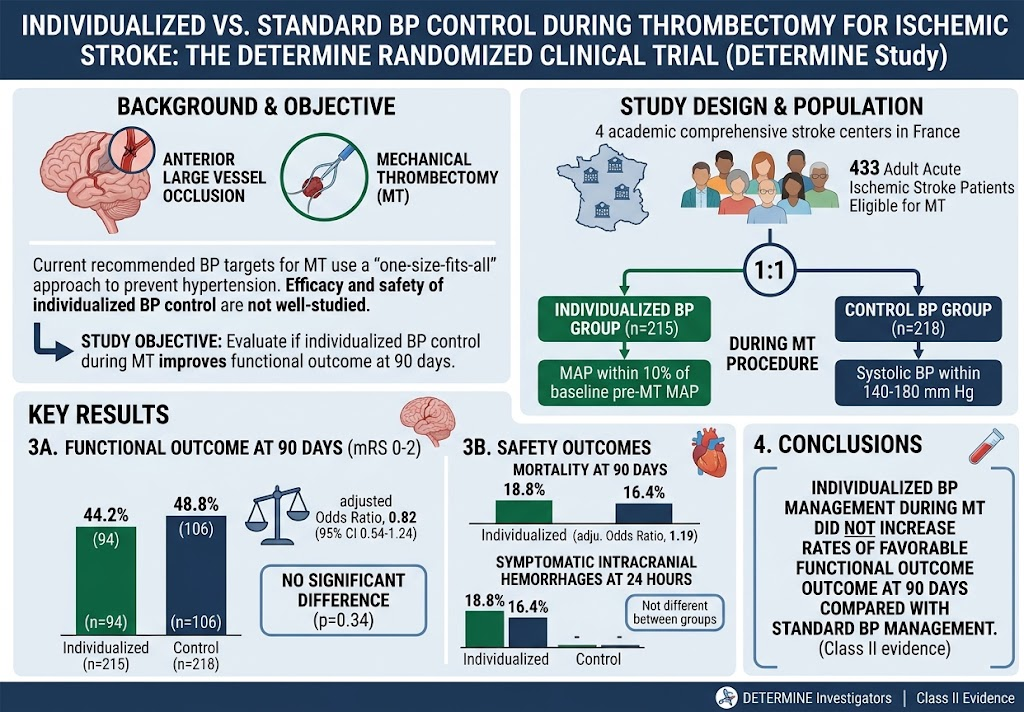
Individualized vs Standard Blood Pressure Control During Mechanical Thrombectomy for Acute Ischemic Stroke: Insights from the DETERMINE Randomized Clinical Trial
MedXY Editorial Team•Aug 24, 2026•Critical Care
mechanical thrombectomycase reportclinical trialischemic strokeBlood Pressure Management

Background

The DETERMINE trial enrolled adult patients presenting with acute ischemic stroke secondary to anterior large vessel occlusion, indicated for mechanical thrombectomy (MT). The median age of participants was 69.3 years, with a slight female predominance (52.8%). Key inclusion parameters included radiological confirmation of anterior circulation large vessel occlusion and eligibility for MT as per established clinical protocols. Relevant medical histories varied, though demographic and baseline characteristics were balanced between groups.

Treatment and Management

MedXY registered readers

Sign in free to continue reading

Create or use your MedXY account to unlock the complete article.

This article was created using several editorial tools, including AI, as part of the process. Human editors reviewed this content before publication.

Related articles

Open language-specific specialty feeds and department pages.

Inpatient Rehabilitation and Major Adverse Cardiovascular Events After Ischemic Stroke: Clinical Implications and Evidence SynthesisPostacute discharge to inpatient rehabilitation facilities (IRF) after acute ischemic stroke (AIS) is associated with a reduced 1-year risk of major adverse cardiovascular events (MACE) compared to discharge to home or skilled nursing facilSep 19, 2026Emergent Interfacility Transfers for Ischemic Stroke in the U.S.: Patterns and Implications from 2016 to 2022This study analyzes national trends in emergent interfacility ischemic stroke transfers among Medicare beneficiaries, revealing shifts in transfer rates, patient characteristics, and hospital features associated with transferred versus nontSep 19, 2026Evaluating Stroke Risk in Asymptomatic Carotid Stenosis: Transcarotid Artery Revascularization versus Carotid Artery StentingThis comparative analysis assesses ischemic stroke outcomes in patients with asymptomatic carotid stenosis undergoing transcarotid artery revascularization (TCAR) versus carotid artery stenting (CAS), highlighting no significant differenceSep 17, 2026
Loading comments...
MedXY briefing

Get the free newsletter

Evidence-led clinical news, trends, and analysis—delivered to your inbox.

Ask MedXY AI

Most popular

Intimate Health
Five Benefits for Women Continuing Sexual Activity After Menopause
Intimate Health
Why Some Women Have a Strong Sex Drive—And Why Men Shouldn't Worry About It
Nursing & care
How often should a couple have sex?
Intimate Health
Classic Intimacy Recommendations: How to Help Women Reach Orgasm and Enjoy Mutual Pleasure
Intimate Health
What Makes a Woman "Physiologically Addicted" Is Never Money, But These Two Relationship Qualities
© 2026 MedXY
Contact usAbout usPrivacy PolicyMedXY story
Impact of an AI-Powered Gamified Mobile Health Application on Blood Pressure Control in a Matched Patient Cohort
Study found that use of an AI-driven gamified mobile app integrating home blood pressure monitoring significantly improved blood pressure control compared to usual care in hypertensive patients.
Sep 17, 2026
Widening the Spectrum of Disease Expression due to Heterozygous Variants in EFEMP1A case series delineating a novel EFEMP1 variant, p.Arg140Trp, associated with late-onset peripheral retinal degeneration distinct from classic DHRD/ML, highlighting rod dysfunction precedes structural changes.Sep 13, 2026
Global Trends in the Burden of Ischemic Stroke Attributable to Diabetes Versus Atrial FibrillationThis study analyzes global trends comparing ischemic stroke burdens linked to diabetes and atrial fibrillation, revealing a rising impact of diabetes-related stroke and highlighting the need for targeted interventions.Sep 12, 2026