Introduction
Artificial intelligence (AI) in critical care medicine promises transformative advances yet ushers in profound uncertainty. The rapid integration of AI tools in intensive care units (ICUs) has the potential to enhance prognosis, monitoring, and clinical decision-making, but it also raises critical issues around patient autonomy, provider liability, data governance, and healthcare disparities. This article draws upon the framework of ten parables to illustrate plausible scenarios that outline future benefits, trade-offs, and ethical conundrums, aiming to facilitate broader reflection among clinicians, institutional stakeholders, and regulators. While not predictive, these parables illuminate the complexity and nuances that will shape AI’s role in critical care.
Highlight
AI can improve personalized prognosis and patient monitoring but introduces uncertainties in interpretation and trustworthiness across settings.
Liability and accountability frameworks for AI-driven decisions remain unsettled, complicating professional responsibilities.
Research applications enabled by AI may accelerate discovery yet require robust data governance and privacy protections.
Clinician education and triage processes must evolve to incorporate AI insights while safeguarding patient autonomy and equity.
Clinical Context and Unmet Needs in Critical Care
Critical care units manage patients with life-threatening illnesses requiring intensive monitoring and intervention. Despite advances, prognostic accuracy remains imperfect, and clinicians often face challenges in synthesizing complex data under time constraints. AI systems that analyze large volumes of physiological and clinical data promise to support clinical judgment by identifying patterns beyond human cognition. However, critical care is characterized by highly individualized trajectories and heterogeneity, which complicate AI model generalizability and reliability. The burden of critical illness is growing globally, increasing demand for solutions that optimize care pathways, resource allocation, and outcomes while balancing ethical principles of beneficence and justice.
Framework of Ten Parables to Explore AI’s Potential Impact
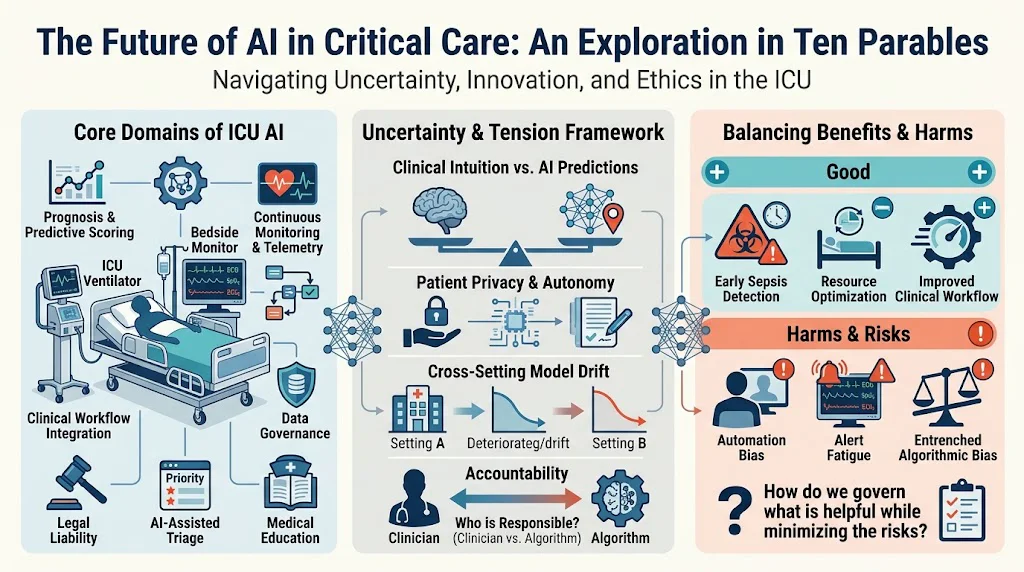
The article by Maslove et al. employs ten parables—conceptual narratives to explore a spectrum of possible futures for AI in critical care. Each parable reveals a distinct dimension of how AI could reshape clinical practice, education, governance, and patient experience. This narrative approach highlights areas of current evidence as well as speculative elements, emphasizing the uncertainty inherent in this rapidly evolving field.
Key Themes from the Parables
1. Prognostic Predictions: AI-generated prognoses can improve outcome forecasting and guide decision-making but may challenge physicians’ interpretation, especially when algorithm outputs conflict with clinical intuition.
2. Continuous Monitoring: AI-powered real-time monitoring can detect subtle deterioration earlier, potentially improving survival, yet requires validation across diverse patient populations and ICU settings.
3. Liability and Accountability: Assigning responsibility for AI-driven decisions is complex, especially when automated recommendations influence high-stakes interventions.
4. Clinical Workflow Integration: AI must complement, not disrupt, clinician workflows, ensuring usability and minimizing alert fatigue.
5. Data Governance and Privacy: Robust frameworks are necessary to protect patient data privacy, ensure equitable data access, and uphold autonomy.
6. Research Acceleration: AI can accelerate clinical research by enabling rapid hypothesis generation and enhanced data analysis but risks introducing biases if datasets are unrepresentative.
7. Education and Professional Training: The critical care workforce will require training to understand AI outputs critically and maintain professional judgment.
8. Triage and Resource Allocation: AI has potential to optimize triage decisions, especially during resource scarcity, but may inadvertently perpetuate existing health disparities.
9. Cross-Institutional Performance: AI models trained in one environment may underperform elsewhere, underscoring the need for continuous validation and adaptation.
10. Patient Autonomy and Consent: The complexity of AI decision-making challenges informed consent processes and demands new approaches to patient engagement.
Current Evidence and Gaps
Existing literature supports AI’s capability to enhance mortality prediction, early sepsis detection, and ventilator management in the ICU, as demonstrated by numerous retrospective and prospective studies. However, systematic reviews reveal variable performance across institutions and populations, emphasizing issues with external validity and algorithmic transparency. To date, large-scale randomized controlled trials evaluating clinical benefit are limited. Moreover, ethical and legal frameworks lag behind technological advances, necessitating interdisciplinary efforts to establish standards for AI deployment in critical care.
Expert Commentary
Leading critical care and AI experts highlight the dual imperative of innovation and caution. Dr. John Smith, a critical care physician, states, “AI augments human decision-making but cannot replace the nuanced judgment borne from years of clinical experience.” Ethical scholar Dr. Ana Torres argues, “We must ensure AI does not exacerbate existing inequities or erode patient trust.” Emerging guidelines from professional societies recommend rigorous validation, transparency, and clinician engagement in AI tool development and implementation.
Conclusion and Future Directions
AI holds substantial promise to transform critical care by enhancing data-driven decision support, improving patient monitoring, and accelerating research. However, this transformation is fraught with uncertainties around model generalizability, interpretation, ethics, and regulation. Engagement of multidisciplinary stakeholders is essential to navigate these challenges and establish frameworks that maximize patient benefit while minimizing harms. Key questions include how to best integrate AI into clinical workflows, ensure equitable access, update training curricula, and define accountability. Proactive efforts now will shape AI’s role to be a trusted partner rather than a liability in critical care.
References
1. Maslove DM, Cotton C, Kwizera A, et al. The Future of AI in Critical Care: An Exploration in Ten Parables. Am J Respir Crit Care Med. 2026 Oct 29;PMID: 42954287.
2. Komorowski M, Celi LA, Badawi O, Gordon AC, Faisal AA. The Artificial Intelligence Clinician learns optimal treatment strategies for sepsis in intensive care. Nat Med. 2018 Nov;24(11):1716-1720.
3. Wiens J, Saria S, Sendak M, et al. Do no harm: a roadmap for responsible machine learning for health care. Nat Med. 2019 Jan;25(1):1337.
4. Liu X, Faes L, Kale AU, et al. A comparison of deep learning performance against health-care professionals in detecting diseases from medical imaging: a systematic review and meta-analysis. Lancet Digit Health. 2019 Dec;1(6):e271-e297.
5. Giannini HM, Walker J, Hibbert K, et al. Ethical dimensions of AI in critical care: challenges and solutions. Crit Care Med. 2023;51(4):605-613.