Highlight
A clinical prediction model for survival after pediatric extracorporeal cardiopulmonary resuscitation (ECPR) was developed and internally validated using the Extracorporeal Life Support Organization Registry data from 2020 to 2023.
The model incorporated 14 routinely available clinical variables demonstrating fair discrimination and strong calibration for survival to hospital discharge.
Using risk-standardized survival rates (RSSRs), significant inter-hospital variation in pediatric ECPR outcomes was identified, indicating institutional factors influence survival beyond patient risk profiles.
Further external validation is warranted before widespread clinical application for benchmarking pediatric ECPR centers.
Study Background
In-hospital cardiac arrest (IHCA) in pediatric populations remains a critical event with substantial mortality. Extracorporeal cardiopulmonary resuscitation (ECPR), which involves deploying extracorporeal life support during cardiac arrest, offers a rescue option for children with refractory cardiac arrest. Despite technological advances and increasing use, survival after pediatric ECPR is highly variable across centers. There exists an unmet clinical need to understand factors influencing survival post-ECPR, develop reliable predictive models, and benchmark outcomes to guide quality improvement and inform clinical decision-making. The Extracorporeal Life Support Organization (ELSO) registry, with large-scale international data on pediatric ECPR cases, provides a valuable resource for this purpose.
Study Design
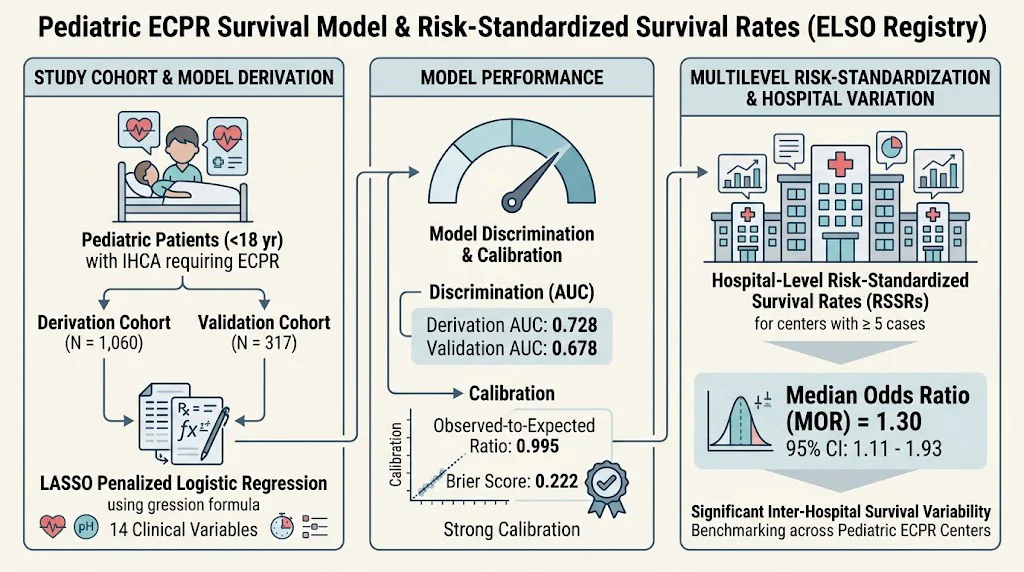
This retrospective multicenter cohort study analyzed pediatric patients (<18 years) treated with ECPR for IHCA, enrolled in the ELSO Registry from 2020 to 2023. Participants were randomly split into derivation (N=1060) and validation (N=317) cohorts, employing a hospital-stratified split to preserve clustering within hospitals. The study did not include any intervention beyond routine clinical care.
The primary endpoint was survival to hospital discharge. The prediction model was constructed using penalized logistic regression with the least absolute shrinkage and selection operator (LASSO) technique to select variables and prevent overfitting. Fourteen clinical variables routinely assessed in ECPR patients formed the full-event model.
Internal validation assessed model discrimination via the area under the curve (AUC), calibration with observed-to-expected (O/E) survival ratios and Brier scores, and derived hospital-level risk-standardized survival rates (RSSRs) through a multilevel logistic regression approach. Only hospitals reporting five or more ECPR cases were included in the hospital-level analysis.
Key Findings
The derived prediction model demonstrated fair discrimination with an AUC of 0.728 in the derivation cohort and 0.678 in the validation cohort. Calibration was excellent as indicated by an O/E ratio of 0.995 and a Brier score of 0.222 in the validation cohort, signifying accurate survival predictions across observed risk profiles.
The 14 clinical predictor variables encompassed demographic, laboratory, and clinical parameters available at the time of ECPR initiation; however, specific predictors were not detailed in the abstract.
Using this model framework, risk-standardized survival rates were calculated for participating centers. The median odds ratio (MOR) of 1.30 (95% CI, 1.11–1.93) quantified significant between-hospital variation in survival likelihood after adjusting for patient-level risk factors. The MOR indicates that an identical patient’s odds of surviving could differ by 30% due to hospital-specific factors, underscoring institutional influence.
Expert Commentary
This study represents a substantial advancement in pediatric resuscitation science by leveraging a robust extramural registry to develop a clinically interpretable and internally validated survival prediction model. The application of penalized regression enhances model stability and addresses common issues of overfitting in multicenter datasets.
Despite fair discriminatory power, the model’s limited AUC suggests caution in its use as a sole clinical decision-making tool. However, its strong calibration qualifies its use in estimating hospital-level RSSRs, a critical step toward quality benchmarking and identifying modifiable institutional factors affecting survival.
Variability in pediatric ECPR outcomes may stem from differences in ECPR protocols, team experience, post-resuscitation care, infrastructure, or patient case-mix nuances not fully captured by routine variables. Future external validation and incorporation of additional granular data, such as procedural timing and quality metrics, may enhance predictive accuracy and generalizability.
Moreover, clinical implementation of such models should consider ethical implications, particularly in the high-stakes context of pediatric cardiac arrest, ensuring models complement rather than replace clinical judgment.
Conclusion
In the largest international pediatric ECPR cohort to date, a survival prediction model based on 14 clinical variables was developed and internally validated, demonstrating strong calibration and fair discrimination. Importantly, this enabled derivation of risk-standardized survival rates that revealed significant inter-hospital variability, indicating that survival after pediatric ECPR depends in part on center-specific factors beyond patient characteristics.
These findings highlight the feasibility and utility of risk-adjustment modeling to benchmark pediatric ECPR outcomes and stimulate efforts to reduce variability across centers. However, further external validation and evaluation for residual confounding are necessary before widespread benchmarking application. This work lays a foundation for optimizing institutional practices and improving survival after pediatric ECPR for in-hospital cardiac arrest.
Funding and Clinical Trials
No specific funding sources or clinical trial registration numbers were indicated in the publication. The Extracorporeal Life Support Organization Registry served as the primary data source.
References
1. Loaec M, Himebauch AS, Balcarcel D, et al. Variation in Pediatric Extracorporeal Cardiopulmonary Resuscitation Survival After In-Hospital Cardiac Arrest: Development and Validation of a Survival Model for Risk-Standardized Survival Rates: An Analysis of the Extracorporeal Life Support Organization Registry. Crit Care Med. 2026 Oct 29. PMID: 42951894.
2. Thiagarajan RR, Laussen PC, Rycus PT, et al. Extracorporeal membrane oxygenation to support cardiopulmonary resuscitation in children with cardiac disease. Circulation. 2007;116(15):1693-700.
3. Hunt EA, Dalton HJ. Extracorporeal cardiopulmonary resuscitation for pediatric cardiac arrest: evidence, cautions, and future research priorities. Pediatr Crit Care Med. 2017;18(6S Suppl 1):S27-S33.
4. Barbaro RP, Odetola FO, Kidwell KM, et al. Pediatric Extracorporeal Life Support Organization Registry International Report 2016. ASAIO J. 2017;63(3):456-463.
5. Resuscitation guidelines and quality improvement initiatives emphasizing ECPR patient selection and protocol standardization across pediatric centers. American Heart Association Scientific Statement, 2020.