Highlight
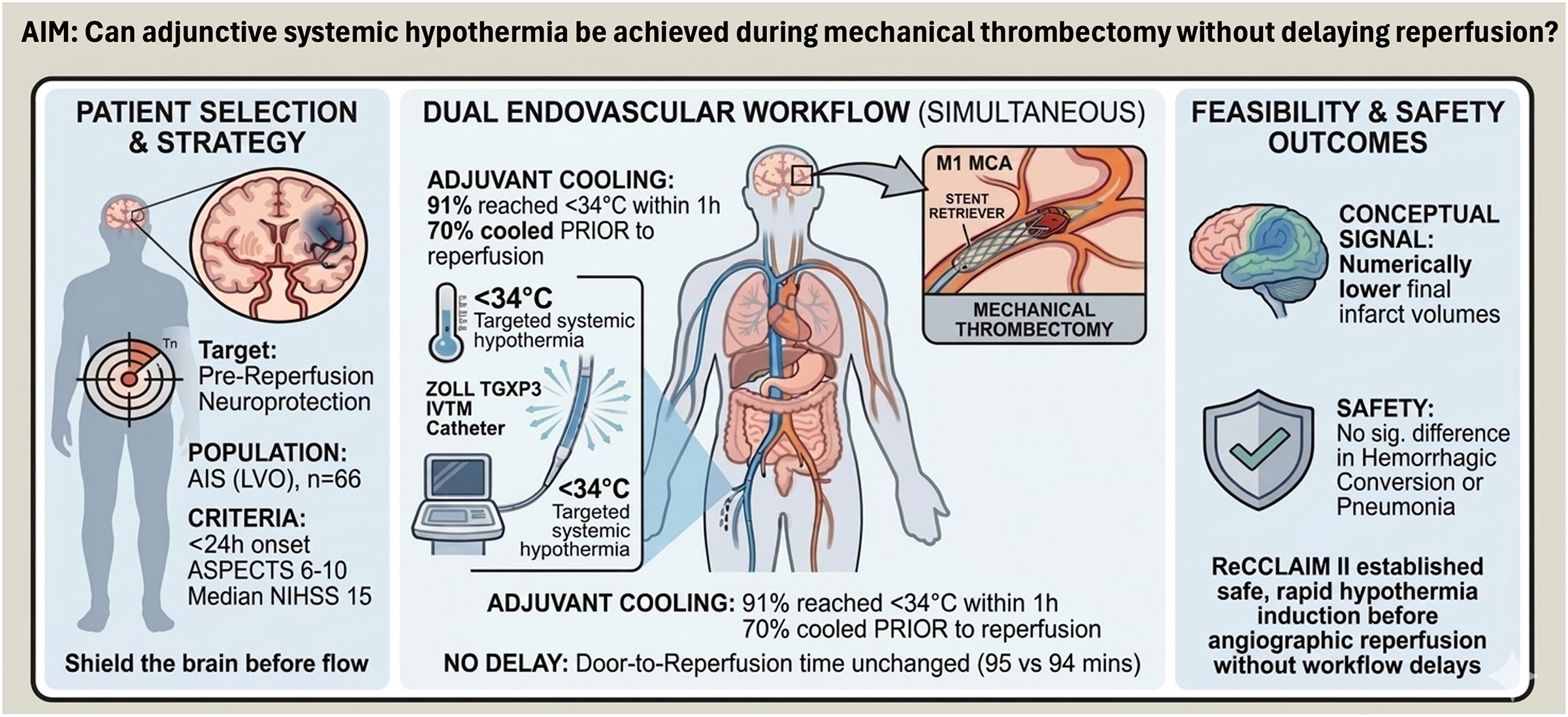
1. The ReCCLAIM II trial establishes the feasibility of rapid systemic hypothermia during mechanical thrombectomy for large-vessel occlusion stroke without prolonging reperfusion time.
2. A high proportion (91%) of patients treated with intravascular cooling achieved target hypothermia (<34°C) within one hour of arterial puncture.
3. Although final infarct volumes tended to be lower in the hypothermia group, differences were not statistically significant.
4. No significant increase in hemorrhagic conversion or pneumonia rates was observed, though serious adverse events were more frequent with hypothermia.
Study Background
Large-vessel occlusion (LVO) strokes account for a significant proportion of acute ischemic strokes and often result in severe disability or death. Mechanical thrombectomy (MT) has revolutionized treatment by enabling timely reperfusion of occluded cerebral arteries, improving outcome substantially. However, ischemic injury prior to reperfusion and reperfusion injury itself continue to limit functional recovery. Experimental studies have consistently shown that hypothermia can mitigate ischemic brain injury by reducing metabolic demand and attenuating inflammatory cascades. Despite promising preclinical data, translation of systemic hypothermia as adjunct therapy in acute ischemic stroke has been hindered by challenges in inducing rapid, safe cooling without delaying reperfusion or causing complications such as infection or coagulopathy. The ReCCLAIM II trial was designed to address these translational challenges by investigating a novel intravascular cooling catheter approach to induce rapid systemic hypothermia during MT in patients with LVO stroke.
Study Design
ReCCLAIM II was a multicenter, phase II randomized feasibility-controlled trial conducted across 10 U.S. sites between May 2019 and May 2024. Eligible patients had confirmed proximal middle cerebral artery (MCA) or internal carotid artery (ICA) occlusions, Alberta Stroke Program Early CT Scores (ASPECTS) of 6 to 10, and symptom onset within 24 hours. All patients underwent standard mechanical thrombectomy. Participants were randomized to receive either standard care alone or adjuvant systemic hypothermia induced via a novel intravascular cooling catheter. The hypothermia protocol targeted a core temperature of less than 34°C, initiated at arterial puncture and maintained through reperfusion.
The primary feasibility endpoints were achieving target temperature within 1 hour of arterial puncture and door-to-reperfusion times. The primary safety endpoint was hemorrhagic conversion within 36 hours adjudicated by a core laboratory. Secondary outcomes included final infarct volume assessed by imaging and the incidence of serious adverse events (SAEs).
Key Findings
The study enrolled 95 patients, including a 29-patient roll-in phase and 66 randomized participants. The randomized cohort had a mean age of 65±12 years and median NIH Stroke Scale (NIHSS) score of 15, indicating moderate to severe neurological deficits.
In the hypothermia arm (33 patients), 91% (30/33) reached the target temperature of below 34°C within 1 hour of arterial puncture, with 70% achieving this target prior to reperfusion. Median time to hypothermia was 10 minutes (IQR 7–22). Importantly, hypothermia induction did not delay reperfusion, with median door-to-reperfusion times similar between hypothermia (95 minutes, IQR 54–116) and control arms (94 minutes, IQR 77–121; P=0.70).
Final infarct volumes were numerically smaller in the hypothermia group (median 11 cm³, IQR 5–42) compared to controls (median 30 cm³, IQR 6–80), though this difference did not reach statistical significance (P=0.13). Rates of hemorrhagic conversion within 36 hours were not significantly different between groups, nor were incidences of pneumonia.
Serious adverse events were more frequent in the hypothermia arm (45.5%) versus control (24.2%), although this difference was not statistically significant (P=0.12). The trial was not powered to detect efficacy or safety outcome differences, so this finding warrants cautious interpretation.
Expert Commentary
The ReCCLAIM II trial represents an important step forward in bridging the gap between promising hypothermic neuroprotection demonstrated in animal models and clinical practice. Its use of a novel intravascular cooling catheter enabled rapid, controlled systemic cooling initiated early in the ischemic cascade without delay to reperfusion—a critical requirement for clinical applicability.
Though preliminary data showed trends toward reduced infarct size, the absence of statistically significant efficacy calls for larger, adequately powered phase III studies. The slightly increased rate of serious adverse events highlights the need for ongoing vigilance regarding infection risk, hemodynamic instability, and coagulopathy during hypothermia. Future investigations should refine patient selection, hypothermia duration, and rewarming protocols to maximize benefit-risk balance.
Recent guidelines acknowledge hypothermia as a promising neuroprotective strategy but caution that robust clinical evidence is still needed before routine implementation in stroke care. Mechanistically, systemic hypothermia reduces cerebral metabolic rate, inhibits excitotoxicity and free radical production, and modulates postischemic inflammation, which makes it biologically plausible that this adjunct could improve outcomes if administered safely and swiftly at reperfusion.
Conclusion
ReCCLAIM II confirms that rapid initiation of systemic hypothermia during mechanical thrombectomy is feasible without prolonging reperfusion times. While this approach shows promise for neuroprotection reflected by trends toward smaller infarcts, definitive evidence of clinical benefit awaits larger trials. Safety signals require further evaluation to mitigate potential risks. Continued development of optimized hypothermia techniques may ultimately enhance the therapeutic impact of thrombectomy in ischemic stroke.
Funding and Registration
The trial was registered with ClinicalTrials.gov (NCT03804060). Funding sources were not detailed in the publication.
References
Kass-Hout T, Horn C, Sun CJ, et al. Adjuvant Systemic Hypothermia During Mechanical Thrombectomy (ReCCLAIM II): A Multicenter, Randomized, Controlled Trial. Stroke. 2026 Oct 9; PMID: 42852505.