Impact of Maternal Third-Trimester TRAb Levels on Neonatal Thyroid Function and Early Childhood Neurodevelopment: Insights from a Bidirectional Cohort Study
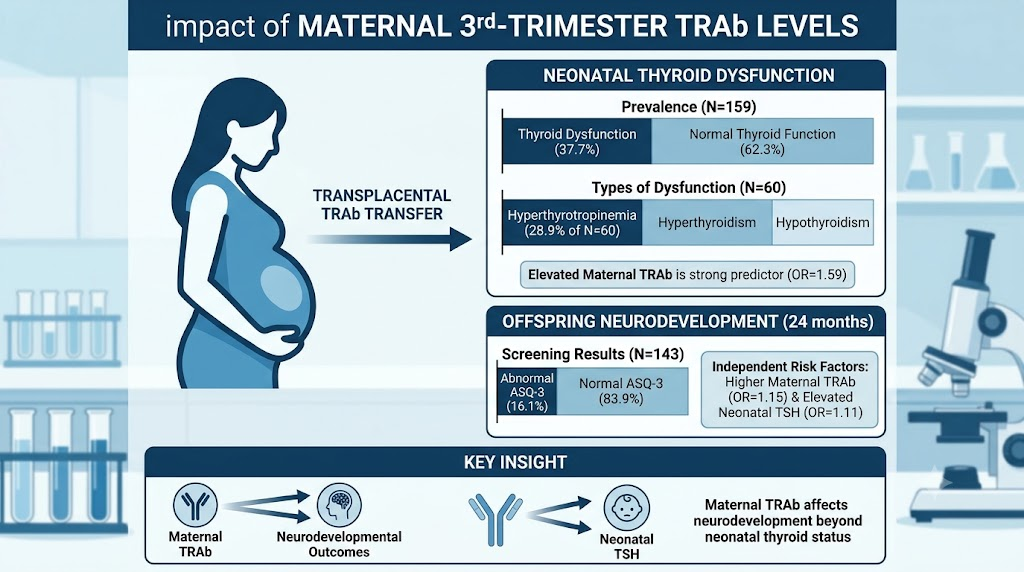
Highlight
Maternal third-trimester thyrotropin receptor antibody (TRAb) levels significantly correlate with neonatal thyroid dysfunction in infants born to mothers with Graves’ disease.
Higher maternal TRAb levels during late pregnancy are associated with abnormal neurodevelopmental screening results at 24 months of corrected age.
Neonatal thyroid dysfunction partly contributes to neurodevelopmental outcomes, but neonatal thyroid status alone does not fully mediate the impact of maternal TRAb on neurodevelopment.
Study Background
Graves’ disease (GD), an autoimmune disorder characterized by the presence of thyrotropin receptor antibodies (TRAbs), is a common cause of hyperthyroidism and affects a substantial proportion of women of reproductive age. Maternal GD during pregnancy can adversely affect fetal and neonatal thyroid function due to transplacental transfer of TRAbs, potentially leading to neonatal thyroid dysfunction such as hyperthyroidism or hypothyroidism. While the neonatal thyroid dysfunction risks are relatively well characterized, the long-term effects of maternal GD and TRAb levels, particularly on early childhood neurodevelopment, are less understood. Neurodevelopmental impairments during infancy and toddlerhood can have far-reaching consequences on cognitive, motor, and behavioral outcomes. This study addresses the critical knowledge gap regarding how maternal GD-related thyroid factors influence offspring neurodevelopment at 24 months, a key developmental milestone period.
Study Design
This was a single-center bidirectional cohort study enrolling pregnant women diagnosed with Graves’ disease and their offspring, with births occurring between January 1, 2019, and December 31, 2023. Maternal thyroid-related parameters including thyroid-stimulating hormone (TSH), free thyroxine (free T4), thyrotropin receptor antibodies (TRAbs), and exposure to antithyroid drugs were longitudinally collected throughout pregnancy. Neonatal thyroid function assessments—including serum TSH and thyroid hormone levels—were conducted 7 to 14 days postpartum. Neurodevelopmental screening of offspring was performed at the corrected age of 24 months using the Ages and Stages Questionnaire, Third Edition (ASQ-3), a validated tool for early developmental surveillance across multiple domains.
Multivariate logistic regression models identified associations between maternal thyroid factors, neonatal thyroid dysfunction, and abnormal neurodevelopmental outcomes with covariate selection guided by a directed acyclic graph to account for confounders. Additionally, exploratory mediation analysis using PROCESS Model 4 was conducted to examine whether neonatal thyroid function mediated the relationship between maternal TRAb levels and neurodevelopmental outcomes.
Key Findings
A total of 159 neonates born to mothers with GD were included, with 60 neonates (37.7%) exhibiting thyroid dysfunction. The most frequent abnormality was hyperthyrotropinemia, observed in 28.9% of cases. Elevated maternal third-trimester TRAb levels were robustly and independently associated with neonatal thyroid dysfunction (OR = 1.59, 95% CI: 1.29–1.97, p < 0.001), highlighting the antibody’s direct impact on neonatal thyroid status near term.
Among 143 offspring with comprehensive 24-month follow-up data, 23 (16.1%) showed abnormal neurodevelopmental screening results on the ASQ-3. Both higher maternal third-trimester TRAb levels (OR = 1.15, 95% CI: 1.04–1.27, p = 0.005) and elevated neonatal TSH levels (OR = 1.11, 95% CI: 1.02–1.20, p = 0.016) independently increased the odds of abnormal neurodevelopment. This suggests that maternal autoimmunity and neonatal thyroid status each contribute to early developmental risk.
However, exploratory mediation analysis did not find significant evidence that neonatal TSH mediated the effect of maternal TRAb on neurodevelopmental outcomes. This implies that maternal TRAb may influence offspring neurodevelopment through additional pathways beyond immediate neonatal thyroid dysfunction, possibly including subtle in utero immune or metabolic effects or placental factors.
Expert Commentary
The study by Zhang et al. provides valuable prospective data linking maternal TRAb concentrations in late pregnancy to both neonatal thyroid outcomes and neurodevelopmental screening results in toddlers. Their findings underscore the importance of close monitoring of maternal TRAb titers, especially in the third trimester, to anticipate neonatal thyroid complications. Importantly, the decoupling of neonatal thyroid dysfunction from complete mediation of neurodevelopmental abnormalities invites further research into mechanisms such as antibody-mediated effects on fetal brain development, placental function, or maternal metabolic milieu.
One limitation to consider is the reliance on ASQ-3 screening rather than comprehensive neuropsychological assessment, which may limit the granularity of detected neurodevelopmental deficits. The single-center nature may also restrict generalizability. Future multi-center studies with longer follow-up and detailed neurocognitive testing will be critical to fully characterize the developmental trajectories of infants born to mothers with GD.
Conclusion
This bidirectional cohort study robustly demonstrates that higher maternal third-trimester TRAb levels are associated with an increased risk of neonatal thyroid dysfunction and adverse neurodevelopmental screening outcomes at 24 months. While neonatal thyroid dysfunction partially contributes to neurodevelopmental risks, maternal TRAbs appear to have additional effects beyond neonatal thyroid hormone status. These findings highlight the need for vigilant maternal immune and thyroid monitoring during pregnancy and early developmental surveillance of at-risk offspring. Interventional strategies tailored to modulate maternal TRAb levels or protect fetal neurodevelopment may warrant investigation to improve long-term outcomes.
Funding and ClinicalTrials.gov
The original study did not specify external funding sources or clinical trial registration details. Further inquiries may be made through the publishing institution or corresponding authors.
References
Zhang J, Wang Y, Sun G, Zhang Y, Sun W, Gao Y, Hou X. Maternal Third-Trimester TRAb Is Associated with Neonatal Thyroid Dysfunction and 24-Month Offspring Neurodevelopment: A Bidirectional Cohort Study. Thyroid. 2026 Aug 3:10507256261471687. doi: 10.1089/thy.2026.10507256261471687. PMID: 42546086.
Brabant G, Guzzetti I, Bellmann-Weiler R, Freitas A, Halban PA. Autoimmune thyroid disease during pregnancy and adverse neurodevelopmental outcomes: mechanisms and implications. J Clin Endocrinol Metab. 2021;106(12):3396-3407.
Park KH, Moon JH, Park HJ, et al. Thyroid dysfunction in neonates exposed to maternal autoimmune thyroid disease. J Clin Endocrinol Metab. 2020;105(6):e2171-e2179.
American Thyroid Association Task Force on Thyroid Disease During Pregnancy and Postpartum. 2017 Guidelines for the management of thyroid disease during pregnancy and postpartum. Thyroid. 2017;27(3):315-389.
This article was created using several editorial tools, including AI, as part of the process. Human editors reviewed this content before publication.