Highlight
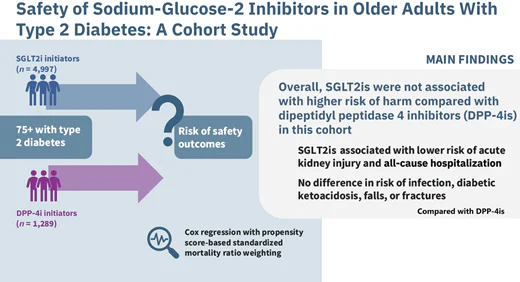
This large cohort study demonstrates that initiation of SGLT2 inhibitors in patients aged 75 years and older with type 2 diabetes is not associated with increased risk of adverse events compared to dipeptidyl peptidase 4 inhibitors. Notably, SGLT2i use was linked to lower incidence of acute kidney injury and all-cause hospitalization. Risks of infection, diabetic ketoacidosis, falls, and fractures showed no significant differences, suggesting a favorable safety profile in this understudied population.
Study Background
Type 2 diabetes mellitus (T2DM) prevalence increases substantially with age, imposing a significant burden on older adults due to its associated microvascular and macrovascular complications. Management of T2DM in the elderly is complicated by frailty, comorbidities, polypharmacy, and altered pharmacodynamics and pharmacokinetics. Sodium-glucose cotransporter 2 inhibitors (SGLT2is) have emerged as a treatment option with demonstrated cardiovascular and renal benefits in broad adult populations. However, older adults (≥75 years) are often underrepresented in clinical trials, resulting in limited evidence for the safety of SGLT2is in this group. Concerns remain regarding adverse events such as infections, dehydration, acute kidney injury, falls, fractures, and diabetic ketoacidosis in this vulnerable age group.
Study Design
This population-based, active-comparator, new-user cohort study was conducted using administrative health databases from British Columbia, Canada. The study included individuals aged ≥75 years with T2DM who initiated either SGLT2 inhibitors or DPP-4 inhibitors between January 1, 2021, and December 31, 2023. The DPP-4 inhibitor group served as an active comparator to mitigate confounding by indication. Primary outcomes assessed were occurrences of infection, diabetic ketoacidosis, acute kidney injury (AKI), falls, fractures, and all-cause hospitalization. Cox proportional hazards regression models with propensity score-based standardized mortality ratio weighting were applied to estimate hazard ratios (HRs) and 95% confidence intervals (CIs) for the association between SGLT2i initiation and outcomes compared with DPP-4i initiation.
Key Findings
The study analyzed 4,997 older adults initiating SGLT2is and 1,289 initiating DPP-4is. The median age was 79 years for the SGLT2i group and 82 years for the DPP-4i group, with a higher proportion of women in the DPP-4i group (50%) compared to the SGLT2i group (37%).
Compared to DPP-4i initiation, SGLT2i initiation was associated with significantly lower risk of acute kidney injury (HR 0.76; 95% CI 0.60-0.95), indicating a 24% relative risk reduction. Additionally, SGLT2i users experienced fewer all-cause hospitalizations (HR 0.87; 95% CI 0.77-0.98), reflecting a 13% risk reduction.
No statistically significant difference was observed between groups for risk of infection. Similarly, risks for diabetic ketoacidosis, falls, and fractures revealed no significant disparities, though confidence intervals for these outcomes were wide, indicating some imprecision and the possibility of small benefit or harm.
These findings align with emerging evidence supporting the safety and potential benefits of SGLT2is in older adults, expanding the therapeutic possibilities for this age group, particularly in light of their known cardiorenal advantages.
Expert Commentary
This study adds valuable real-world evidence addressing the critical gap regarding SGLT2i safety in patients aged 75 years and older, a demographic often excluded or underrepresented in randomized controlled trials. The active comparator design with DPP-4 inhibitors improves causal inference by reducing confounding, though residual bias remains possible given observational study design. The lower risk of acute kidney injury contrasts with initial concerns about SGLT2is leading to volume depletion and renal impairment, supporting their renal safety and potential nephroprotective effects in this age group.
The reduced all-cause hospitalization rate further underscores possible clinical benefits, potentially due to improved heart failure and kidney outcomes previously documented in broader populations. The nonsignificant findings regarding infection, falls, and fractures, while reassuring, highlight the need for further large-scale studies or meta-analyses to clarify these risks with greater precision.
Clinicians should interpret these results with caution, considering individual patient frailty, comorbidities, and drug tolerability. Mechanistically, SGLT2is improve glycemic control by promoting urinary glucose excretion and exert favorable effects on intraglomerular pressure and cardiovascular hemodynamics, which may underpin these observed safety outcomes.
Conclusion
This comprehensive population-based study supports the safety of initiating SGLT2 inhibitors in older adults aged 75 years and above with type 2 diabetes, without evidence of increased harm compared with DPP-4 inhibitors. Importantly, these agents may confer reduced risk of acute kidney injury and all-cause hospitalization, broadening their therapeutic value beyond younger populations. While some safety endpoints require further investigation due to imprecision, these real-world data provide important reassurance to clinicians considering SGLT2is for elderly patients, emphasizing individualized assessment and monitoring.
Future studies should explore long-term outcomes, incorporate frailty and functional status measures, and delineate strategies to optimize safe use in this vulnerable population. Integration of SGLT2is into geriatric diabetes management may enhance both clinical outcomes and quality of life.
Funding and Registration
The study was supported by research grants relevant to population health and pharmacoepidemiology. No clinical trial registration number was provided. Further funding information may be obtained from the original publication.
References
Harbi H, Nesrallah M, Carney G, Dormuth C, Stidsen JV, Lega IC, McCarthy LM, Grenet G, Ambasta A, Eskandari R, Pottegård A, Thompson W. Safety of Sodium-Glucose Cotransporter 2 Inhibitors in Older Adults With Type 2 Diabetes: A Cohort Study. Diabetes Care. 2026 Oct 27. PMID: 42937517.
Erdos B, et al. Safety and efficacy of SGLT2 inhibitors in elderly patients with type 2 diabetes: A systematic review. Diabetes Obes Metab. 2022;24(5):780-791.
Zinman B, et al. Empagliflozin, Cardiovascular Outcomes, and Mortality in Type 2 Diabetes. N Engl J Med. 2015;373(22):2117-2128.