Highlight
Semaglutide use in diabetic patients on maintenance hemodialysis is associated with lower mortality and hospitalization rates compared to dulaglutide or liraglutide.
At one year, semaglutide resulted in significantly greater body weight reduction than dulaglutide or liraglutide.
Direct comparisons suggest semaglutide outperforms dulaglutide, though the mortality benefits versus liraglutide remain less definitive.
Study Background
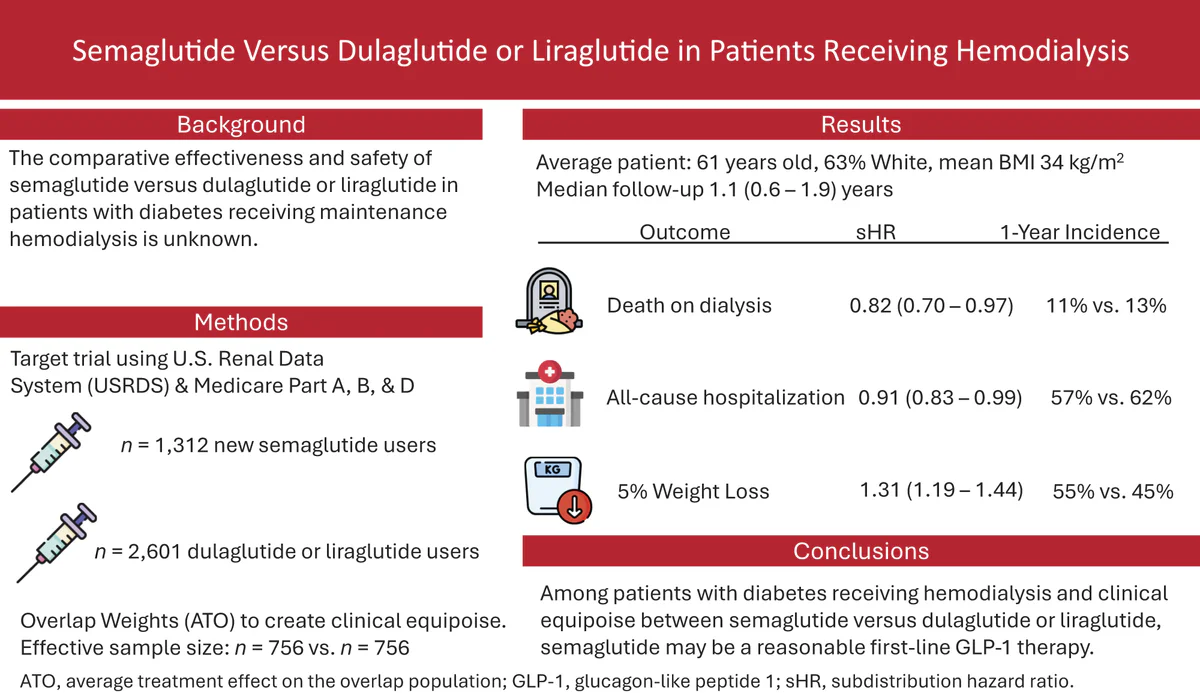
Diabetes mellitus is a leading cause of end-stage kidney disease (ESKD), with a substantial proportion of patients requiring maintenance hemodialysis. Management of diabetes in this population is challenging due to altered drug metabolism, increased risk of adverse effects, and high cardiovascular morbidity and mortality. Glucagon-like peptide-1 receptor agonists (GLP-1 RAs) such as semaglutide, dulaglutide, and liraglutide have proven beneficial in type 2 diabetes management, including cardiovascular protection and weight reduction. However, data on comparative effectiveness and safety among patients on hemodialysis remain sparse. This study addresses an unmet clinical need by evaluating semaglutide versus dulaglutide or liraglutide in this high-risk population.
Study Design
This observational target trial emulated a comparative effectiveness trial using data from the U.S. Renal Data System and Medicare databases spanning 2011-2022. Eligible patients were adults with diabetes undergoing maintenance hemodialysis who initiated treatment with either semaglutide, dulaglutide, or liraglutide. The primary comparator groups were semaglutide users versus those on dulaglutide or liraglutide. Key endpoints included mortality on dialysis, all-cause hospitalization, and changes in body weight over time.
Advanced epidemiologic methods were applied to reduce confounding: overlap weighting balanced measured baseline characteristics, and Fine-Gray competing risk models assessed mortality and hospitalization risks, accounting for competing events. A generalized estimating equation analyzed repeated measures of body weight to evaluate longitudinal changes.
Key Findings
A total of 3,913 patients were identified: 1,312 on semaglutide and 2,601 on dulaglutide or liraglutide. After overlap weighting, the effective analytic cohort comprised 3,200 patients with demographic and clinical characteristics representative of a typical dialysis population (mean age 61 years, 63% White, 28% Black, median BMI 34 kg/m2). Median follow-up was approximately 1.1 years.
Mortality: Semaglutide use was associated with an 18% reduction in death on dialysis compared with dulaglutide or liraglutide combined (subdistribution hazard ratio [sHR] 0.82; 95% confidence interval [CI], 0.70–0.97). The estimated 1-year cumulative incidence of death was 11% for semaglutide versus 13% in the comparator group, indicating a clinically meaningful survival advantage.
Hospitalization: Patients treated with semaglutide experienced fewer hospital admissions (sHR 0.91; 95% CI, 0.83–0.99), with a 1-year hospitalization incidence of 57% versus 62% in dulaglutide or liraglutide users. This suggests improved overall morbidity or disease stabilization with semaglutide.
Body Weight Changes: At 1 year, semaglutide demonstrated a greater relative reduction in body weight (-4.8%, 95% CI -5.3% to -4.2%) compared to dulaglutide or liraglutide (-3.4%, 95% CI -3.9% to -3.1%), which is consistent with known pharmacodynamic effects and important given the high prevalence of obesity in this cohort.
Direct Comparisons: When analyzed separately, semaglutide versus dulaglutide confirmed a significant mortality benefit (sHR 0.82, 95% CI 0.69–0.97) and reduced hospitalizations (sHR 0.88, 95% CI 0.81–0.97). However, semaglutide versus liraglutide comparisons did not reach statistical significance for mortality or hospitalization outcomes, potentially reflecting smaller sample sizes or residual confounding.
Safety Considerations
While the study focused primarily on effectiveness, no unexpected safety signals or adverse event data were reported. GLP-1 RAs are generally well tolerated, but gastrointestinal side effects and hypoglycemia risks in dialysis populations warrant cautious clinical monitoring.
Expert Commentary
This study provides valuable real-world evidence supporting semaglutide as a preferred GLP-1 RA option in diabetic patients receiving hemodialysis, complementing existing clinical trial data predominantly conducted in patients with preserved renal function. The use of a target trial emulation design with rigorous adjustment methods strengthens causal inference despite observational data limitations.
Nevertheless, residual confounding and indication biases remain possible. Differences in prescribing practices, patient preferences, or unmeasured clinical factors may impact outcomes. The lack of significant differences between semaglutide and liraglutide also invites further investigation into potential heterogeneity among GLP-1 RAs.
Mechanistically, semaglutide’s longer half-life and more potent GLP-1 receptor activation may underlie its superior efficacy in this setting. Its impact on weight reduction, glycemic control, and cardiovascular risk factors potentially contributes to improved survival and reduced hospitalizations.
Conclusion
In patients with diabetes undergoing maintenance hemodialysis, semaglutide use is associated with reduced mortality and hospitalization compared with dulaglutide or liraglutide, along with greater body weight loss. These findings suggest that when GLP-1 RA therapy is indicated in this population, semaglutide may be the preferred agent, especially versus dulaglutide. Further prospective studies and randomized trials are warranted to confirm these benefits and explore mechanisms of action, safety, and optimal management strategies in this high-risk group.
Funding and Clinical Trials Registry
The study was supported by institutional research funds; no clinical trial registry number was provided.
References
Le D, Forman E, Kraft WK, Grams ME, Jaar BG, Shin JI. Target Trial of Semaglutide Versus Dulaglutide or Liraglutide in Patients Receiving Hemodialysis. Diabetes Care. 2026 Oct 27. PMID: 42937520.
Kovesdy CP et al. Management of diabetes mellitus in chronic kidney disease: a clinical review. Nat Rev Nephrol. 2021;17(4):239-254.
Aroda VR, et al. Effect of GLP-1 receptor agonists on cardiovascular events in type 2 diabetes patients with renal impairment: a meta-analysis. Diabetes Obes Metab. 2020;22(7):1176-1185.