Culturally Tailored Meal Program Reduces Hospitalizations in Navajo Patients With Heart Failure: The MUTTON-HF Trial
An 8-week culturally tailored meal program reduced the risk of all-cause hospitalization or ED visit by 28% in Navajo patients with heart failure.
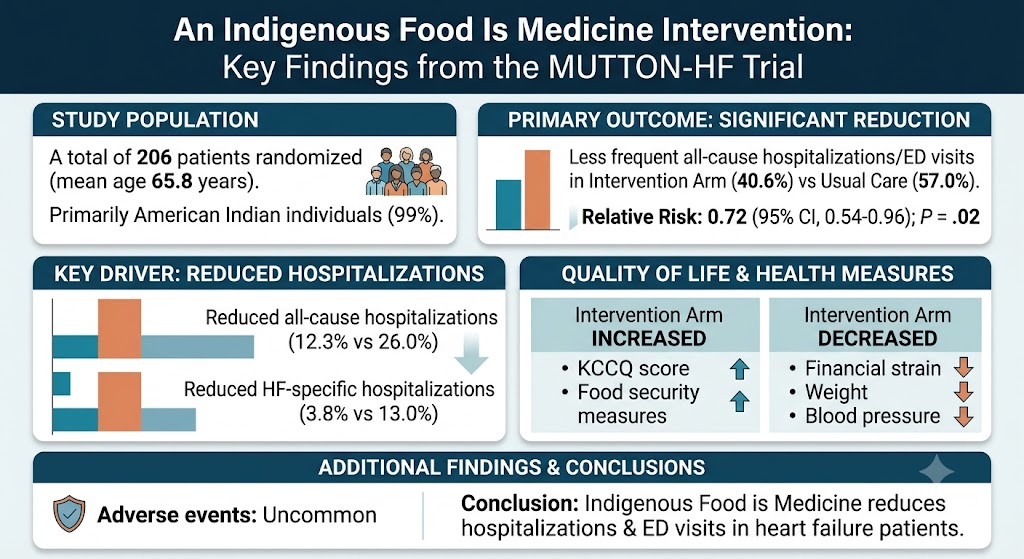
The benefit was driven mainly by fewer hospitalizations (12.3% vs 26.0%), including heart failure-specific hospitalizations (3.8% vs 13.0%).
Patients receiving the intervention reported improved quality of life, reduced food insecurity, and lower blood pressure and weight.
Adverse events were uncommon, though the study was open-label.
Population: 206 adults with heart failure, mean age 66, 42% female, from two Indian Health Service sites in Navajo Nation.
Intervention: 8 weeks of culturally and medically tailored meals (traditional Navajo foods) vs usual dietary advice.
Primary endpoint: Proportion with all-cause hospitalization or ED visit within 90 days.
Primary result: 40.6% vs 57.0%; RR 0.72 (95% CI 0.54–0.96; P=0.02).
Safety: Adverse events uncommon (details not fully reported in abstract).
A Culturally Rooted Approach to Heart Failure Care
Nutrition insecurity is a well-recognized driver of poor cardiovascular health in Indigenous communities. Despite high rates of heart failure, few interventions have been designed to address both the medical and cultural needs of these populations. The MUTTON-HF (Medically Utilized Tailored Traditional Foods to Optimize Nutrition in Heart Failure) trial evaluated whether a program that provides medically tailored meals based on traditional Navajo foods could improve clinical outcomes in patients with heart failure living in the Navajo Nation.
Study Design and Participants
This pragmatic, open-label randomized clinical trial was conducted from May to November 2025 at two Indian Health Service sites in rural Navajo Nation. Eligible adults had heart failure with at least one hospitalization or emergency department visit in the prior 12 months. A total of 206 patients (mean age 65.8 years, 42% female, 99% American Indian) were randomized 1:1 to receive either 8 weeks of a culturally and medically tailored meal program (which incorporated traditional Navajo foods such as mutton, blue corn, and vegetables) or usual dietary advice. All patients were followed for 12 weeks for outcomes and adverse events.
Primary Endpoint Met: Fewer Hospitalizations and ED Visits
The primary endpoint was the proportion of patients with an all-cause hospitalization or emergency department visit within 90 days. The intervention group had a significantly lower rate: 40.6% (43 patients) compared with 57.0% (57 patients) in the usual-advice group. The relative risk was 0.72 (95% CI 0.54–0.96; P=0.02), corresponding to a 28% reduction.
The benefit was driven primarily by a lower rate of hospitalizations: 12.3% (13 patients) in the arm receiving meals versus 26.0% (26 patients) in the control group. Heart failure-specific hospitalizations were also reduced: 3.8% (4 patients) vs 13.0% (13 patients). The number of emergency department visits showed a smaller difference, but the composite primary endpoint achieved statistical significance.
Secondary Outcomes: Quality of Life and Food Security Improved
Several secondary endpoints favored the intervention. Scores on the Kansas City Cardiomyopathy Questionnaire (KCCQ), a measure of heart failure-related quality of life, improved significantly more in the meal-program group. Food security measures also increased, while measures of financial strain decreased. In addition, systolic and diastolic blood pressure and body weight declined modestly but significantly in the intervention arm. The authors noted that the changes in blood pressure and weight were consistent with the overall cardiovascular benefits seen in the primary endpoint.
Safety Was Acceptable
Adverse events were reported as uncommon, though the abstract does not provide a detailed breakdown. No unexpected safety signals emerged. Because the trial was open-label, patient-reporting bias cannot be excluded.
Limitations and Interpretation
The pragmatic design and open-label nature are important limitations, as patients and clinicians were aware of treatment assignment. The study enrolled exclusively Navajo patients, so generalizability to other Indigenous or non-Indigenous populations is not established. The intervention lasted only 8 weeks, with outcome assessment at 90 days; longer-term durability of the effect is unknown. Nonetheless, the trial provides evidence that a culturally tailored food-as-medicine intervention can reduce hospitalizations and improve quality of life in a high-risk population. The results underscore the potential of community-based interventions that leverage protective assets of Native communities.
Funding and Trial Registration
The study was registered at ClinicalTrials.gov (NCT06549699). Funding sources were not listed in the abstract.
References
Eberly LA, George C, Sandman S, et al. An Indigenous Food Is Medicine Intervention: The MUTTON-HF Randomized Clinical Trial. JAMA Internal Medicine. 2026; published online July 27. PMID: 42507456.
This article was created using several editorial tools, including AI, as part of the process. Human editors reviewed this content before publication.