Highlight
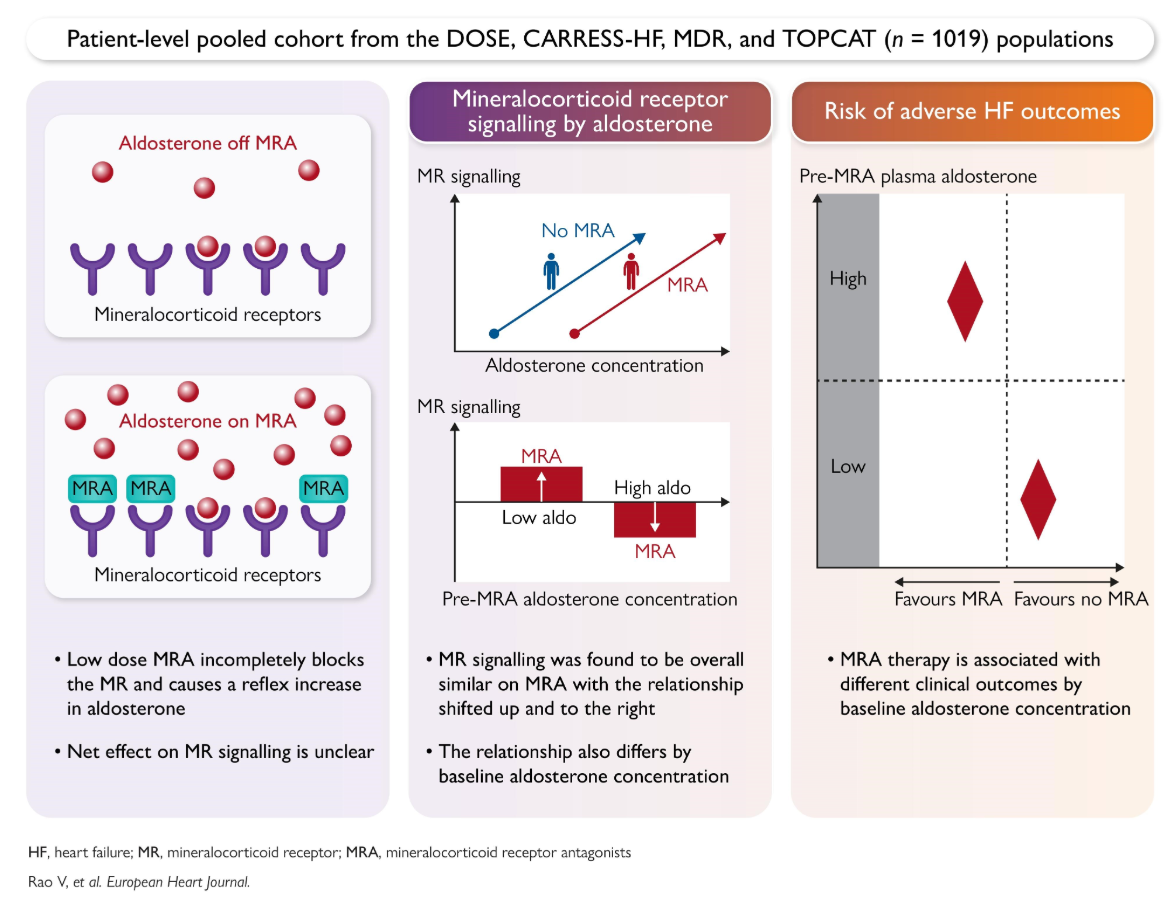
• Mineralocorticoid receptor antagonists (MRAs) raise aldosterone concentrations but may not fully suppress receptor activity in heart failure (HF) patients.
• Higher baseline aldosterone levels correlate with improved clinical outcomes following MRA initiation.
• In patients with low baseline aldosterone, MRA use may worsen mineralocorticoid receptor activity and clinical outcomes.
• These findings challenge the uniform application of low-dose MRAs in HF and suggest a need for biomarker-guided therapy.
Study Background
Heart failure (HF) is a complex clinical syndrome characterized by impaired cardiac function and neurohormonal activation. The mineralocorticoid receptor (MR) pathway, stimulated principally by aldosterone, plays a detrimental role in HF progression by promoting sodium retention, fibrosis, and inflammation. Mineralocorticoid receptor antagonists (MRAs), such as spironolactone and eplerenone, are established guideline-directed medical therapies that reduce morbidity and mortality in HF. However, MRAs, particularly at low doses recommended by guidelines, paradoxically induce aldosterone secretion, potentially sustaining residual MR activation despite receptor blockade.
This paradox highlights an unmet clinical need to understand how circulating aldosterone concentrations before and during MRA therapy affect MR activity and patient outcomes. Improved knowledge could pave the way toward individualized treatment strategies in HF.
Study Design
This analysis pooled patient-level data from multiple HF cohorts and clinical trials with available plasma aldosterone measurements and MRA exposure. Specifically, data from DOSE, CARRESS-HF, MDR, and TOPCAT cohorts (n=1019) were combined for primary analyses. Additional meta-analyses integrated the EARLIER (n=300) and EPHESUS (n=453) trial datasets to strengthen clinical associations.
The study employed urine sodium to potassium (Na/K) ratio as a surrogate marker for mineralocorticoid receptor activity, particularly within the MDR cohort (n=136). The relationships among pre-treatment aldosterone levels, subsequent changes during MRA use, MR activity, and clinical outcomes (e.g., mortality and HF hospitalization) were systematically examined.
Key Findings
Aldosterone Concentrations and MRA Use
<pMRA therapy was associated with significantly elevated median plasma aldosterone concentrations compared to non-MRA-treated patients (310 pg/mL vs 174 pg/mL, P < .001). This finding confirms the known aldosterone escape phenomenon whereby low-dose MRA-induced receptor blockade paradoxically stimulates aldosterone synthesis as a compensatory feedback mechanism.
MR Activity Correlates with Aldosterone Levels
Within the MDR cohort, higher aldosterone concentrations correlated with increased mineralocorticoid receptor activity, measured via urine Na/K ratio (negative correlation coefficients off and on MRA: r = -.44 and r = -.52, respectively; both P < .001). Notably, despite MRA therapy, higher aldosterone levels were necessary to achieve comparable MR activity suppression, indicating incomplete receptor blockade at low doses.
Differential Effects by Baseline Aldosterone Levels
Notably, the impact of initiating MRA therapy depended markedly on baseline aldosterone levels. Patients with high pre-MRA aldosterone experienced a reduction in MR activity upon MRA initiation (median change in urine Na/K ratio = +1.4), implying effective receptor antagonism despite elevated aldosterone. However, patients with low baseline aldosterone paradoxically showed increased MR activity after MRA initiation (median change = -0.9), suggesting that in these individuals, MRAs may fail to inhibit and might even exacerbate receptor activation.
Clinical Outcomes Stratified by Baseline Aldosterone
The pooled cohort analysis revealed a significant interaction between baseline aldosterone concentration and clinical outcomes with MRA use (P interaction = .005). Among patients with high baseline aldosterone, MRA therapy significantly improved outcomes (hazard ratio [HR] 0.63; 95% confidence interval [CI], 0.42–0.92; P = .02). Conversely, in patients with low baseline aldosterone, MRA use was associated with worse outcomes (HR 1.66; 95% CI, 1.12–2.45; P = .01).
Expert Commentary
These findings highlight a complex interplay between aldosterone levels, MR blockade, and clinical efficacy of MRAs in HF. Traditionally, MRAs have been viewed as uniformly beneficial; however, the data reveals heterogeneity in response linked to underlying aldosterone status. This may partly explain variable responses to MRAs observed clinically and raises important questions about optimal dosing and patient selection.
Biologically, the compensatory rise in aldosterone induced by MRA therapy can saturate receptors or activate alternate signaling pathways, which low-dose MRAs fail to block fully. This incomplete antagonism may be detrimental in patients with relatively low baseline aldosterone concentrations, possibly due to unopposed or paradoxical receptor activation.
Current guidelines recommend MRAs broadly for HF with reduced ejection fraction without stratification by aldosterone levels. Incorporation of aldosterone measurement and MR activity biomarkers, such as urine Na/K ratio, could enable precision medicine approaches. Prospective studies are needed to validate whether adjusting MRA therapy based on hormone profiling improves safety and outcomes.
Limitations include the reliance on urine Na/K ratio as an indirect MR activity marker and observational nature regarding outcome associations, limiting causality inference. Nonetheless, the large pooled population and consistent findings across diverse cohorts strengthen the validity of these hypothesis-generating results.
Conclusion
Low-dose MRA therapy in heart failure induces elevated aldosterone secretion but may inadequately inhibit MR activity at these increased hormone levels. Patients with high baseline aldosterone derive clinical benefit and MR activity reduction from MRAs, whereas those with low baseline aldosterone may experience adverse receptor activation and worse outcomes. These findings underscore the potential need for biomarker-guided MRA therapy personalization in HF management to optimize efficacy and safety. Future prospective, randomized studies are warranted to confirm these observations and guide clinical practice refinements.
Funding and Clinicaltrials.gov
Funding sources and trial registration numbers for the included cohorts and trials are detailed in the original publications associated with DOSE, CARRESS-HF, MDR, TOPCAT, EARLIER, and EPHESUS trials available via clinicaltrials.gov IDs.
References
Rao VS, Ivey-Miranda JB, Cox ZL, Wilson FP, Petrie MC, Sarnak M, Wilcox CS, Pitt B, McCallum W, Testani JM. Blood aldosterone concentrations and effects of mineralocorticoid receptor antagonists in heart failure. Eur Heart J. 2026 Oct 9;47(38):5558-5568. doi: 10.1093/eurheartj/ehag440. PMID: 42301739; PMCID: PMC13652509.