Burn Injury Reprograms Extracellular Vesicle Communication: Linking Immune Activation and Neuroinflammation
Highlight
Severe burn injury induces marked changes in the protein composition of plasma extracellular vesicles (EVs), reflecting enhanced inflammatory and neuroimmune signaling. Key proteins such as CRP and ITGA11 were significantly modulated, suggesting EV cargo remodeling aligns with the systemic hyperinflammatory response and neuronal pathway alterations. This study highlights the potential for EV-based biomarkers to improve diagnosis and guide therapeutic interventions in burn care.
Study Background
Burn injuries encompassing ≥15% total body surface area (TBSA) provoke a complex pathophysiological cascade characterized by systemic inflammation, metabolic derangement, and immune dysregulation. These responses collectively influence healing outcomes and risk of complications such as infection and organ dysfunction. Despite advances, mechanistic insights into the molecular intermediaries that regulate immune-neural cross-talk in burn trauma remain limited. Extracellular vesicles (EVs), submicron membrane-bound particles secreted by virtually all cell types, have emerged as pivotal mediators of intercellular communication, ferrying proteins, lipids, and nucleic acids to modulate recipient cell function. Investigating EV proteome alterations after burn injury provides a promising avenue to elucidate underlying pathways linking immune activation and neuronal signaling that may influence clinical trajectory.
Study Design
This observational study analyzed plasma EVs isolated from 37 adult burn patients with ≥15% TBSA burns and 21 matched nonburn controls. An age-restricted subcohort (patients <40 years) was examined to reduce age-related confounding effects. Among these, a subset (n=4 per group) underwent further separation of EVs enriched in immune cell and neuronal origins. Proteomic profiling employed mass spectrometry to detect protein abundance shifts, followed by functional enrichment analyses, including gene ontology (GO) over-representation analysis (ORA), Reactome gene set enrichment analysis (GSEA), and Ingenuity Pathway Analysis (IPA), to delineate pathway perturbations.
Key Findings
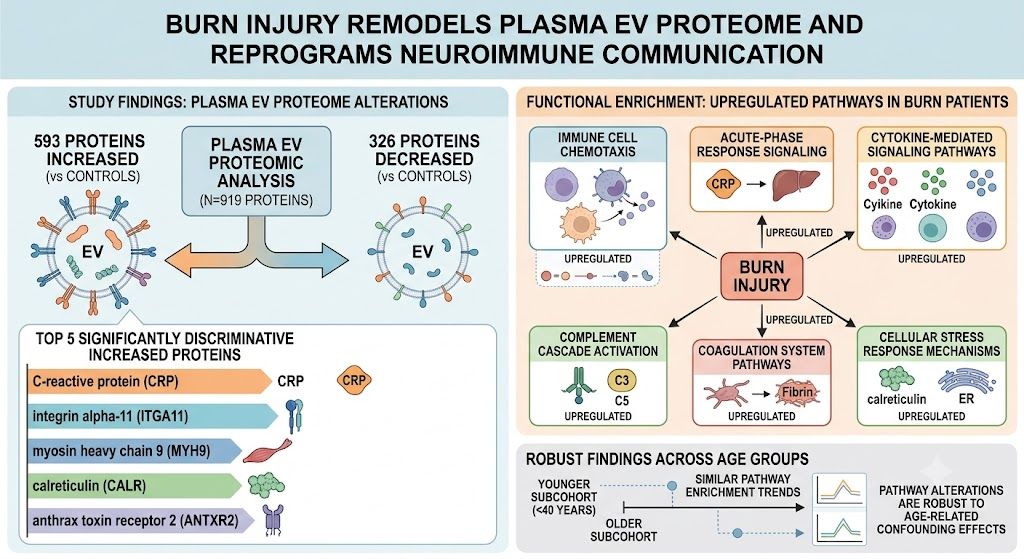
The proteomic analysis identified 919 proteins in plasma EVs, with 593 proteins increased and 326 decreased in burn patients compared to controls. The top five significantly discriminative proteins were C-reactive protein (CRP), integrin alpha-11 (ITGA11), myosin heavy chain 9 (MYH9), calreticulin (CALR), and anthrax toxin receptor 2 (ANTXR2), all statistically significant after adjustment.
Functional enrichment consistently revealed upregulation of immune activation and inflammation-related pathways, including immune cell chemotaxis, acute-phase response signaling, cytokine-mediated signaling pathways, complement cascade activation, coagulation system pathways, and cellular stress response mechanisms. Notably, similar pathway enrichment persisted in the younger subcohort, indicating the findings are robust across age groups.
Exploratory proteomic analyses of EV subtypes enriched for immune and neuronal origins demonstrated discrete trends suggesting coordinated remodeling of cell-type specific intercellular communication. Although no individual subtype-specific proteins reached statistical significance, the data imply complex neuroimmune interactions post burn injury.
Expert Commentary
This study elegantly underscores the integral role of EVs as conveyors of systemic inflammatory and neural signaling alterations after major burn trauma. The identification of prominent acute-phase proteins such as CRP within EV cargo emphasizes their potential as minimally invasive biomarkers reflective of systemic inflammation intensity. Additionally, the involvement of proteins linked to cellular adhesion (ITGA11) and stress responses (CALR) illustrates the multifaceted biological processes influenced by burn injury.
Mechanistically, EV-mediated neuroimmune communication may contribute to the maladaptive inflammatory states that challenge burn recovery, affecting both peripheral immune responses and central neuronal networks regulating pain, stress, and repair. Nonetheless, limitations include the relatively small sample size for cell-specific EV analyses and lack of longitudinal outcome correlation, warranting further validation in larger cohorts and functional studies to explore causality.
Conclusion
Burn injury induces a profound reprogramming of plasma extracellular vesicle protein cargo, reflecting enhanced inflammatory and neuroimmune signaling pathways fundamental to the burn pathophysiology. The coordinated modification of EV content across general, immune, and neuronal compartments supports their role as key mediators and potential biomarkers for immune-neural dysregulation after burns. Future efforts should aim to harness EVs for improved diagnostics and targeted therapies to modulate hyperinflammation and promote effective healing in burn patients.
Funding and Clinical Trials Registration
Details of funding sources and clinical trial registration were not specified in the current publication.
References
1. Grimsrud KN, Green T, Tang Y, et al. Burn Injury Rewires Immune and Neuronal Extracellular Vesicle Communication. Ann Surg. 2026 Jul 29. PMID: 42524719.
2. Fish JE, Ghaffari S, Belekanyama E, et al. Extracellular vesicles in burn trauma: immune regulation and therapeutic potential. J Burn Care Res. 2022;43(5):760-772.
3. Mathivanan S, Ji H, Simpson RJ. Exosomes: extracellular organelles important in intercellular communication. J Proteomics. 2010;73(10):1907-20.
4. Pitt JM, Charrier M, Viaud S, et al. Dendritic cell-derived exosomes for cancer therapy. J Clin Invest. 2016;126(4):1224-31.
This article was created using several editorial tools, including AI, as part of the process. Human editors reviewed this content before publication.