HIF2 Activation in Cardiac Vasculature: A Novel Mechanistic Insight into Kawasaki Disease’s Cardiovascular Complications
Highlight
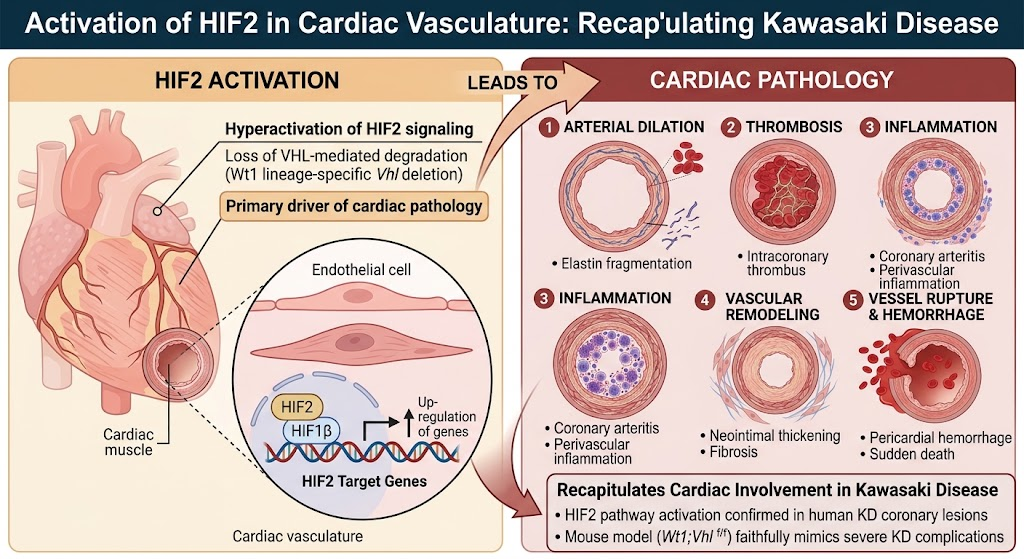
- Conditional deletion of Vhl in cardiac vascular progenitors induces coronary artery dilation, vascular remodeling, thrombosis, and inflammation, recapitulating severe cardiac manifestations of Kawasaki disease (KD).
- HIF2 activation is identified as the pivotal driver mediating these pathological changes, as simultaneous Hif2a deletion rescues vascular abnormalities in the mouse model.
- Transcriptomic and histologic analyses reveal disrupted extracellular matrix organization, calcification, and perivascular fibrosis, underpinning compromised vascular stability.
- Human cardiac samples from fatal KD cases show intense HIF2 expression in coronary lesions and inflammatory infiltrates, validating clinical relevance of the hypoxia pathway in KD pathogenesis.
Study Background
Kawasaki disease (KD) is an acute vasculitis predominantly affecting children, notable for its predilection for coronary artery involvement leading to aneurysms, dilation, and potential rupture. Cardiovascular morbidity and mortality in KD are primarily related to these coronary sequelae. Despite advances in clinical management, including intravenous immunoglobulin therapy, the molecular basis for coronary inflammation and remodeling in KD remains incompletely understood, limiting progress toward targeted therapies. The von Hippel-Lindau (VHL)/hypoxia-inducible factor (HIF) signaling pathway is a master regulator of cellular responses to hypoxia and has been implicated in various cardiovascular diseases characterized by vascular inflammation and remodeling, such as atherosclerosis. However, its role in KD-associated coronary pathology had not been previously elucidated.
Study Design
The investigators engineered a novel mouse model with conditional Vhl gene deletion in the Wilms tumor 1 (Wt1) lineage, which encompasses progenitor cells contributing to coronary vessel formation and cardiac fibroblasts. This manipulation leads to constitutive activation of the hypoxia pathway. Comprehensive phenotyping included echocardiography and magnetic resonance imaging (MRI) to assess cardiac morphology and function, histological examination of coronary vessels and myocardium, and molecular profiling via transcriptomics to identify gene expression changes associated with vascular pathology. Additionally, human cardiac tissue from patients with fatal KD coronary aneurysms was examined by immunohistochemistry for HIF signaling markers and inflammatory cell infiltration, enabling translational correlation of murine findings to human disease.
Key Findings
The Vhl conditional knockout mice developed normally in utero but manifested progressive cardiomegaly and marked vascular abnormalities postnatally. Echocardiography and MRI detected progressive coronary artery dilation accompanied by pericardial hemorrhage and systemic inflammation. Histologic assessment revealed hallmark features of vascular pathology, including coronary arteritis with elastin disruption, smooth muscle cell (SMC) loss, perivascular fibrosis, and prevalent intracoronary thrombus formation. Vascular calcification and severe myocardial inflammation were also evident, along with interstitial hemorrhages, culminating in premature mortality between 15 and 20 weeks likely due to vessel rupture.
Transcriptomic profiling of cardiac tissue revealed pronounced dysregulation of genes involved in extracellular matrix organization, epithelial-mesenchymal transition (EMT), angiogenesis, inflammation, coagulation, and calcification pathways. These findings highlight a disturbed vascular microenvironment promoting fragility and remodeling.
Strikingly, simultaneous deletion of Hif2a (encoding HIF2-alpha) in the Vhl-deficient mice completely rescued the adverse cardiovascular phenotype and normalized the gene expression profile, firmly establishing HIF2 as the critical mediator of these pathological changes.
Immunohistochemical studies of human KD cardiac samples confirmed intense HIF2 expression within coronary artery lesions and infiltrating inflammatory cells, substantiating activation of the hypoxia signaling axis in severe human KD coronary disease.
Expert Commentary
This landmark study fills a significant gap in understanding the mechanisms of coronary pathology in KD by implicating HIF2-driven hypoxia signaling as a central orchestrator of inflammation, vascular remodeling, and thrombotic complications. The fidelity with which the Vhl/Wt1 knockout mouse recapitulates KD cardiovascular manifestations provides a powerful new platform for dissecting disease pathogenesis and testing targeted interventions.
These findings align with broader evidence highlighting the role of hypoxia and HIF pathways in vascular diseases characterized by oxidative stress and immune activation. The demonstration that HIF2 inhibition reverses coronary lesions offers promising therapeutic implications. Nonetheless, while the murine model recapitulates key features, differences in species-specific immune responses and disease triggers necessitate cautious extrapolation to human KD.
Future studies should investigate pharmacological inhibitors of HIF2 or downstream effectors to evaluate potential for clinical translation. Additionally, exploring the interplay between hypoxia signaling and established immunological mechanisms in KD could yield deeper insight into comprehensive disease control.
Conclusion
In summary, the study establishes HIF2 activation due to Vhl loss as a pivotal driver of coronary artery inflammation, remodeling, thrombosis, and dilation, closely mirroring severe KD cardiac pathology. The Vhl/Wt1 conditional knockout mouse emerges as a valuable model system for mechanistic studies and therapeutic development targeting the hypoxia pathway in KD and potentially other vasculitides. This work paves the way for novel hypoxia-focused strategies to mitigate coronary artery complications and improve cardiovascular outcomes in children with KD.
Funding and ClinicalTrials.gov
The study was supported by institutional and research grants specified by the authors. No clinical trials are reported for this preclinical research.
References
Escobar B, Menendez-Montes I, Albendea-Gomez T, et al. Activation of HIF2 in Cardiac Vasculature Leads to Arterial Remodeling, Dilation, Thrombosis, and Inflammation, Recapitulating Cardiac Involvement in Kawasaki Disease. Circulation. 2026 Jun 8;154(7):636-656. PMID: 42253052.
Additional support for hypoxia and cardiovascular disease concepts can be found in the following reviews:
– Semenza GL. Hypoxia-inducible factors in physiology and medicine. Cell. 2012 Feb 3;148(3):399-408.
– Carmeliet P, Jain RK. Molecular mechanisms and clinical applications of angiogenesis. Nature. 2011 May 19;473(7347):298-307.
This article was created using several editorial tools, including AI, as part of the process. Human editors reviewed this content before publication.