We use cookies

Our website uses essential cookies and, with your consent, additional cookies to measure performance and improve our services. Cookie Policy.

You can change your choice at any time.

MMedXYNews
HomeVideos
MedXY AI/MedXY News/Section: Hematology-Oncology

TP53-Mutated Clonal Hematopoiesis Drives Pro-Inflammatory Phenotype and Predicts Poor Outcomes After CAR T-Cell Therapy
MedXY Editorial Team•Aug 26, 2026•Hematology-Oncology
inflammationCAR T-cell therapyHematopoiesisTP53 突变CHIP

Highlight

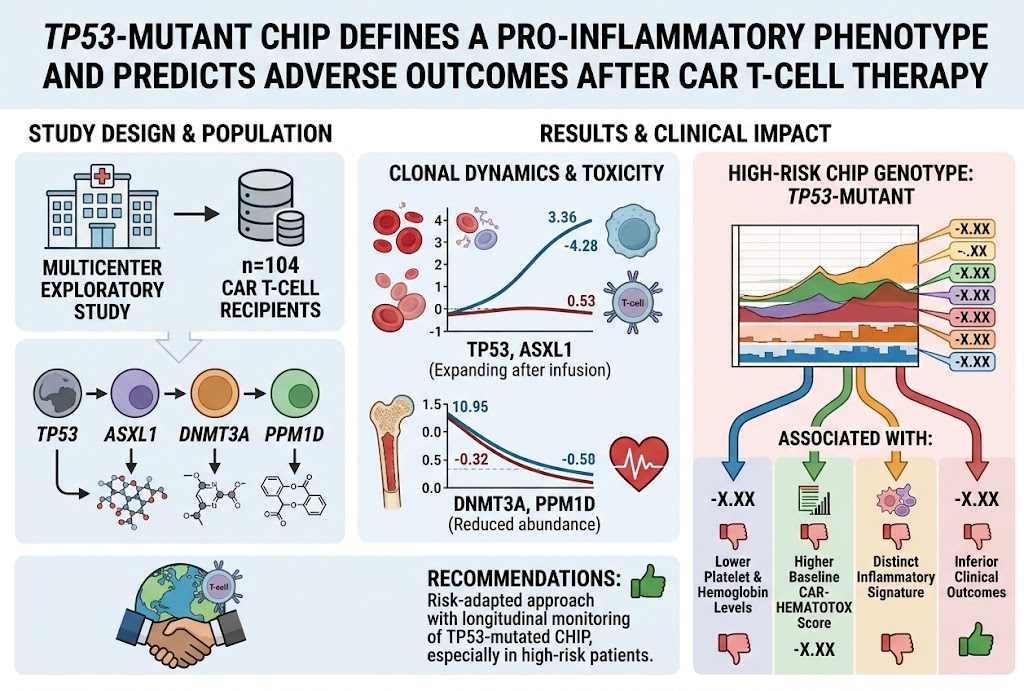
– TP53-mutated clonal hematopoiesis of indeterminate potential (CHIP) predicts adverse clinical outcomes post-CAR T-cell therapy.
– TP53-mutant clones exhibit expansion after CAR T infusion and associate with pro-inflammatory serum proteomic signatures.
– TP53 CHIP correlates with hematologic toxicity, including thrombocytopenia and anemia, and higher baseline CAR-HEMATOTOX scores.
– Monitoring of TP53-mutated CHIP clones may identify patients at risk for treatment-emergent myeloid neoplasms and guide risk-adapted management.

Study Background

MedXY registered readers

Sign in free to continue reading

Create or use your MedXY account to unlock the complete article.

This article was created using several editorial tools, including AI, as part of the process. Human editors reviewed this content before publication.

Related articles

Open language-specific specialty feeds and department pages.

Five-Year Survival and Durable Remission with Lisocabtagene Maraleucel in Relapsed/Refractory Large B-Cell Lymphoma: Insights from the TRANSCEND NHL 001 StudyLisocabtagene maraleucel demonstrates durable five-year survival and potential cure in relapsed/refractory large B-cell lymphoma, with manageable long-term safety, based on data from the TRANSCEND NHL 001 trial and its long-term follow-up.Sep 18, 2026Optimizing Bridging Therapy Before BCMA-Directed CAR T-Cell Treatment in Relapsed/Refractory Multiple Myeloma: A Real-World Multicenter AnalysisBridging therapy before BCMA-directed CAR T-cell infusion in relapsed/refractory multiple myeloma impacts disease control and outcomes. This study analyzes regimen efficacy and safety in 399 patients, highlighting variable responses and safSep 13, 2026Arlocabtagene Autoleucel: Advancing Treatment Paradigms in Heavily Pretreated Relapsed/Refractory Multiple MyelomaArlocabtagene autoleucel (arlo-cel) is a novel GPRC5D-targeted CAR T-cell therapy showing promising efficacy and manageable safety in patients with relapsed/refractory multiple myeloma heavily pretreated with standard regimens, including prSep 12, 2026
Loading comments...
MedXY briefing

Get the free newsletter

Evidence-led clinical news, trends, and analysis—delivered to your inbox.

Ask MedXY AI

Most popular

Intimate Health
Five Benefits for Women Continuing Sexual Activity After Menopause
Intimate Health
Why Some Women Have a Strong Sex Drive—And Why Men Shouldn't Worry About It
Nursing & care
How often should a couple have sex?
Intimate Health
Classic Intimacy Recommendations: How to Help Women Reach Orgasm and Enjoy Mutual Pleasure
Intimate Health
What Makes a Woman "Physiologically Addicted" Is Never Money, But These Two Relationship Qualities
© 2026 MedXY
Contact usAbout usPrivacy PolicyMedXY story
Csnk1a1 E98 Mutations: Metabolic and Signaling Rewiring in del(5q) Myelodysplastic NeoplasmsThis study reveals that CSNK1A1 E98 mutations in del(5q) MDS alter kinase signaling and metabolism, creating a stress-tolerant yet inflexible hematopoietic cell state with distinct clinical features and potential therapeutic vulnerabilitiesSep 9, 2026
Unveiling the Role of snoRNA-Derived RNAs in Hematopoiesis and Acute Myeloid Leukemia PrognosisThis article explores the expression and functional impact of snoRNA-derived RNAs in healthy blood formation and acute myeloid leukemia, highlighting their potential as biomarkers and therapeutic targets.Sep 9, 2026
Impact of Germline and Somatic DNMT3A Variants on Pulmonary Arterial Hypertension: A New Frontier in Biomarkers and TherapeuticsGermline and somatic variants in DNMT3A and other CHIP genes elevate pulmonary arterial hypertension risk, including connective tissue disease-associated forms, through pro-inflammatory pathways, highlighting novel biomarkers and therapeutiSep 8, 2026