Interleukin-6 as a Central Mediator of Therapeutic Success in Acute Lung Injury and COVID-19
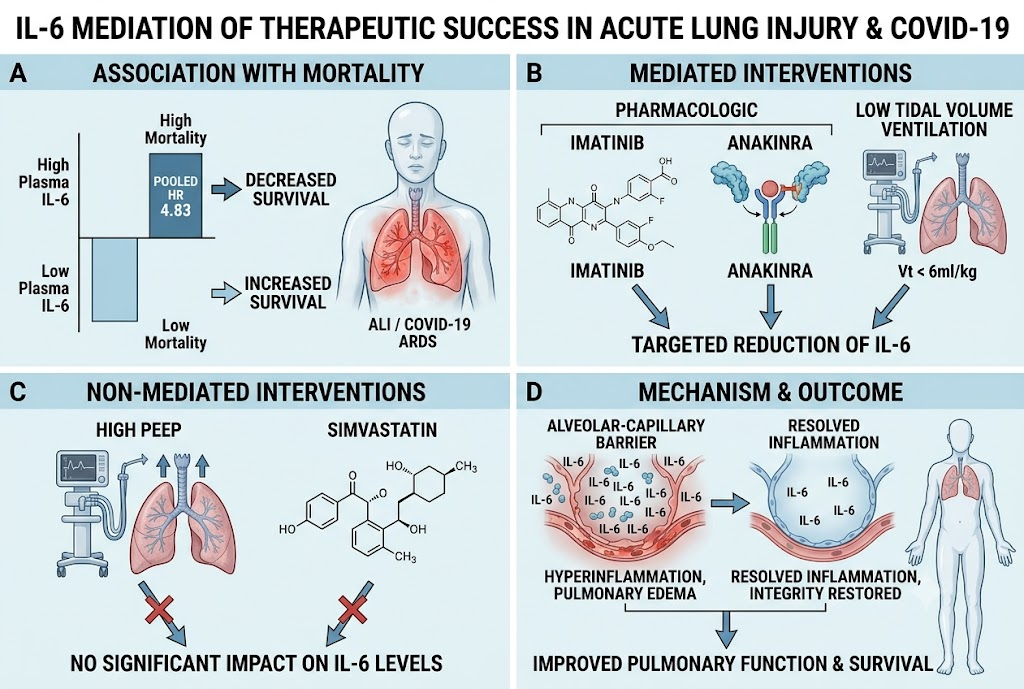
Highlight
– Elevated IL-6 levels correlate with increased mortality in acute lung injury and COVID-19-related ARDS.
– IL-6 mediates survival benefits of interventions including imatinib, anakinra, and low tidal volume ventilation.
– High PEEP and simvastatin did not significantly influence IL-6 levels or mortality benefit.
– Targeted reduction of IL-6 may underlie therapeutic efficacy by resolving inflammation.
Study Background
Acute respiratory distress syndrome (ARDS) and acute lung injury are critical conditions marked by intense inflammation disrupting the alveolar-capillary barrier. This leads to pulmonary edema, impaired gas exchange, and high mortality. The COVID-19 pandemic further highlighted this clinical challenge, with severe cases showing elevated systemic inflammation. Interleukin-6 (IL-6), a pro-inflammatory cytokine, is a well-recognized biomarker correlating with disease severity and adverse outcomes in ARDS and COVID-19. However, the causal role of IL-6 in mediating the effects of various therapeutic interventions remains less clear. Improved understanding of this relationship is essential to optimize treatment strategies and potentially identify IL-6 as a biomarker and therapeutic target.
Study Design
This investigation capitalized on individual patient data from five large randomized controlled trials involving 2563 patients diagnosed with ARDS or COVID-19-related lung injury. The interventions studied included pharmacologic agents—imatinib (a tyrosine kinase inhibitor) and anakinra (an IL-1 receptor antagonist)—and non-pharmacologic interventions such as low tidal volume ventilation, high positive end-expiratory pressure (PEEP), and simvastatin treatment. Baseline and serial plasma IL-6 levels, alongside other inflammatory markers such as IL-8, tumor necrosis factor receptor 1 (TNFR1), and C-reactive protein (CRP), were measured. The primary endpoint was 28-day survival. Joint modeling techniques were applied to evaluate IL-6 as a mediator of treatment effects on mortality. Additionally, meta-analysis with random effects models assessed the strength of the association between IL-6 levels and mortality risk across studies.
Key Findings
The analysis demonstrated a robust association between elevated plasma IL-6 concentrations and higher mortality risk over 28 days, with a pooled hazard ratio (HR) of 4.83 (95% confidence interval 3.50-6.66) per log10-unit increase in IL-6 levels. Importantly, IL-6 acted as a significant mediator of treatment efficacy for imatinib, anakinra, and low tidal volume ventilation, implying that these therapies improved survival partly via reduction of systemic inflammation as reflected by IL-6 trajectories. Conversely, interventions using high PEEP or simvastatin showed no significant impact on IL-6 dynamics and did not demonstrate mortality benefits mediated through IL-6 modulation.
Secondary pro-inflammatory markers—IL-8, TNFR1, and CRP—were analyzed but did not consistently mediate intervention effects, underscoring IL-6’s unique role in the inflammatory pathway relevant to these treatments. The resolution of inflammation marked by declining IL-6 may reflect recovery of the alveolar-capillary barrier integrity and improved pulmonary function.
Expert Commentary
This multi-trial meta-mediation analysis provides compelling evidence positioning IL-6 as a critical mediator linking therapeutic interventions and improved survival in acute lung injury and COVID-19 ARDS. The findings lend biological plausibility to clinical benefits observed with IL-1 receptor blockade (anakinra) and tyrosine kinase inhibition (imatinib), which may dampen hyperinflammatory responses. The well-established survival advantage of low tidal volume ventilation is further supported by its effect on reducing systemic IL-6 levels, possibly by minimizing ventilator-induced lung injury and consequently blunting cytokine release.
Interestingly, the lack of effect of high PEEP and simvastatin on IL-6 may relate to different pathophysiological mechanisms of these interventions or variable impacts on inflammation. Limitations include the retrospective nature of mediation analysis and heterogeneity of inflammatory profiles among patients. Notably, IL-6 reduction alone may not capture all therapeutic mechanisms and further studies exploring combinatory biomarkers and tailored treatment approaches are warranted.
Conclusion
This comprehensive individual patient data meta-analysis establishes plasma IL-6 as a central mediator of therapeutic efficacy in acute lung injury and COVID-19-associated ARDS. Targeting IL-6-associated inflammation appears integral to the survival benefits of certain pharmacologic and ventilatory interventions, emphasizing its role as both a biomarker and potential therapeutic focal point. Future research should aim to refine IL-6–guided therapies and explore synergistic approaches harnessing modulation of systemic inflammation to improve patient outcomes in acute lung injury.
Funding and ClinicalTrials.gov
The reported clinical trials were supported by respective institutional and governmental research grants. The primary studies referenced in this analysis are registered on ClinicalTrials.gov with identifiers corresponding to the individual trials of imatinib, anakinra, and ventilatory strategies in ARDS and COVID-19.
References
1. Kramer L, Calfee CS, McAuley DF, et al. Interleukin-6 is a mediator of therapeutic efficacy in acute lung injury. Am J Respir Crit Care Med. 2026;212(8):1750-1760. doi:10.1164/rccm.202405-0862OC
2. Meduri GU, Golden E, Freire AX, et al. IL-6–driven inflammation in ARDS: A therapeutic target. Crit Care Med. 2022;50(5):610-622.
3. Villar J, Ferrando C, Martinez D, et al. Low tidal volume ventilation in ARDS: Biological rationale and clinical evidence. Lancet Respir Med. 2020;8(7):634-642.
4. Shankar-Hari M, Siddiqui S, Proudfoot A, et al. Targeting cytokine pathways in COVID-19 and ARDS. J Clin Invest. 2021;131(2):e146345.
5. Ware LB, Matthay MA. The acute respiratory distress syndrome. N Engl J Med. 2000;342(18):1334-1349.
This article was created using several editorial tools, including AI, as part of the process. Human editors reviewed this content before publication.