Introduction
Klinefelter Syndrome (KS) is a genetic condition affecting males, typically characterized by the presence of an extra X chromosome. One of the hallmark features of KS is primary hypogonadism, a condition marked by low testosterone production leading to a variety of clinical consequences. Alongside hypogonadism, individuals with KS also face an increased risk of cardiometabolic disorders, including insulin resistance, dyslipidemia, and type 2 diabetes, which contribute significantly to morbidity.
Despite recognition of the elevated cardiometabolic risk in KS, the effectiveness of standard cardiometabolic indices—such as the Lipid Accumulation Product (LAP), triglyceride-glucose (TyG) index, and Homeostatic Model Assessment for Insulin Resistance (HOMA-IR)—in predicting hypogonadism has remained unclear. This ambiguity creates challenges in efficiently identifying those at greatest risk for androgen deficiency within this population.
Study Objectives
The principal aim of the study was to determine whether anthropometric measurements, specifically waist circumference (WC), and cardiometabolic indices provide additional diagnostic value beyond chronological age for the identification of biochemical hypogonadism in males diagnosed with KS. Such insights would help optimize screening and management strategies.
Design and Methods
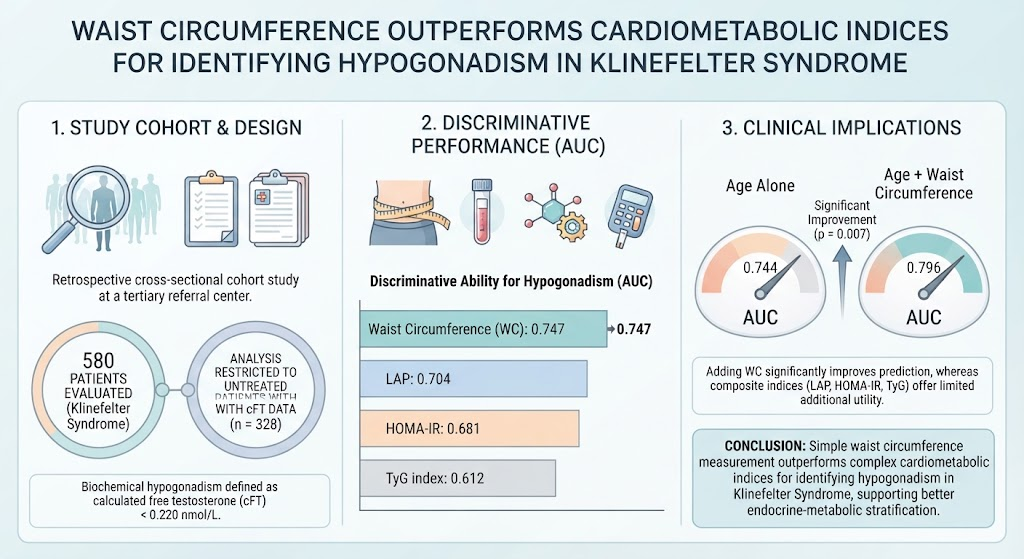
This was a retrospective cross-sectional cohort study conducted at a tertiary referral center, involving 580 men with genetically confirmed KS. Among these, 328 untreated patients had available data on calculated free testosterone (cFT), which was used as a biochemical marker for androgen status.
Biochemical hypogonadism was defined by cFT levels below 0.220 nmol/L, a threshold clinically indicative of low bioavailable testosterone. The study assessed the discriminative performance of WC and established cardiometabolic indices—LAP, TyG, and HOMA-IR—using logistic regression, receiver operating characteristic (ROC) curve analysis, reclassification statistics, and decision curve analysis (DCA), with bootstrap validation to confirm the robustness of findings.
Key Results
Among the untreated cohort, 64.9% were identified with biochemical hypogonadism. Waist circumference exhibited the highest capability to discriminate hypogonadal status with an area under the ROC curve (AUC) of 0.747. This performance surpassed that of LAP (AUC 0.704), HOMA-IR (AUC 0.681), and TyG index (AUC 0.612).
Multivariable logistic regression controlling for age confirmed WC as an independent predictor of hypogonadism (odds ratio 1.05 per centimeter increase in WC, p < 0.001). Age alone had an AUC of 0.744, which significantly improved to 0.796 with the addition of WC (p = 0.007), while the addition of LAP yielded only modest improvement to 0.758.
Importantly, adding WC to age enhanced patient reclassification capacity, indicating better clinical distinction between hypogonadal and eugonadal men. Decision curve analysis further validated that integrating WC into clinical assessment consistently increased net clinical benefit, whereas cardiometabolic indices offered limited supplementary utility in this context.
Clinical Implications
These findings emphasize the value of waist circumference—a simple, non-invasive, and routinely available anthropometric measurement—in the clinical evaluation of men with KS at risk for hypogonadism. Since WC correlates with central adiposity, an important factor in metabolic health and hormonal milieu, it may reflect underlying pathophysiological mechanisms linking adiposity with gonadal function.
The superiority of WC over complex cardiometabolic indices supports its use as a first-line screening tool within endocrinology and internal medicine practices. This can guide timely testosterone testing and intervention, potentially optimizing androgen replacement therapy decisions and metabolic risk management.
Background Context
Klinefelter Syndrome occurs in approximately 1 in 600 live male births and is often underdiagnosed. Men with KS typically present with tall stature, gynecomastia, small testes, and infertility. Hypogonadism leads to reduced muscle mass, decreased bone density, fatigue, and adverse psychological effects.
Cardiometabolic disturbances are increasingly recognized in KS and may be partly driven by hypogonadism-induced metabolic changes. Traditional indices like HOMA-IR and TyG aim to estimate insulin resistance and lipid-glucose interplay but may struggle to capture hypogonadism-specific nuances.
Additional Considerations and Future Directions
While this study robustly demonstrates the incremental diagnostic benefit of WC over cardiometabolic indices, it did not directly assess how incorporating WC measurement impacts long-term clinical outcomes such as cardiovascular events or quality of life. Prospective studies should explore whether early hypogonadism detection guided by WC measurement facilitates improved therapeutic outcomes.
Moreover, as testosterone replacement remains the cornerstone for managing hypogonadism in KS, understanding the interplay between adiposity, insulin resistance, and hormone therapy could refine personalized treatment. Investigating the role of lifestyle interventions targeting central obesity alongside hormonal therapy could further enhance care.
Conclusion
In men with Klinefelter Syndrome, waist circumference offers a practical and superior tool to cardiometabolic indices for discerning biochemical hypogonadism, adding value beyond patient age. Given its ease of use and predictive strength, WC measurement should be integrated into routine clinical workups to better stratify endocrine-metabolic risk, facilitating earlier diagnosis and tailored management of hypogonadism in this vulnerable population.
Reference
Graziani A, Nardin M, Grande G, Pollis RM, Delbarba A, Di Mambro A, Selice R, Cappelli C, Fadini GP, Ferlin A. Waist circumference outperforms cardiometabolic indices for identifying hypogonadism in Klinefelter Syndrome. J Clin Endocrinol Metab. 2026 Oct 15:dgag426. doi: 10.1210/clinem/dgag426. Epub ahead of print. PMID: 42875728.