We use cookies

Our website uses essential cookies and, with your consent, additional cookies to measure performance and improve our services. Cookie Policy.

You can change your choice at any time.

MMedXYNews
HomeVideos
MedXY AI/MedXY News/Section: Diabetes & Endocrinology

Unveiling Neuroimaging Patterns and Genotype-Phenotype Links in Noonan Syndrome: Insights from a Multicenter Cohort
MedXY Editorial Team•Aug 28, 2026•Diabetes & Endocrinology
Brain MRIRAS/MAPK pathwayゲノタイプ-フェノタイプ相関NeuroimagingNoonan Syndrome

Highlight

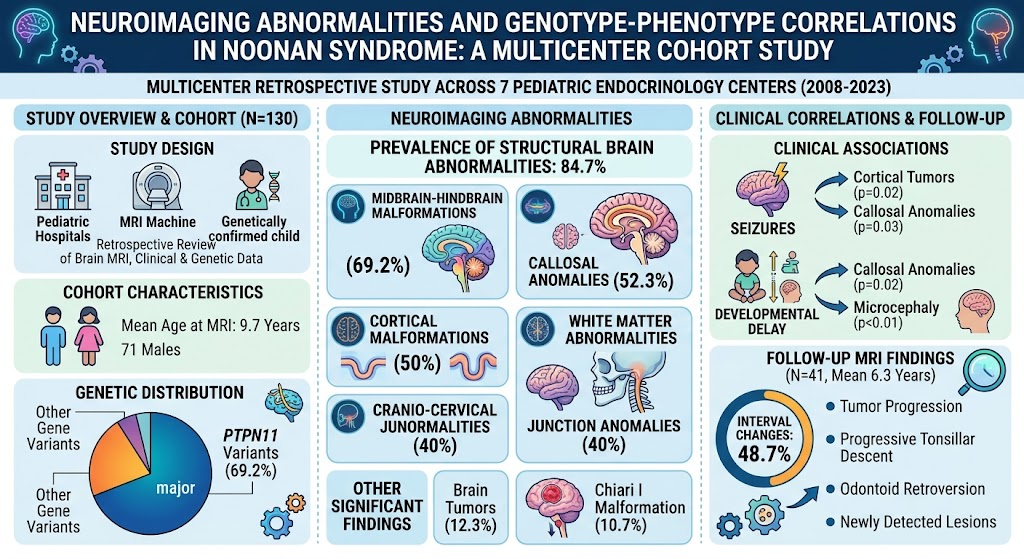
  • Structural brain abnormalities were identified in 84.7% of children with genetically confirmed Noonan syndrome (NS), predominantly midbrain-hindbrain malformations, corpus callosum anomalies, and cortical malformations.
  • Neuroimaging findings showed significant genotype-phenotype correlations, especially with PTPN11 variants, which comprised the majority of cases.
  • Neurological manifestations such as seizures and developmental delay were strongly associated with specific brain abnormalities including cortical tumors, callosal anomalies, and microcephaly.
  • Longitudinal MRI revealed progressive changes in brain lesions and cranio-cervical anomalies, emphasizing the need for ongoing neuroimaging surveillance in selected patients.

Study Background

MedXY registered readers

Sign in free to continue reading

Create or use your MedXY account to unlock the complete article.

This article was created using several editorial tools, including AI, as part of the process. Human editors reviewed this content before publication.

Related articles

Open language-specific specialty feeds and department pages.

Arterial Spin Labeling Hemodynamic Metrics Predict Cognitive Decline and Small Vessel Disease Progression Over 11 YearsThis study demonstrates that arterial spin labeling spatial coefficient of variation (ASL-sCoV) correlates with cerebral small vessel disease burden and predicts cognitive decline over 11 years, outperforming traditional cerebral blood flowSep 19, 2026CSF Biomarkers as Indicators of Disease Severity in Probable Cerebral Amyloid Angiopathy: Insights Beyond MRIThis study demonstrates that cerebrospinal fluid beta-amyloid peptides correlate with MRI markers of disease severity in probable cerebral amyloid angiopathy, suggesting CSF biomarkers provide a direct measure of vascular amyloid burden, inSep 6, 2026Mapping Cognitive Load in Novice Surgeons: Insights Into Brain Activation and Performance Under StressThis study elucidates how escalating cognitive workload affects brain activation in novice surgical residents, revealing distinct neural patterns linked to performance resilience or decline during simulated suturing tasks.Aug 25, 2026
Loading comments...
MedXY briefing

Get the free newsletter

Evidence-led clinical news, trends, and analysis—delivered to your inbox.

Ask MedXY AI

Most popular

Intimate Health
Five Benefits for Women Continuing Sexual Activity After Menopause
Intimate Health
Why Some Women Have a Strong Sex Drive—And Why Men Shouldn't Worry About It
Nursing & care
How often should a couple have sex?
Intimate Health
Classic Intimacy Recommendations: How to Help Women Reach Orgasm and Enjoy Mutual Pleasure
Intimate Health
What Makes a Woman "Physiologically Addicted" Is Never Money, But These Two Relationship Qualities
© 2026 MedXY
Contact usAbout usPrivacy PolicyMedXY story
Rigosertib: A Promising Therapeutic Agent for Reversing Hypertrophic Cardiomyopathy in Noonan Syndrome
Rigosertib demonstrates significant reversal of hypertrophic cardiomyopathy and other syndromic features in Noonan syndrome models, highlighting its potential as a targeted therapy for RASopathy-associated cardiac and developmental abnormal
Aug 19, 2026
Plasma Biomarkers for Neocortical Tau BurdenA multiprotein plasma panel improves detection of advanced neocortical tau pathology in Alzheimer’s disease risk individuals beyond p-tau217 alone, enhancing patient stratification and clinical trial selection.Aug 15, 2026
Connectivity- vs Scalp-Based Targeting of Accelerated Transcranial Magnetic Stimulation for Depression: A Randomized Clinical TrialThis randomized trial compared connectivity-based versus scalp-based targeting of accelerated TMS in treatment-resistant depression, showing greater antidepressant effects with individualized connectivity-guided targeting.Aug 10, 2026