Systemic Interleukin-6 Inhibition as a Novel Approach to Reduce Diabetic Retinopathy Risk and Progression
Highlight
Systemic inhibition of interleukin-6 (IL-6) correlates with a significant reduction in the incidence and progression of diabetic retinopathy (DR) over five years. Patients receiving IL-6 inhibitors have lower risks of nonproliferative diabetic retinopathy (NPDR), proliferative diabetic retinopathy (PDR), diabetic macular edema (DME), vitreous hemorrhage, and necessity for retinal interventions such as anti-VEGF injections, panretinal photocoagulation, and pars plana vitrectomy. These findings were consistent when compared to both diabetic controls and alternative immunosuppressants.
Study Background
Diabetic retinopathy remains a leading cause of vision impairment among adults with diabetes, representing a considerable clinical and socioeconomic burden. Existing therapies, including intravitreal anti-vascular endothelial growth factor (anti-VEGF) agents and laser photocoagulation, primarily target late-stage disease manifestations. Inflammation, particularly mediated by cytokines like interleukin-6 (IL-6), plays a recognized role in the pathogenesis and progression of diabetic retinal damage. However, the therapeutic potential of systemic IL-6 inhibition in modifying the course of diabetic retinopathy remains underexplored.
Study Design
This study utilized a retrospective propensity score-matched cohort design leveraging the US TriNetX electronic health records network, covering patients from January 1, 2004, to May 30, 2026. Adults with type 1 or type 2 diabetes who received systemic IL-6 inhibitors were matched 1:1 with diabetic controls on demographic, clinical, medication, inflammatory disease burden, and ophthalmic history parameters. The primary analysis assessed incident DR among patients without baseline retinopathy (n=2,605 per group). Secondary analyses focused on patients with known NPDR at baseline (n=1,057 per group), evaluating progression to PDR and comparing IL-6 inhibitors with alternative immunosuppressants. Sensitivity analyses included comparisons with intravitreal steroids and frequency-dependent effects of IL-6 inhibition. The main outcomes were risk ratios (RR) for incident or progressive retinal disease, vision-threatening complications, and retinal treatments at 1, 3, and 5 years.
Key Findings
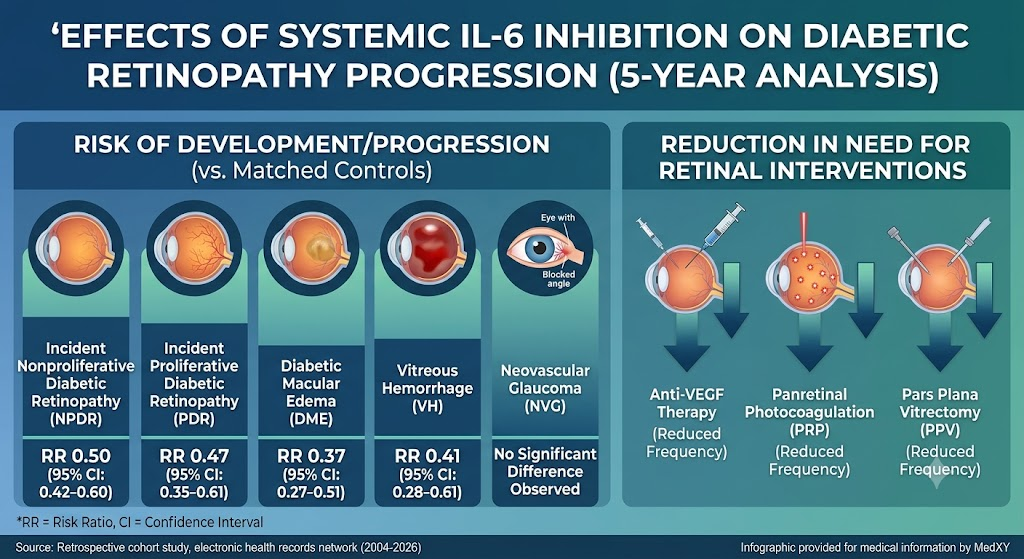
The primary analysis demonstrated that systemic IL-6 inhibitor use was associated with markedly reduced 5-year risks of multiple diabetic retinopathy outcomes compared with matched controls:
Incident nonproliferative diabetic retinopathy (NPDR): RR 0.50 (95% CI: 0.42-0.60)
Incident proliferative diabetic retinopathy (PDR): RR 0.47 (95% CI: 0.35-0.61)
Diabetic macular edema (DME): RR 0.37 (95% CI: 0.27-0.51)
Vitreous hemorrhage (VH): RR 0.41 (95% CI: 0.28-0.61)
No significant difference in neovascular glaucoma (NVG) incidence was observed.
Retinal interventions also occurred less frequently among IL-6 inhibitor users at 5 years:
Anti-VEGF therapy
Panretinal photocoagulation (PRP)
Pars plana vitrectomy (PPV)
Among patients with baseline NPDR, IL-6 inhibitor use was associated with reduced 5-year risk of progression to PDR and lower rates of vision-threatening complications and retinal procedures. These associations persisted in analyses using active comparators (alternative immunosuppressants) and sensitivity analyses comparing IL-6 inhibitors to intravitreal steroids in severe NPDR or PDR.
Notably, a dose-response relationship was suggested with increased frequency of IL-6 inhibitor administration correlating with stronger protective effects. Safety outcomes were not detailed in the summary but should be evaluated in prospective trials.
Expert Commentary
The findings support a biologically plausible role for systemic IL-6 inhibition in attenuating the inflammatory milieu that contributes to diabetic retinal microvascular damage. Given IL-6’s capacity to promote vascular permeability, leukostasis, and neovascularization—key pathological features in DR—the observed reduction in DR incidence and progression aligns with mechanistic expectations. This expands the therapeutic landscape beyond local ocular treatments to potentially systemic immunomodulation.
However, several limitations warrant consideration. The retrospective design and reliance on electronic health records may introduce confounders despite propensity score matching. The precise duration, dosage, and adherence to IL-6 inhibitor therapy were not fully characterized, and potential adverse effects of systemic immunosuppression require safety validation. Moreover, retinal imaging and grading details were not available, restricting detailed phenotypic correlation. Generalizability may be limited to diabetic patients with indications for IL-6 inhibitor use, often due to concurrent inflammatory diseases, which may also influence DR risk.
Current guidelines for diabetic retinopathy management do not incorporate systemic immunomodulatory approaches, underscoring the novelty and potential impact of these findings. Prospective randomized controlled trials are essential to establish causality, define optimal treatment protocols, and evaluate long-term safety.
Conclusion
This real-world evidence study demonstrated that systemic IL-6 inhibitor therapy is associated with a significant reduction in the risk of incident diabetic retinopathy, progression to proliferative disease, vision-threatening complications, and retinal interventions over a 5-year period. These data highlight the IL-6 pathway as a promising therapeutic target in diabetic eye disease and provide impetus for prospective clinical trials. Integrating systemic immunomodulatory strategies may complement existing local therapies to better preserve vision in diabetic patients.
Funding and Clinical Trials Registration
Details on funding sources and clinical trial registration were not provided in the abstract and should be referenced from the full publication.
References
Abdi A, Alshaikhsalama A, Zaidi Z, et al. Systemic Interleukin-6 Inhibition and Risk of Diabetic Retinopathy Development and Progression. Ophthalmology. 2026 Aug 3; doi:10.1016/j.ophtha.2026.07.015. PMID: 42546975.
Cheung N, Mitchell P, Wong TY. Diabetic retinopathy. Lancet. 2010 Jul 10;376(9735):124-36. doi:10.1016/S0140-6736(09)62124-3.
Joussen AM, Poulaki V, Le ML, et al. A central role for inflammation in the pathogenesis of diabetic retinopathy. FASEB J. 2004 Jun;18(12):1450-2.
Ghasemi H, Ghiasi SM, Aslani M, Ebrahimi SM. Interleukin-6 and diabetic retinopathy: A potential role. Diabetes Metab Syndr. 2019 Nov-Dec;13(6):2563-2570.
This article was created using several editorial tools, including AI, as part of the process. Human editors reviewed this content before publication.