Subtype-Specific Enteric Neuronal Activation in IBS: Linking Faecal Proteases and Immune Signatures
Highlight
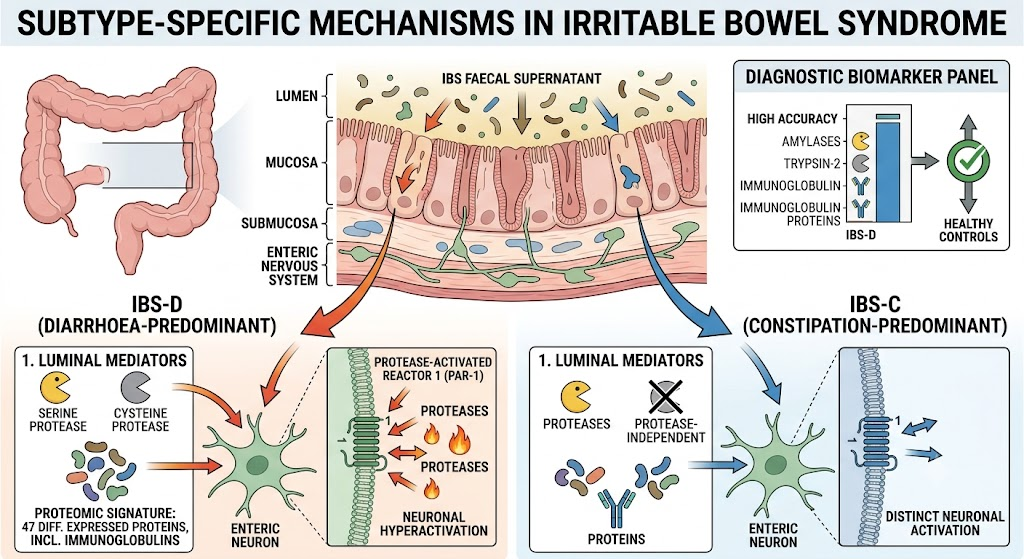
Faecal supernatants from IBS-D and IBS-C patients induce distinct activation in enteric neurons compared to healthy controls.
IBS-D neuronal activation is mediated by serine and cysteine proteases through the protease-activated receptor 1 (PAR-1) pathway, unlike IBS-C.
Proteomic analysis identifies 47 proteins, including immunoglobulin components, differentially expressed in IBS-D versus controls, indicating microinflammation involvement.
A biomarker panel combining amylases, trypsin-2, and immunoglobulin proteins discriminates IBS-D from healthy controls with high diagnostic accuracy.
Study Background
Irritable bowel syndrome (IBS) is a prevalent functional gastrointestinal disorder characterized by chronic abdominal pain and altered bowel habits, classified into subtypes such as diarrhoea-predominant (IBS-D) and constipation-predominant (IBS-C). The pathophysiology of IBS is multifactorial, involving gut motility disturbances, visceral hypersensitivity, immune activation, epithelial barrier dysfunction, and alterations in the enteric nervous system (ENS). Luminal proteases have recently garnered interest for their role in modulating epithelial integrity and visceral sensitivity, but their direct interaction with the ENS remains incompletely understood. The ENS, as the intrinsic nervous system of the gut, orchestrates gastrointestinal motility and secretory functions. Understanding how different faecal luminal factors affect enteric neuronal activity may provide subtype-specific mechanistic insights and identify novel targets for therapy and diagnosis.
Study Design
This cross-sectional study examined faecal supernatants (FSN) from 21 IBS-D, 9 IBS-C, and 18 healthy control (HC) individuals recruited from multiple centres in three countries. The primary investigation involved assessing the impact of FSN on enteric neurons isolated from the guinea pig distal colon submucous plexus using advanced neuroimaging techniques to measure neuronal activation. Subsequent molecular analyses measured faecal proteolytic activities focusing on serine and cysteine proteases and employed proteomics to profile the faecal protein content, emphasizing proteins related to immune function. The study design integrated functional neuronal response assays with biochemical and proteomic assessments to delineate biological differences among IBS subtypes and controls.
Key Findings
The study found that faecal supernatants from IBS patients induced significantly greater activation of enteric neurons compared to healthy controls, confirming that luminal mediators directly modulate ENS function. This neuronal activation was significantly more prominent in IBS-D samples than in IBS-C and HC samples.
Crucially, the neuronal effects of IBS-D samples were mediated by serine and cysteine proteases acting through the protease-activated receptor 1 (PAR-1). Pharmacologic inhibition of these proteolytic enzymes or blockade of PAR-1 significantly attenuated neuronal activation by IBS-D FSN, whereas IBS-C neuronal activation appeared to be independent of this pathway, implying distinct pathogenic mechanisms across IBS subtypes.
Proteomic analysis underscored these mechanistic differences by identifying 47 differentially abundant proteins in IBS-D compared to HC FSN. Many of these proteins were immunoglobulin components, supporting a role for low-grade intestinal immune activation or microinflammation in IBS-D pathogenesis.
Furthermore, a biomarker panel comprising amylases, trypsin-2, and specific immunoglobulin proteins demonstrated high sensitivity and specificity in differentiating IBS-D from healthy controls. This panel holds potential as a non-invasive diagnostic tool, particularly for IBS-D, aiding in subtype classification and personalized treatment strategies.
Expert Commentary
This investigation contributes critical mechanistic insights into the luminal-ENS axis in IBS, highlighting the heterogeneity of the disorder. The confirmation that proteases and PAR-1 signaling contribute specifically to neuronal activation in IBS-D aligns with emerging paradigms linking protease dysregulation to sensitization of sensory and enteric neurons.
Conversely, the findings that IBS-C effects do not involve serine/cysteine proteases or PAR-1 suggest alternative mediators warranting further study. The distinct faecal proteomic signature corroborates clinical observations of immune involvement in IBS-D, which may implicate mucosal immune cells and barrier dysfunction as upstream factors.
Limitations include the small sample size for IBS-C patients, which may affect generalizability. Additionally, using guinea pig ENS models, while informative, may not fully recapitulate human ENS complexity.
Overall, this study advocates for tailored therapeutic approaches targeting protease activity and immune modulation in IBS-D, distinct from strategies needed for IBS-C. It also sets the stage for biomarker-based, subtype-specific diagnostic frameworks.
Conclusion
This study elucidates a previously unrecognized luminal-ENS interaction in IBS, revealing that faecal proteases and immune protein signatures distinctly activate enteric neurons according to IBS subtype. IBS-D is characterized by protease-dependent neuronal activation mediated by PAR-1 and an immune-enriched faecal proteome, whereas IBS-C involves protease-independent mechanisms. These findings have significant translational implications, supporting protease inhibition and immune-targeted therapies in IBS-D and advancing biomarker-driven personalized diagnostics. Further studies should focus on validating these biomarkers in larger cohorts and exploring mechanistic pathways in IBS-C to optimize management strategies.
Funding and ClinicalTrials.gov
The original study did not specify funding sources or clinical trial registration details. Future work should ensure transparency regarding support and registration.
References
1. Ridžal L, Frieling T, Róka R, et al. Faecal proteases and immune signatures drive subtype-specific enteric neuronal activation in IBS. Gut. 2026 Aug 4. PMID: 42552107.
2. Camilleri M, et al. Irritable bowel syndrome: diagnosis and clinical management. Gut. 2021;70(5):965-978.
3. Barbara G, et al. The immune system in irritable bowel syndrome. J Neurogastroenterol Motil. 2020;26(2):142-160.
4. Cenac N, et al. Protease-activated receptor-2 induces visceral pain in irritable bowel syndrome. Gastroenterology. 2007;132(6):2049-2061.
This article highlights the altering landscape of IBS pathophysiology, emphasizing the need for subtype-specific diagnostics and therapies based on luminal-ENS interactions mediated by proteases and immune factors.
This article was created using several editorial tools, including AI, as part of the process. Human editors reviewed this content before publication.