Highlights
Days at Home within 90 days post-surgery (DAH-90) integrates mortality, complications, and institutional care, reflecting holistic patient recovery after gastrointestinal (GI) cancer surgery.
DAH-90 varies by cancer site, histology, procedure type, and patient factors such as frailty and surgical approach, correlating inversely with major morbidity and 1-year mortality.
Virtual multimodal prehabilitation approaches demonstrate feasibility and potential to improve postoperative DAH and quality of life in GI cancer patients.
Physical activity monitoring complements DAH as an objective, responsive patient-centered outcome, correlating with functional status and quality of life in oncology care.
Background
Surgical resection remains a cornerstone for curative intent in gastrointestinal (GI) cancers, including esophageal, gastric, colorectal, small bowel, and pancreatic malignancies. Despite advances, postoperative morbidity and mortality remain significant, influencing recovery and long-term outcomes. Traditional postoperative metrics such as complication rates, length of hospital stay, readmission, and mortality do not fully capture patient experience or the multifaceted trajectory of recovery. There is growing emphasis on patient-centered outcomes that reflect meaningful functional status, healthcare utilization, and survival collectively.
Days at Home (DAH) has emerged as a patient-centered metric that quantifies the number of days a patient is alive and out of acute care and other institutional settings within a defined postoperative window, integrating survival, complications, and healthcare resource use. This comprehensive measure aligns with patient priorities of returning home and resuming normal life. The optimal postoperative observation window for assessing DAH and its validity across GI cancer surgeries, however, requires rigorous evaluation.
Key Content
Validation and Characterization of Days at Home (DAH) After GI Cancer Surgery
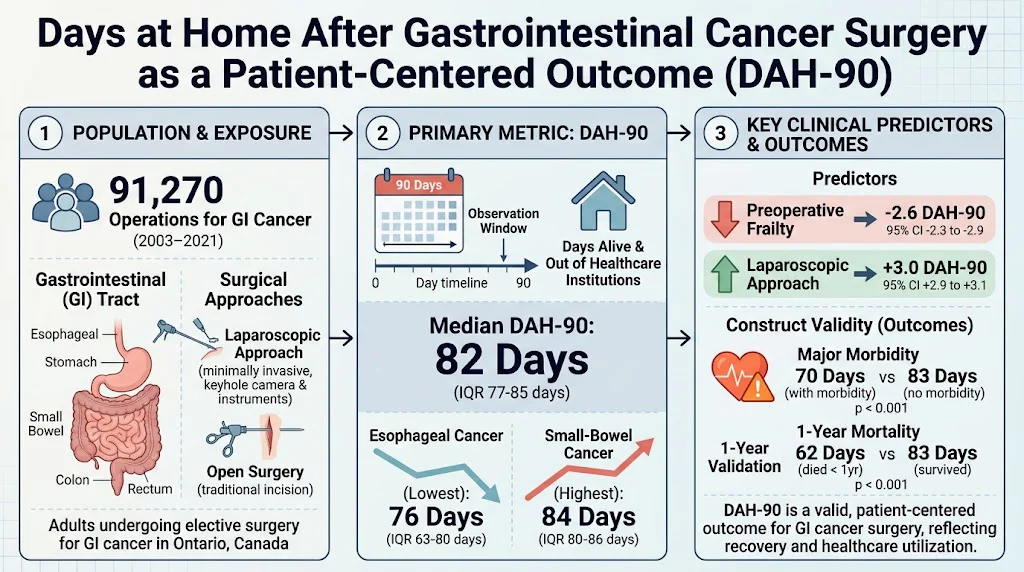
The landmark population-based retrospective cohort study by Ribeiro et al. (2026) analyzed 91,270 elective GI cancer surgeries in Ontario, Canada, over 18 years to evaluate DAH at 30, 90, 180, and 365 days postoperatively and validate it as a patient-centered outcome.
The study excluded emergency surgeries, long-term care residents, and patients with other cancer diagnoses within 2 years, focusing on elective resection. DAH was defined strictly as days alive and spent outside healthcare institutions, with any death within the observation window assigned DAH = 0.
Comparing DAH timepoints, DAH-90 was identified as the optimal postoperative window, balancing sensitivity to early complications and meaningful observation of recovery trajectories. Median DAH-90 was 82 days (IQR 77–85), with notable variation by cancer site: lowest in esophageal cancer (76 days [63–80]) and highest in small-bowel cancer (84 days [80–86]).
Multivariable quantile regression revealed key predictors impacting DAH-90. Preoperative frailty was associated with 2.6 fewer DAH-90 (95% CI: 2.3–2.9), indicating vulnerability adversely affects postoperative recovery. Conversely, laparoscopic surgical approaches conferred 3.0 more DAH-90 (95% CI: 2.9–3.1), highlighting minimally invasive surgery’s benefit in reducing recovery burden.
Importantly, patients experiencing major postoperative morbidity had markedly reduced DAH-90 (median 70 vs 83 days; P3). Similarly, 1-year mortality correlated with significantly lower DAH-90, affirming criterion validity of the metric.
Virtual Multimodal (P)rehabilitation and Impact on DAH
Complementing DAH as a recovery outcome, the PRIORITY-CONNECT 2 Pilot RCT (2026) tested the feasibility and acceptability of a virtual, multidisciplinary prehabilitation and rehabilitation program for adults undergoing GI cancer surgery. The program spanned up to 6 weeks preoperatively and 3 months postoperatively, delivering tailored physical, psychological, nutritional, and social support via telehealth.
Despite small sample size, the pilot demonstrated high uptake (65%), retention (95%), and adherence (74%), with 78% patient satisfaction. Secondary outcomes suggested potential to reduce postoperative complications and enhance days at home within 30 and 90 days, warranting definitive RCTs. Such interventions may augment patient-centered recovery metrics including DAH.
Physical Activity Monitoring as a Complementary Patient-Centered Outcome
Prior to DAH validation, objective physical activity (PA) monitoring using wearable devices has shown promise as a responsive, meaningful patient-centered outcome in oncology. A 2012 study (Brown et al.) monitored daily PA in 162 cancer patients, including those with resectable GI malignancies, correlating PA metrics with functional status scores and quality of life instruments.
Findings illustrated PA declines with advanced disease and treatment phases, mirroring fatigue and physical impairment. PA measurements significantly correlated with physical and role functioning subscales, positioning PA monitoring as a surrogate for patient well-being and potential complement to DAH in comprehensive recovery assessment.
Expert Commentary
The integration of DAH-90 into clinical practice offers a transformative patient-centered metric that encapsulates the complex interplay of survival, morbidity, and healthcare utilization post-GI cancer surgery. Unlike isolated traditional measures such as length of stay or complication rates, DAH explicitly values time spent alive and at home, resonating with patient priorities.
The robust population-level study by Ribeiro et al. provides compelling evidence supporting DAH-90’s construct and criterion validity across heterogeneous GI cancer subtypes and procedures. Its associations with frailty and minimally invasive surgery underscore targets for risk stratification and quality improvement.
However, limitations include reliance on administrative data lacking granular patient-reported outcomes and functional assessments. Additionally, the complexity of care settings and regional healthcare system differences may affect DAH applicability globally. Future studies should integrate DAH with PROMs and detailed recovery trajectories for holistic insight.
Complementary interventions such as virtual multimodal (p)rehabilitation may improve DAH through multidisciplinary support, enhance postoperative functional recovery, and reduce institutional healthcare reliance. The promising pilot data await confirmatory trials with DAH as a key outcome.
Physical activity monitoring represents an objective, ecologically valid adjunct outcome, capable of capturing daily functional status postoperatively and during systemic therapies. The convergence of DAH with PA metrics could define multidimensional recovery benchmarks in GI oncology.
In clinical counseling, DAH-90 offers an accessible, interpretable metric for shared decision-making on surgical risks and expectations. For quality assessment and research, DAH-90 facilitates benchmarking and comparative effectiveness evaluations, advancing patient-centered care paradigms.
Conclusion
Days at Home within 90 days post-GI cancer surgery (DAH-90) emerges as a valid, meaningful patient-centered outcome that encompasses survival, complications, and healthcare use. Its sensitivity to clinical, procedural, and patient factors validates its utility for postoperative counseling and quality measurement.
Future research should focus on prospective evaluation of DAH in diverse healthcare settings, its integration with patient-reported outcomes and physical activity metrics, and assessment of interventions such as multimodal prehabilitation to improve recovery trajectories. Such efforts will refine patient-centered perioperative care and optimize functional recovery after gastrointestinal cancer surgery.
References
Ribeiro T, Bondzi-Simpson A, Chan WC, Mahar A, Jerath A, Coburn N, Hallet J. Days at Home After Gastrointestinal Cancer Surgery as a Patient-Centered Outcome. JAMA Surg. 2026 Oct 21; PMID: 42905729. https://pubmed.ncbi.nlm.nih.gov/42905729/
Ribeiro T, Bondzi-Simpson A, Chan WC, et al. Population-based evaluation of patient-centered outcome “days at home” after gastrointestinal cancer surgery. Ann Surg Oncol. 2026 Jun;33(6):5739-5750. doi: 10.1245/s10434-026-19355-0. PMID: 41832362.
Brown JC, Hagerty DL, Butow PN, et al. Physical activity monitoring: a responsive and meaningful patient-centered outcome for surgery, chemotherapy, or radiotherapy? J Pain Symptom Manage. 2012 Jun;43(6):1025-35. doi: 10.1016/j.jpainsymman.2011.06.013. PMID: 22269181.