Highlight
Current guideline-recommended pediatric CPR ventilation rates (20-30 bpm) were not associated with improved survival to hospital discharge in children with in-hospital cardiac arrest.
Exploratory analysis identifies age-specific ventilation rate thresholds, with higher rates (≥26 bpm) linked to improved survival in children younger than 8 years.
Findings suggest consideration of tailored ventilation strategies during CPR in pediatric patients, emphasizing the need for future confirmatory studies.
Study Background
Cardiopulmonary resuscitation (CPR) is a critical intervention in pediatric cardiac arrest to sustain blood flow and oxygenation until return of spontaneous circulation. Ventilation rate during CPR is a key modifiable parameter, with current pediatric resuscitation guidelines recommending ventilation rates between 20 and 30 breaths per minute (bpm). However, evidence supporting this range remains limited and largely extrapolated from adult data or animal models. Given the physiological differences among children of varying ages, optimal ventilation strategies may differ, yet data informing age-specific targets are scarce.
In-hospital pediatric cardiac arrests, although relatively rare compared with adults, carry significant morbidity and mortality. Determining ventilation strategies that maximize survival while minimizing injury is a priority for pediatric critical care providers. This study investigates whether adherence to guideline ventilation rates is associated with survival to hospital discharge and explores novel ventilation targets stratified by age.
Study Design
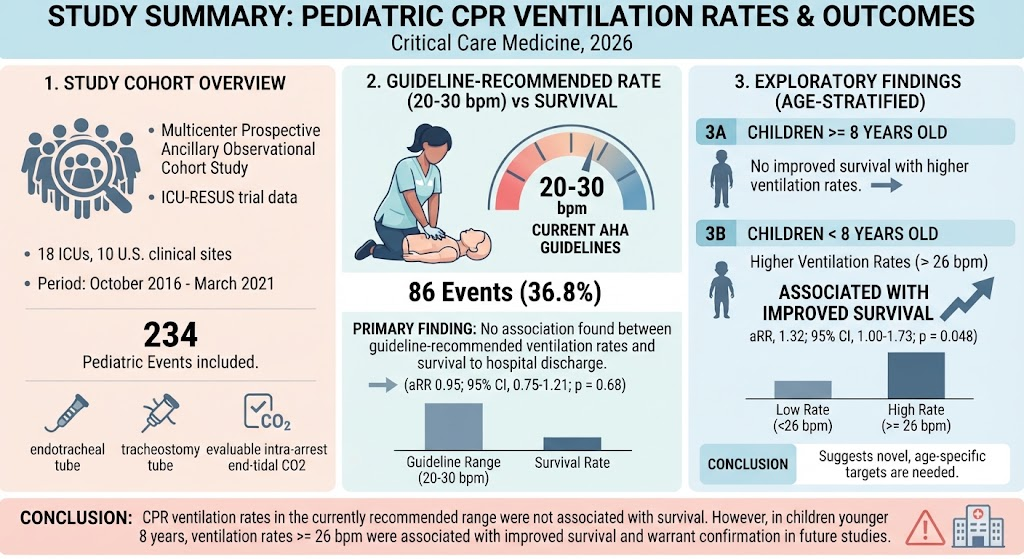
This ancillary observational cohort study was nested within the ICU-RESUS trial (ClinicalTrials.gov identifier: NCT02837497), conducted prospectively across 18 intensive care units (ICUs) within 10 U.S. clinical sites between October 2016 and March 2021.
The cohort includes 234 hospitalized children aged 18 years or younger who experienced in-hospital cardiac arrest and were intubated with endotracheal or tracheostomy tubes. A key inclusion criterion was the availability of evaluable intra-arrest end-tidal carbon dioxide (EtCO2) data, which allowed accurate calculation of ventilation rates during CPR.
No interventions were applied specifically for ventilation; thus, the study is observational. The primary outcome was survival to hospital discharge.
Statistical analysis incorporated Poisson regression models using generalized estimating equations controlling for prespecified confounders, including initial pulse status and immediate cause of arrest. Exploratory analyses applied natural cubic splines to identify potential age-specific ventilation rate thresholds associated with outcomes.
Key Findings
Among the 234 cardiac arrest events, 86 (36.8%) recorded guideline-recommended ventilation rates (20-30 bpm) during CPR.
The main analysis demonstrated no statistically significant association between ventilation within the guideline-recommended range and survival to hospital discharge (adjusted relative risk [aRR] 0.95; 95% confidence interval [CI], 0.75-1.21; p=0.68).
Notably, the exploratory age-stratified analysis revealed differential effects: for children younger than 8 years, an average ventilation rate ≥ 26 bpm was significantly associated with improved survival (aRR 1.32; 95% CI, 1.00-1.73; p=0.048) compared to lower rates. In contrast, for children aged 8 years and older, ventilation rates < 26 bpm showed no detrimental effect but no survival benefit was clearly identified.
This nuanced finding suggests that younger pediatric patients might benefit from ventilation rates at or above the higher end of the guideline spectrum, whereas older children may not require the same elevated ventilation frequency during CPR.
Expert Commentary
These results challenge the uniform adoption of guideline-specified ventilation rates for pediatric CPR by uncovering potential age-specific differences in optimal ventilation frequency. The thresholds identified in this study underscore the need to tailor resuscitation protocols more precisely to physiological developmental stages.
Mechanistically, younger children have higher baseline metabolic rates and respiratory demands, potentially explaining the benefit of higher ventilation rates during arrest. However, ventilation must be balanced to avoid adverse effects, such as increased intrathoracic pressure reducing venous return and cardiac output.
Limitations include the observational design, potential confounding factors despite statistical adjustments, and the exploratory nature of age-stratified analyses, which require prospective verification. Additionally, the study population was limited to intubated children in intensive care settings, possibly limiting generalizability to emergency department or prehospital scenarios.
Comparatively, adult CPR ventilation recommendations differ substantially, further supporting pediatric-specific research. Previous studies have also shown variable associations between ventilation and outcomes, highlighting the complexity of pediatric resuscitation physiology.
Conclusion
This multicenter study provides important insights into ventilation practices during pediatric in-hospital cardiac arrest. Guideline-recommended ventilation rates (20-30 bpm) as a broad target do not appear to influence survival to discharge uniformly across all pediatric age groups.
However, exploratory data indicate that in children under 8 years old, ventilation rates at or exceeding 26 breaths per minute may enhance survival outcomes. These findings advocate for reconsideration of age-dependent ventilation strategies in pediatric CPR protocols.
Future research should aim to confirm these thresholds prospectively and examine the physiological mechanisms underlying age-specific ventilation requirements. Refining guidelines with an evidence-based approach to ventilation rates may ultimately improve pediatric resuscitation outcomes.
Funding and ClinicalTrials.gov Information
This study was conducted under the ICU-RESUS trial funded by the Eunice Kennedy Shriver National Institute of Child Health and Human Development Collaborative Pediatric Critical Care Research Network (CPCCRN). ClinicalTrials.gov registration number: NCT02837497.
References
1. Shepard LN, Friess SH, Reeder RW, et al. Pediatric Cardiopulmonary Resuscitation Ventilation Rates and Outcomes. Crit Care Med. 2026 Oct 14. PMID: 42872941.
2. American Heart Association Guidelines for Cardiopulmonary Resuscitation and Emergency Cardiovascular Care. Circulation. 2020;142(16_suppl_2):S469-S523.
3. Berg RA, Nadkarni VM, Zuercher M, et al. Pediatric Advanced Life Support: 2015 American Heart Association Guidelines Update for Cardiopulmonary Resuscitation and Emergency Cardiovascular Care. Pediatrics. 2015;136 Suppl 2:S150-S166.