Risk Factors and Management of Iatrogenic Hypercalcemia during Active Vitamin D Supplementation for Hypoparathyroidism Post-Total Thyroidectomy
Highlight
- Iatrogenic hypercalcemia affects 14% of patients treated for hypoparathyroidism after total thyroidectomy.
- Low early postoperative parathyroid hormone levels and earlier initiation of active vitamin D are significant risk factors.
- Hypercalcemia can be severe, with 25% of affected patients requiring rehospitalization.
- Standard preoperative measures and common hypocalcemia predictive scores do not reliably predict hypercalcemia risk.
Study Background and Disease Burden
Total thyroidectomy, a definitive surgical treatment for various thyroid pathologies, carries a substantial risk of postoperative hypoparathyroidism due to inadvertent damage or removal of parathyroid glands. This complication leads to hypocalcemia, manifesting clinically with neuromuscular irritability and potentially life-threatening symptoms if untreated. Postoperative hypoparathyroidism occurs in approximately 20% to 30% of patients, necessitating lifelong supplementation with calcium and active vitamin D analogues to maintain normocalcemia.
However, supplementation with active vitamin D derivatives, while essential for calcium homeostasis, carries the risk of iatrogenic hypercalcemia, a condition that can result in renal impairment, cardiac arrhythmias, neurological symptoms, and hospitalization. Despite its clinical importance, factors predicting which patients will develop hypercalcemia remain poorly defined, limiting targeted preventive strategies.
Study Design
This retrospective cohort study analyzed 198 patients treated at Lille University Hospital between 2018 and 2025 who underwent total thyroidectomy and subsequently developed postoperative hypoparathyroidism with hypocalcemia requiring supplementation. The patient cohort received standard supportive care including calcium, magnesium, and active vitamin D supplementation.
Patients were stratified into two groups based on the occurrence of iatrogenic hypercalcemia: those who developed hypercalcemia (n = 28) and those with uncomplicated supplementation (n = 170). Clinical data (age, sex, BMI), biochemical markers (pre- and postoperative calcium, phosphate, parathyroid hormone [PTH], 25-hydroxyvitamin D, thyroid-stimulating hormone), and timing and dosing of supplementation were compared. The primary endpoint was the incidence of hypercalcemia within the first postoperative month.
Key Findings
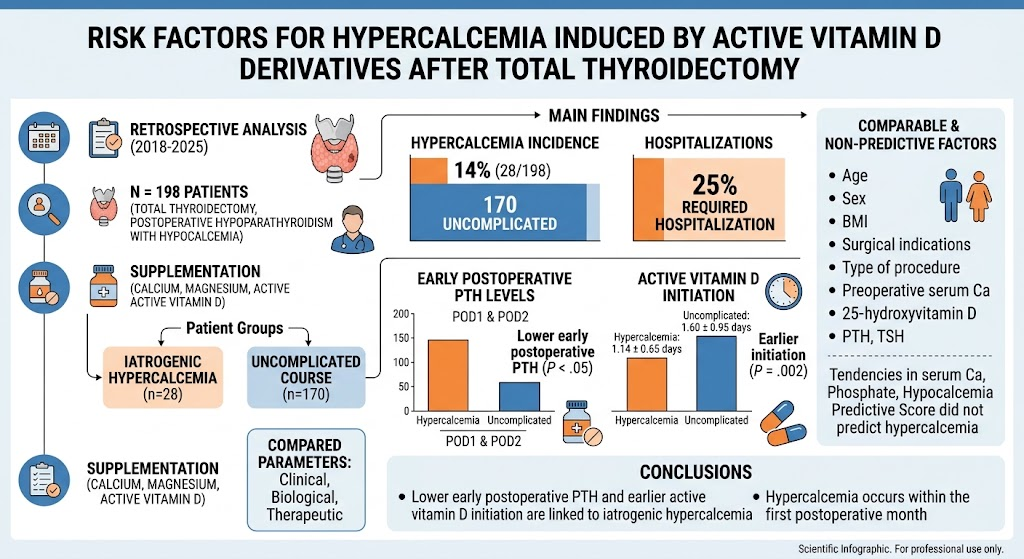
Iatrogenic hypercalcemia occurred in 14% (28/198) of the patients, consistently within the first postoperative month. Notably, 25% of these patients required rehospitalization due to the severity of hypercalcemia-related symptoms or complications.
The analysis revealed no statistically significant differences between the hypercalcemia and non-hypercalcemia groups in baseline demographics, surgical indications, type of thyroidectomy procedure, or preoperative serum levels of calcium, 25-hydroxyvitamin D, PTH, and thyroid-stimulating hormone. Importantly, commonly used preoperative predictive scores for hypocalcemia did not forecast hypercalcemia risk.
Conversely, patients who developed hypercalcemia had significantly lower early postoperative PTH levels on postoperative days 1 and 2 (P < .05). This low PTH appears counterintuitive but may indicate impaired endogenous parathyroid function necessitating higher or earlier doses of active vitamin D supplementation.
Consistent with this, the hypercalcemia group received active vitamin D earlier postoperatively (mean 1.14 ± 0.65 days) compared with the non-hypercalcemia group (mean 1.60 ± 0.95 days; P = .002). These findings suggest that earlier administration of active vitamin D is associated with a higher risk of overshoot calcium levels.
Serum calcium and phosphate trajectories postoperatively showed no predictive difference, underscoring the challenge of early identification based solely on biochemical trends.
Expert Commentary
These findings underscore the complexity in managing postoperative hypoparathyroidism following total thyroidectomy. The paradoxical association of low early postoperative PTH with hypercalcemia supports the notion that supplement dosing based on PTH alone may be insufficient or misleading in some patients. The timing of active vitamin D initiation appears crucial; premature or aggressive supplementation might excessively elevate calcium absorption and serum levels, precipitating hypercalcemia.
If confirmed by prospective studies, these observations warrant a reevaluation of postoperative protocols to include more individualized assessment combining PTH dynamics with careful stepwise titration of vitamin D supplementation.
Current guidelines recommend routine monitoring of calcium and PTH levels post-thyroidectomy but lack specific directives on timing or dosing strategies to mitigate hypercalcemia risk. Clinicians should maintain high vigilance during the early postoperative period, especially within the first month when iatrogenic hypercalcemia is most common.
A limitation of the study is its retrospective design and single-center setting, which may affect generalizability. Challenges remain in defining an ideal predictive model that integrates clinical and biochemical parameters for safer supplementation strategies.
Conclusion and Clinical Implications
Iatrogenic hypercalcemia is a significant complication affecting approximately one in seven patients undergoing supplementation for hypoparathyroidism after total thyroidectomy. Early postoperative low PTH levels and earlier initiation of active vitamin D supplementation are associated with increased risk.
This highlights the necessity for cautious, individualized dosing and rigorous monitoring of calcium and phosphate levels during the first postoperative weeks. Prospective studies are needed to develop and validate predictive tools and optimal supplementation algorithms to reduce hypercalcemia incidence and related morbidity.
Clinicians should balance the urgency to correct hypocalcemia against the potential harms of oversupplementation, tailoring care to patient-specific biochemical profiles and clinical status.
Funding and Disclosures
The study was conducted at Lille University Hospital with no specific funding reported. The authors disclose no conflicts of interest.
References
- Kuzmova M, Marciniak C, Gobert M, et al. Risk factors for hypercalcemia induced by active vitamin D derivatives during supplementation for post-total thyroidectomy hypoparathyroidism. Surgery. 2026 May 5;196:110300. doi:10.1016/j.surg.2026.110300. PMID: 42336710.
- Edafe O, Antakia R, Laskar N, Uttley L, Balasubramanian SP. Incidence and predictors of post-thyroidectomy hypocalcemia: a systematic review and meta-analysis. Surgery. 2014 Mar;155(3):739-48. doi:10.1016/j.surg.2013.11.021.
- Shah VN, Landry CS. Hypoparathyroidism: A clinical overview. Indian J Endocrinol Metab. 2016 Jan-Feb;20(1):134-41. doi:10.4103/2230-8210.175767.
This article was created using several editorial tools, including AI, as part of the process. Human editors reviewed this content before publication.