Long-Term Risk of Second Primary Malignancies in Pediatric and Young Adult Differentiated Thyroid Cancer Survivors: A Four-Decade Real-World Study
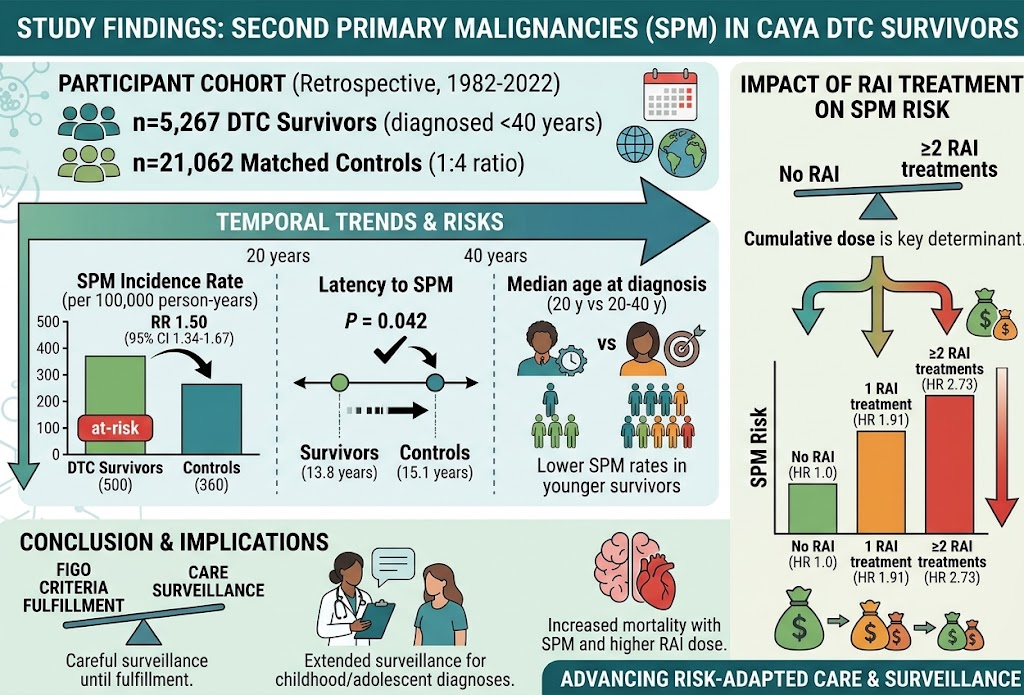
Highlight
- Children, adolescents, and young adults (CAYA) surviving differentiated thyroid cancer (DTC) have a 50% increased risk of developing second primary malignancies (SPMs) compared to matched cancer-free controls.
- Radioactive iodine (RAI) therapy correlates with a dose-dependent increase in SPM risk and higher mortality among survivors.
- SPMs manifest earlier in DTC survivors than in controls, underscoring the need for prolonged monitoring beyond initial cancer remission.
- Survivors diagnosed before age 20 have lower SPM rates but require extended follow-up given their younger age and longevity post-treatment.
Study Background
Differentiated thyroid cancer (DTC) is the most frequent endocrine malignancy in children, adolescents, and young adults (CAYA). Although DTC prognosis is generally favorable with overall survival rates exceeding 95%, increasing incidence rates and the widespread use of radioactive iodine (RAI) therapy raise concerns about long-term adverse effects. Among these, the development of second primary malignancies (SPMs) represents a clinically significant late effect that can affect survivorship quality and longevity. Furthermore, younger patients face decades of post-treatment risk, yet the real-world epidemiology of SPMs and mortality in this population remains incompletely characterized. This study aimed to quantify SPM risk and all-cause mortality among CAYA DTC survivors over four decades and assess the impact of RAI treatment on these outcomes.
Study Design and Methods
This retrospective cohort study utilized comprehensive electronic health records from Clalit Health Services spanning 1982 to 2022. The cohort included 5,267 patients diagnosed with DTC before age 40 who survived at least two years post-diagnosis. Notably, 497 patients (approximately 9.5%) were diagnosed before age 20. Each survivor was matched with four cancer-free controls based on birth year, sex, ethnicity, and socioeconomic status, resulting in 21,062 controls.
The primary endpoint was the incidence of SPMs, with secondary outcomes including latency to SPM and all-cause mortality. Cox proportional hazards models estimated hazard ratios (HRs) with 95% confidence intervals (CIs) for SPM risk comparing survivors to controls and analyzing the influence of RAI treatment stratified by number of doses (none, one, or two or more). Statistical significance was derived from p-values <0.05.
Key Findings
The study demonstrated a significantly higher incidence of SPMs in DTC survivors compared to controls, with 500 versus 360 cases per 100,000 person-years, respectively (HR 1.50, 95% CI 1.34–1.67). Median latency to SPM onset was shorter in survivors (13.8 years) than controls (15.1 years; p=0.042), suggesting accelerated malignancy risk in this group.
The youngest subset (diagnosed before age 20) exhibited lower absolute SPM rates (5.6% vs. 9.0%; p=0.012) but were considerably younger at study follow-up (median 33 years vs. 47 years for those diagnosed at 20–40), requiring cautious interpretation regarding lifetime risk.
RAI treatment was strongly associated with increased SPM risk in a dose-dependent manner. Compared to survivors who did not receive RAI, those receiving one treatment had nearly double the risk (HR 1.91, CI 1.52–2.40), while two or more treatments conferred a substantially elevated risk (HR 2.73, CI 2.13–3.50). Importantly, mortality overall was low (2.8%) and comparable to controls (2.5%), but survivors developing SPMs and/or receiving RAI experienced higher mortality (p < 0.001).
Expert Commentary
This study provides compelling real-world evidence for the substantial impact of SPMs as a critical late effect in CAYA DTC survivors, particularly in relation to cumulative RAI exposure. The findings reinforce current guideline recommendations advocating judicious, risk-adapted RAI use rather than routine application, especially in low-risk disease. The observation of earlier SPM onset highlights a need for extended longitudinal surveillance paradigms spanning multiple decades post-treatment.
Limitations inherent to retrospective designs include potential residual confounding and lack of detailed data on RAI dosimetry, histologic subtypes of SPM, and genetic predispositions. Nevertheless, the large, ethnically diverse population and prolonged follow-up enhance generalizability. The lower SPM rates in patients diagnosed before age 20 likely reflect shorter follow-up time relative to lifespan, underscoring the importance of ongoing vigilance into adulthood.
Biologically, radiation exposure from RAI is a plausible carcinogenic mechanism inducing DNA damage in non-thyroid tissues. This association supports intensified research into precision oncology approaches and novel biomarkers to stratify SPM risk further.
Conclusion
Over four decades, pediatric and young adult differentiated thyroid cancer survivors exhibit a significantly increased risk of second primary malignancies, intensified by cumulative RAI treatment. While overall mortality remains low, the combination of SPM occurrence and RAI exposure correlates with elevated long-term mortality. This evidence underscores the importance of balancing therapeutic benefits of RAI with its late risks and tailoring treatment intensity to individual risk profiles. Extended lifelong surveillance for SPMs is warranted, particularly among those diagnosed early in life.
Clinicians should engage in shared decision-making regarding RAI indications and counsel survivors on the necessity of ongoing follow-up. Future prospective studies integrating molecular markers may refine risk stratification and support personalized survivorship care.
Funding and Trial Registration
The study was supported by institutional resources from Clalit Health Services. No clinical trial registration was applicable as this was a retrospective observational cohort study.
References
1. Bello R, Yackobovitch-Gavan M, Lazar L, Hayek S. Second Primary Malignancies Among Pediatric and Young Adult Survivors of Differentiated Thyroid Cancer: Real-World Evidence. Thyroid. 2026 Aug 16;undefined:10507256261475827. doi: 10.1089/thy.2026.0145.
2. Haugen BR, et al. 2015 American Thyroid Association Management Guidelines for Adult Patients with Thyroid Nodules and Differentiated Thyroid Cancer. Thyroid. 2016 Jan;26(1):1-133.
3. Rubino C, et al. Second primary malignancies in thyroid cancer patients. Br J Cancer. 2003 Mar 3;89(9):1638-44.
4. Sawka AM, et al. Risk of second primary malignancies in thyroid cancer survivors exposed to radioactive iodine therapy: a systematic review. Thyroid. 2009 Dec;19(12):1351-8.
This article was created using several editorial tools, including AI, as part of the process. Human editors reviewed this content before publication.