Long-Term Fatigue in Differentiated Thyroid Cancer Survivors: Early Predictors and the Non-Impact of Thyrotropin Suppression
Study Background
Differentiated thyroid cancer (DTC) represents the most common type of thyroid malignancy with generally excellent prognosis owing to advances in surgical and adjuvant therapies such as radioiodine treatment. Despite high survival rates, patients frequently report persistent symptoms that adversely affect their quality of life, with fatigue being one of the most common and debilitating. Fatigue in cancer survivors can persist for years posttreatment, impacting physical function, emotional well-being, and daily life activities. Understanding predictors of long-term fatigue in DTC patients could enable early identification of at-risk individuals, permitting timely interventions to mitigate this persistent symptom burden. Furthermore, the role of thyrotropin (TSH) suppression—a common therapeutic approach aimed at reducing cancer recurrence risk—has been controversial in relation to fatigue. This nationwide prospective Swedish study aimed to elucidate clinical, psychological, and biochemical predictors of fatigue five years after treatment in DTC patients, thereby addressing an unmet need in survivorship care.
Study Design
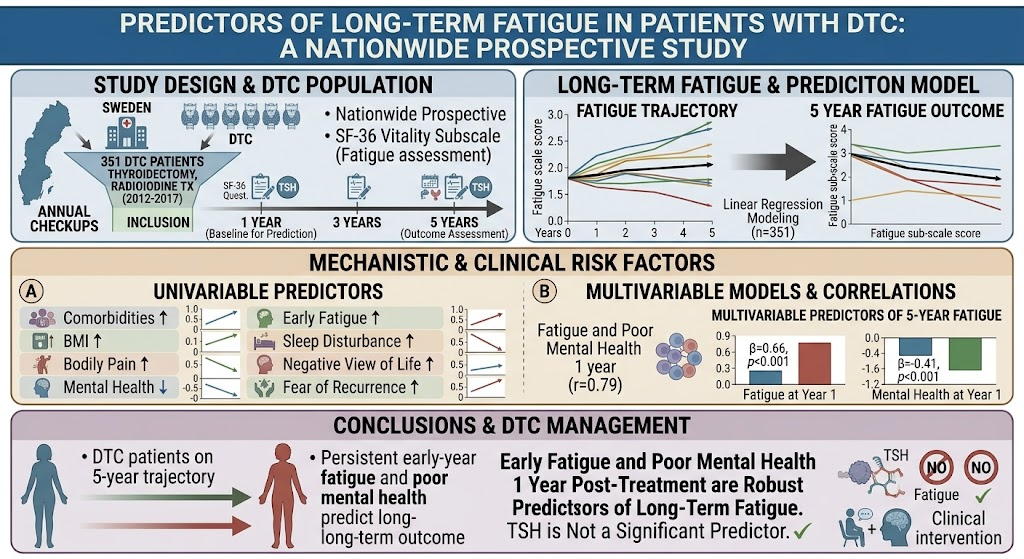
This prospective cohort study enrolled 351 patients diagnosed with differentiated thyroid cancer between 2012 and 2017 across Sweden. All patients underwent thyroidectomy and were scheduled for radioiodine treatment. Fatigue assessment and related health variables were collected longitudinally at baseline (shortly after treatment) and at 1, 3, and 5 years posttreatment. Fatigue was evaluated using the vitality subscale of the Short Form-36 Health Survey (SF-36), a validated and widely used patient-reported outcome measure that captures subjective energy and fatigue levels. Additional data included demographic parameters (age, sex, education), clinical factors (body mass index, comorbidities, smoking status, DTC risk profile), psychological measures (mental health, fear of cancer recurrence, life perspective changes), and symptom-related variables (bodily pain, sleep disturbance). TSH levels were retrieved from medical records to explore potential associations with fatigue longitudinally. Linear regression and mixed model analyses were employed to identify predictors of five-year fatigue, with special attention to variables measured at one year posttreatment.
Key Findings
Univariable analyses revealed multiple factors measured at one year that significantly correlated with fatigue at five years, including a greater number of comorbidities, higher BMI, increased bodily pain, poorer mental health, higher early fatigue levels, more sleep disturbances, a negative life perspective post-DTC diagnosis, and heightened fear of cancer recurrence. Notably, fatigue and mental health showed a very strong correlation (r=0.79), prompting separate multivariable models to avoid collinearity.
In multivariable regression, fatigue reported at one year was the strongest independent predictor of persistent fatigue at five years (β=0.66, p<0.001). Additionally, worse mental health at one year independently predicted long-term fatigue (β=-0.41, p<0.001), underscoring the central role of psychological well-being in chronic fatigue. Conversely, TSH levels exhibited no statistically significant association with fatigue (p=0.161) in the longitudinal mixed model analysis, indicating that standard thyroid hormone suppression regimens likely do not contribute to chronic fatigue symptoms in this population.
Other demographic or disease characteristics such as age, sex, education level, smoking, or DTC risk classification were not identified as significant independent predictors after controlling for confounders. These findings highlight a multidimensional etiology of fatigue centered on comorbidity burden, body composition, somatic symptoms like pain, and psychological factors rather than biochemical thyroid status measured by TSH alone.
Clinically, these results suggest that early posttreatment assessments focusing on fatigue severity and mental health status can stratify patients at risk of long-term fatigue. This opens avenues for targeted supportive interventions such as pain management, psychological counseling, sleep hygiene optimization, and lifestyle modifications aimed at weight control and comorbidity management.
The non-association of TSH suppression with fatigue is particularly reassuring for clinicians balancing the benefits of thyroid hormone suppression to reduce tumor recurrence against quality of life concerns. It suggests that careful management of hormone replacement to minimize overt thyrotoxicosis and hypothyroidism remains essential but is unlikely to explain persistent fatigue symptoms encountered by patients.
Study strengths include its nationwide scope, prospective design, use of validated measures, and comprehensive assessment of biopsychosocial predictors over a long follow-up. However, limitations include the observational design precluding causal inference, absence of objective fatigue biomarkers, and potential unmeasured confounding such as depression or physical activity levels. Generalizability may be limited to similar healthcare settings and primarily Scandinavian populations.
Expert Commentary
This study substantially advances understanding of fatigue in DTC survivors by delineating key early predictors and excluding an influence of TSH suppression, areas previously marked by uncertainty. The strong predictive value of fatigue and mental health at one year posttreatment reinforces the importance of integrating routine psychosocial screening in survivorship clinics. These findings align with emerging evidence in broader oncology populations emphasizing multifactorial drivers of fatigue beyond disease activity or treatment side effects alone.
Multidisciplinary interventions addressing both physical and emotional domains should be prioritized. For example, cognitive-behavioral therapy, exercise programs, and symptom-specific treatments could be evaluated in randomized trials targeting high-risk patients identified early. Further research might explore biological mechanisms linking mental health and fatigue including inflammatory markers, autonomic dysfunction, or neuroendocrine alterations.
Conclusion
Long-term fatigue affects a substantial subset of differentiated thyroid cancer patients and is predicted strongly by fatigue severity and mental health status within the first year after treatment. TSH suppression does not appear to contribute to persistent fatigue, addressing a crucial clinical concern. Early identification of patients with fatigue and poor mental health enables proactive supportive care strategies that may improve quality of life for thyroid cancer survivors. These findings underscore the need for holistic survivorship care encompassing physical, psychological, and lifestyle dimensions to combat chronic fatigue in this generally highly treatable but symptomatically vulnerable population.
Funding and ClinicalTrials.gov
The original study was supported by Swedish national research funds and institutional grants. No specific clinical trial registration is cited.
References
1. Winter J, Axelsson E, Bonn S, Ihre Lundgren C, Björkhem-Bergman L, Hedman C. Predictors of Long-Term Fatigue in Patients with Differentiated Thyroid Cancer: A Nationwide Prospective Study. Thyroid. 2026 Aug 19:10507256261479260. doi:10.1089/thy.2026.0050.
2. Cella D, Chalder T. Measuring fatigue in clinical and community settings. J Psychosom Res. 2010;69(1):17-22.
3. Bower JE. Cancer-related fatigue—mechanisms, risk factors, and treatments. Nat Rev Clin Oncol. 2014;11(10):597-609.
4. Sherman SI. Thyroid carcinoma. Lancet. 2003;361(9356):501-511.
5. Jacobson EM, Huber A, Tomer Y. The Heterogeneity of Autoimmune Thyroid Disease: From Epidemiology to Mechanisms and Outcomes. J Clin Endocrinol Metab. 2016;101(1):115-123.
This article was created using several editorial tools, including AI, as part of the process. Human editors reviewed this content before publication.