Highlight
Venlafaxine metabolism primarily involves CYP2D6, with CYP2C19 playing a secondary role.
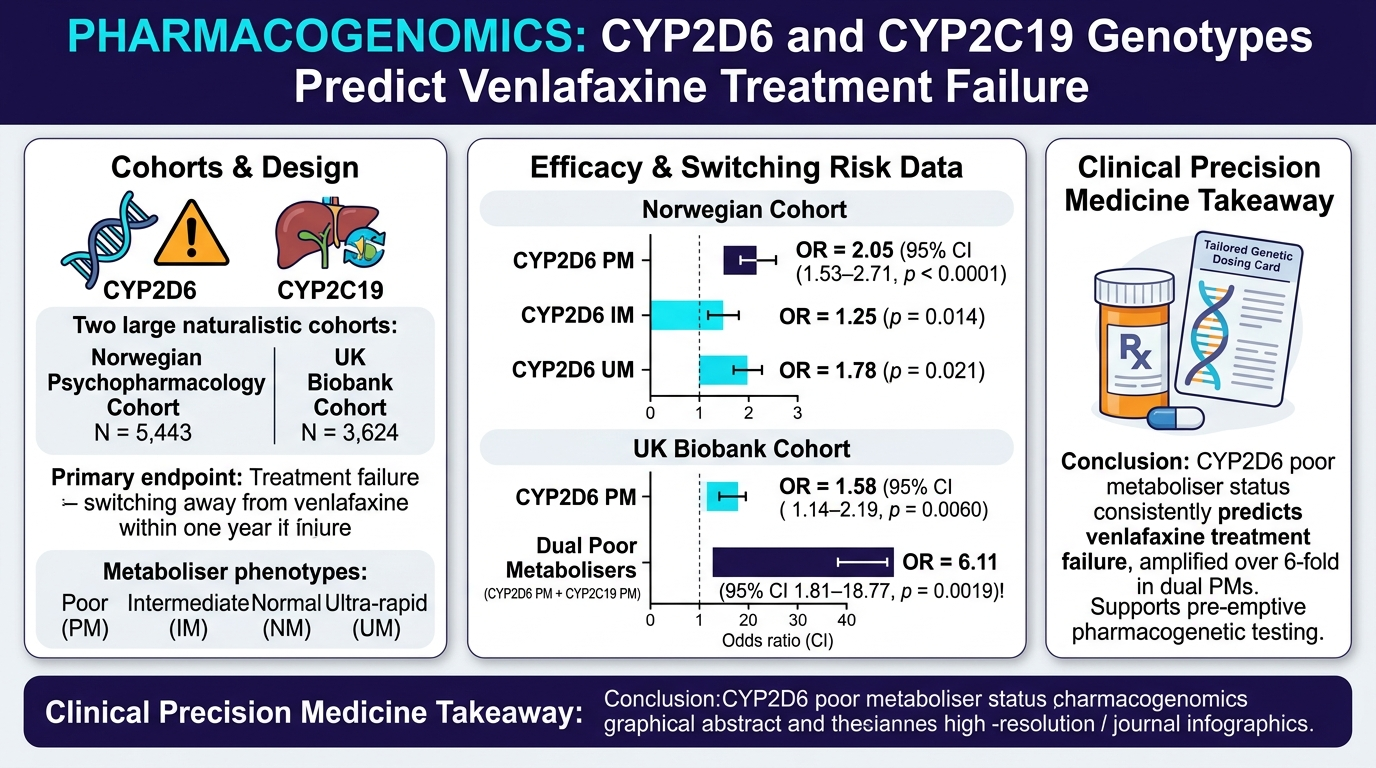
CYP2D6 poor metabolizers (PMs) consistently show increased odds of venlafaxine treatment failure in both Norwegian and UK cohorts.
Dual CYP2D6 and CYP2C19 PM status drastically increases the risk of switching antidepressants, suggesting augmented treatment failure.
Pre-emptive pharmacogenetic testing could optimize venlafaxine therapy and reduce treatment failure.
Study Background
Major depressive disorder (MDD) is a prevalent psychiatric condition with significant morbidity worldwide. Venlafaxine, a serotonin-norepinephrine reuptake inhibitor (SNRI), is commonly prescribed for MDD and often exhibits superior efficacy compared to selective serotonin reuptake inhibitors (SSRIs). However, treatment response to venlafaxine can be highly variable, partly due to genetic factors influencing drug metabolism. Cytochrome P450 enzymes CYP2D6 and CYP2C19 metabolize venlafaxine, with the activity of these enzymes dictated by polymorphisms that define metabolic phenotypes such as poor, intermediate, normal, or ultra-rapid metabolism. Understanding how these genetic variants affect venlafaxine efficacy is crucial for tailoring treatment and improving clinical outcomes.
Study Design
This retrospective, observational study analyzed two independent real-world cohorts: one from the Center for Psychopharmacology in Oslo, Norway, and another from the UK Biobank. Participants were adults treated with venlafaxine who underwent therapeutic drug monitoring and were genotyped for CYP2D6 and CYP2C19. Exclusion criteria included concomitant use of potent CYP2D6 or CYP2C19 inhibitors (such as fluoxetine or paroxetine) and inducers (such as carbamazepine) to avoid confounding metabolic effects. Genotype-predicted metabolic phenotypes were classified as poor (PM), intermediate (IM), normal (NM), or ultra-rapid metabolizers (UM). The primary endpoint was treatment failure operationalized as switching from venlafaxine to another antidepressant within one year after the last therapeutic drug monitoring measurement.
Key Findings
The Norwegian cohort included 5,443 participants (60.9% women; mean age 48.9 years), and the UK Biobank cohort comprised 3,624 participants (66.3% women; mean age 56.5 years). In the Norwegian cohort, CYP2D6 PMs had a significantly increased likelihood of switching antidepressants (odds ratio [OR] 2.05; 95% confidence interval [CI], 1.53–2.71; p<0.0001) compared to NMs. IMs (OR 1.25; 95% CI, 1.05–1.50; p=0.014) and UMs (OR 1.78; 95% CI, 1.06–2.83; p=0.021) also had an elevated risk relative to NMs. Similar findings were replicated in the UK Biobank cohort where CYP2D6 PM status was associated with increased treatment failure (OR 1.58; 95% CI, 1.14–2.19; p=0.0060). Notably, in the Norwegian cohort, individuals with dual PM status for both CYP2D6 and CYP2C19 showed markedly higher odds of switching (OR 6.11; 95% CI, 1.81–18.77; p=0.0019), indicating an additive detrimental effect on venlafaxine treatment efficacy.
The study did not include active contributions from people with lived experience in the design or writing phases, highlighting a purely data-driven pharmacogenetic investigation.
Expert Commentary
This study robustly demonstrates the clinical relevance of CYP2D6 pharmacogenetics in venlafaxine treatment outcomes. The consistent association of CYP2D6 PM status with treatment failure across two large, independent cohorts reinforces the importance of metabolic phenotype in antidepressant efficacy. The increased odds of switching observed in ultra-rapid metabolizers suggest that heightened venlafaxine clearance may also compromise therapeutic levels, warranting dose adjustments or alternative therapies. The amplification of risk in dual CYP2D6 and CYP2C19 PMs underlines the need to consider the combined effect of multiple metabolic pathways.
These findings align with current pharmacokinetic knowledge: CYP2D6 catalyzes venlafaxine’s conversion to its active metabolite O-desmethylvenlafaxine, critical for its antidepressant effect. Poor metabolism may lead to accumulation of venlafaxine and suboptimal active metabolite levels, contributing to adverse effects and treatment failure. Conversely, rapid metabolism may cause insufficient therapeutic exposure.
Limitations include retrospective design and reliance on prescription change as a surrogate for treatment failure, which may be influenced by other clinical factors and adherence issues. The exclusion of patients on strong CYP inhibitors or inducers strengthens the attribution of effects to genotypes but limits generalizability. Future prospective, genotype-guided trials are needed to validate whether pharmacogenetic testing can effectively reduce treatment failures and improve patient outcomes in clinical practice.
Conclusion
This comprehensive retrospective study from Norway and the UK firmly establishes that CYP2D6 metabolic status is a critical determinant of venlafaxine treatment success. Pre-emptive genotyping for CYP2D6, and potentially CYP2C19, could inform personalized venlafaxine dosing or alternative antidepressant selection, enhancing therapeutic precision and minimizing trial-and-error periods. Integrating pharmacogenetics into routine psychiatric care may optimize antidepressant response and improve quality of life for patients with major depressive disorder.
Funding and Disclosures
This research was supported by the European Research Council, Swedish Research Council, Novo Nordisk Foundation, Robert Bosch Foundation, National Research Foundation of Korea, and the South-Eastern Norway Regional Health Authority. The authors declare no conflicts of interest.
References
Park Y, Lenk HÇ, Zhou Y, Lauschke VM, Molden E. Association between CYP2D6 and CYP2C19 genotypes and venlafaxine treatment failure: a retrospective study on two cohorts from Norway and the UK. Lancet Psychiatry. 2026 Oct;13(10):852-860. doi: 10.1016/S2215-0366(26)00238-5. Erratum in: Lancet Psychiatry. 2026 Oct 5:S2215-0366(26)00305-6. doi: 10.1016/S2215-0366(26)00305-6. PMID: 42716055.