Gout as a Modifiable Risk Factor for Ischemic Stroke in Atrial Fibrillation: Insights from the FinACAF Study
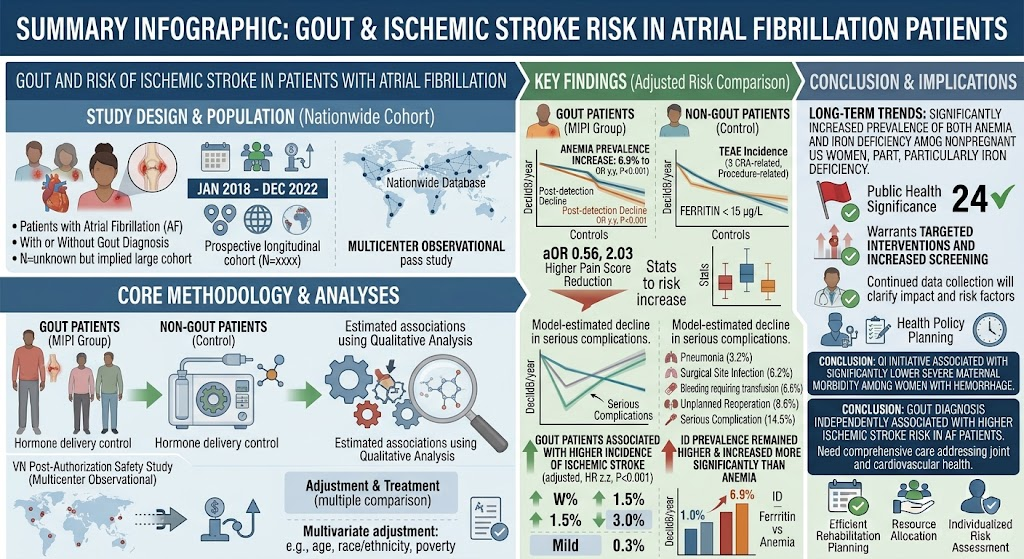
Highlight
– Gout is identified as an independent risk factor for ischemic stroke in patients with atrial fibrillation (AF).
– Urate-lowering therapy in patients with both gout and AF is associated with a significant reduction in stroke risk.
– Stroke risk stratification models for AF may benefit from incorporating gout status.
– The findings stem from a comprehensive nationwide cohort of 229,565 Finnish patients, enhancing the generalizability of results.
Study Background
Atrial fibrillation (AF) is a common cardiac arrhythmia and a well-established risk factor for ischemic stroke due to thromboembolism. Stratifying stroke risk in AF patients is central to deciding anticoagulation treatment. Traditionally, clinical risk factors such as hypertension, diabetes, prior stroke, and heart failure constitute tools like the CHA2DS2-VASc score to assess stroke risk. However, emerging evidence suggests that additional inflammatory and metabolic conditions like gout may contribute to thromboembolic risk. Gout, characterized by monosodium urate crystal deposition and systemic inflammation, has been increasingly linked with cardiovascular disease. Despite this, the specific impact of gout on ischemic stroke risk among AF patients remains incompletely understood, and the influence of urate-lowering therapy has been unexplored extensively at the population level.
Study Design
The Finnish Anticoagulation in Atrial Fibrillation (FinACAF) study is a nationwide registry-linkage cohort involving all Finnish patients diagnosed with AF between 2007 and 2018 from primary to tertiary healthcare settings. The cohort comprised 229,565 patients with new-onset AF, inclusive of both sexes and a broad age range (mean 72.7 years). Gout diagnosis was established by diagnostic coding and pharmacy claims data. The primary endpoint was the incidence of ischemic stroke during follow-up (mean duration approximately 4 years). Medication use, including anticoagulants and urate-lowering agents, was treated as time-dependent variables to evaluate their associations with stroke risk. Analyses adjusted for demographics and comorbidities examined the independent influence of gout on ischemic stroke risk, with additional stratified analyses in anticoagulation-naive patients to exclude confounding by stroke prevention therapy.
Key Findings
Among this large AF population, 6,910 patients (3.0%) had a history of gout. Overall, 16,296 patients (7.1%) experienced ischemic stroke during follow-up. Gout presence was associated with significantly increased ischemic stroke rates, even after adjustment for demographic and clinical risk factors. Specifically, the adjusted incidence rate ratio (IRR) was 1.12 (95% CI, 1.02–1.24) indicating about a 12% increased stroke risk attributable to gout in AF patients.
In analyses restricted to patients not on anticoagulation during follow-up, gout was associated with an even higher relative stroke risk (adjusted IRR 1.26, 95% CI 1.09–1.46), emphasizing the contributory role of gout independent of anticoagulation. Notably, the crude stroke rates among nonanticoagulated gout patients increased steeply according to CHA2DS2-VA score strata: 1.5, 1.0, and 4.8 per 100 patient-years for scores 0, 1, and ≥2 respectively, indicating that gout adds substantive stroke risk particularly in higher-risk profiles.
Crucially, patients with both AF and gout who were treated with urate-lowering therapy demonstrated a 30% lower incidence of ischemic stroke compared to those untreated, suggesting that modifying hyperuricemia and potentially inflammatory burden associated with gout may confer vascular protection against stroke. This observation supports the concept of gout as a modifiable risk factor in ischemic stroke prevention strategies among AF patients.
The robustness of findings is supported by the large, nationwide population-based design, comprehensive follow-up, and adjustment for anticoagulant use and multiple confounders.
Expert Commentary
The FinACAF study elegantly expands the understanding of stroke risk stratification in atrial fibrillation by highlighting gout as an independent and clinically meaningful risk factor. The modest yet statistically significant increase in ischemic stroke risk associated with gout may partially reflect systemic inflammation, endothelial dysfunction, and pro-thrombotic mechanisms recognized in gout pathophysiology.
The clear association between urate-lowering therapy and reduced stroke risk introduces an important paradigm: addressing hyperuricemia is not just symptomatic gout management but may influence cardiovascular outcomes. However, causality cannot be definitively established from observational data, and residual confounding (such as by lifestyle or renal function) cannot be fully excluded.
Current stroke risk tools like CHA2DS2-VASc do not incorporate gout, and the demonstrated additional risk in gout patients suggests that including gout status could refine risk prediction and treatment personalization. Further prospective studies and clinical trials focusing on the role of urate-lowering agents in stroke prevention among AF patients are warranted to clarify mechanisms and guide targeted therapies.
Limitations of the study include reliance on registry diagnosis codes and pharmacy claims data, which may introduce misclassification bias, and lack of granular data on serum urate levels, gout severity, and adherence to urate-lowering therapy.
Conclusion
This comprehensive nationwide cohort study establishes gout as an independent risk factor for ischemic stroke among patients with atrial fibrillation. It also highlights the potential benefit of urate-lowering therapy in reducing stroke risk, underscoring gout’s role as a modifiable cardiovascular risk factor embedded within AF management. Incorporating gout into stroke risk stratification could improve clinical decision-making for anticoagulation and adjunctive therapies. These findings prompt further investigation into therapeutic strategies targeting urate metabolism to optimize stroke prevention in AF populations.
Funding and Clinical Trials Registration
The FinACAF study was supported by Finnish research grants and institutional funding. The study is registered on clinicaltrials.gov under identifier NCT04645537.
Reference
Palomäki A, Langén V, Airaksinen KEJ, Halminen O, Haukka J, Jaakkola J, Kouki E, Salmela B, Putaala J, Linna M, Mustonen P, Aro AL, Hartikainen J, Lehto M, Teppo K. Gout and Risk of Ischemic Stroke in Patients With Atrial Fibrillation: A Nationwide Cohort Study. Stroke. 2026 Aug;57(8):2400-2407. doi: 10.1161/STROKEAHA.126.055194. Epub 2026 Jun 10. PMID: 42267424; PMCID: PMC13399721.
This article was created using several editorial tools, including AI, as part of the process. Human editors reviewed this content before publication.