Highlight
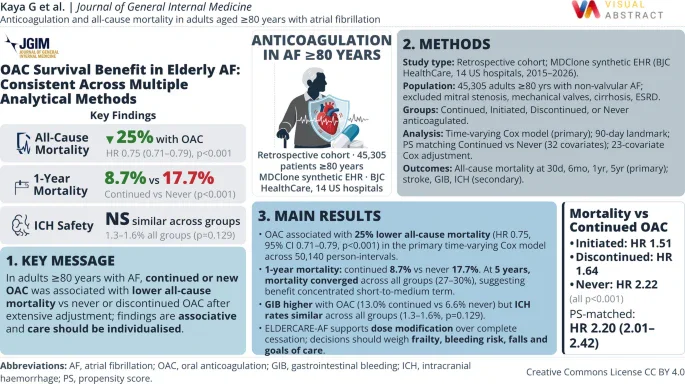
In patients aged 80 years and older with atrial fibrillation (AF), continued anticoagulation is associated with a 25% reduction in all-cause mortality at one year compared to no anticoagulation.
Initiation or discontinuation of anticoagulation in this population is linked to higher mortality compared with continued anticoagulation.
Gastrointestinal bleeding risk increases with anticoagulation therapy, but rates of intracranial hemorrhage remain low and similar across anticoagulation groups.
Five-year mortality rates converge, suggesting time-dependent survival benefit and highlighting complexities in long-term management decisions.
Study Background
Atrial fibrillation (AF) is a common cardiac arrhythmia, particularly prevalent in older populations, and is strongly associated with increased risks of stroke, systemic embolism, and mortality. Anticoagulation therapy is established as the cornerstone for stroke prevention in AF; however, patients aged 80 years and above have historically been underrepresented in randomized clinical trials. This underrepresentation generates uncertainty about the balance of benefits and risks of anticoagulation in this vulnerable population, who often have multiple comorbidities and increased bleeding risk. Understanding how anticoagulation impacts mortality and bleeding in octogenarians with AF is critical to inform clinical decisions that optimize outcomes and minimize harm.
Study Design
This retrospective cohort study utilized the MDClone platform, a synthetic electronic health record database derived from a large US health system, enabling comprehensive data capture while preserving patient privacy. The study included 45,305 patients aged 80 years and older diagnosed with atrial fibrillation, excluding those with mitral stenosis, mechanical heart valves, cirrhosis, or end-stage renal disease, to focus on a typical AF population appropriate for anticoagulant evaluation. Patients were categorized into four groups based on anticoagulation status during follow-up: continued anticoagulation, initiated anticoagulation, discontinued anticoagulation, and never anticoagulated.
The primary endpoint was all-cause mortality assessed at multiple time points: 30 days, 6 months, 1 year, and 5 years after cohort entry. Secondary endpoints included ischemic stroke, gastrointestinal bleeding (GIB), and intracranial hemorrhage (ICH). To address potential immortal time bias inherent in observational anticoagulation studies, a time-varying Cox proportional hazards model was used. Analytical robustness was enhanced through a 90-day landmark analysis and propensity score matching adjusting for confounding factors.
Key Findings
Mortality outcomes demonstrated significantly lower rates at 1 year among patients who continued anticoagulation (8.7%) compared with those never anticoagulated (17.7%), with a p-value < 0.001 indicating strong statistical significance. The time-varying Cox model quantified anticoagulation's protective association, reporting a hazard ratio (HR) of 0.75 (95% confidence interval [CI], 0.71–0.79), indicating a 25% mortality risk reduction in continued anticoagulation patients.
In contrast, patients who initiated anticoagulation during the study had a higher mortality risk compared to the continued anticoagulation group (HR 1.51, 95% CI 1.38–1.66), as did patients who discontinued anticoagulation (HR 1.64, 95% CI 1.49–1.81) and those never anticoagulated (HR 2.22, 95% CI 2.05–2.41). These associations persisted after propensity score matching, underscoring the robustness of the findings.
Long-term survival trends showed mortality rates converging by 5 years across all groups. This convergence may reflect survivor bias, competing risks, or other age-related factors affecting mortality beyond anticoagulation status.
Regarding safety, gastrointestinal bleeding occurred more frequently in anticoagulated patients (13.0% in continued, 11.9% in initiated groups) compared to non-anticoagulated patients. However, rates of intracranial hemorrhage were low (ranging from 1.3% to 1.6%) and did not differ significantly between groups (p = 0.129), suggesting that severe bleeding complications were not markedly increased by anticoagulation in this elderly cohort.
Ischemic stroke outcomes were not detailed in the summary but remain critical to contextualizing anticoagulation benefits and warrant further investigation.
Expert Commentary
The study by Kaya et al. addresses a crucial gap in evidence for anticoagulation management in octogenarians with AF. The substantial mortality benefit associated with continued anticoagulation supports guideline recommendations favoring stroke prevention in the elderly but highlights the importance of sustained therapy rather than intermittent or delayed initiation. The increased gastrointestinal bleeding risk, while notable, must be balanced against the overall survival advantage.
Limitations of the study include its retrospective design and reliance on synthetic EHR data, which may contain residual confounding despite propensity matching. The designation of anticoagulation groups based on treatment patterns might also reflect underlying clinical decisions influenced by frailty, comorbidity burden, or bleeding risk, which are challenging to fully adjust for. Additionally, the convergence of mortality rates by 5 years suggests that decisions regarding anticoagulation should integrate life expectancy and patient preferences.
Overall, this study informs clinical practice by reinforcing that advanced age alone should not preclude anticoagulation in AF patients. Judicious patient selection and management of bleeding risk factors remain pivotal.
Conclusion
In patients aged 80 and older with atrial fibrillation, continued anticoagulation therapy is associated with significantly lower all-cause mortality at 1 year despite an increased incidence of gastrointestinal bleeding. These data advocate against withholding anticoagulation based solely on age and emphasize the importance of individualized treatment decisions. Long-term management requires ongoing assessment of risks, benefits, and patient goals to optimize outcomes in this high-risk population.
Funding and ClinicalTrials.gov
This retrospective study was conducted using a synthetic database and did not report external funding sources or clinical trial registration.
References
Kaya G, Sanchez Garcia J, Schneider M, Yadav D, Ndukwe M, Chen CH, Joynt Maddox KE. Anticoagulation and All-Cause Mortality in Adults Aged 80 Years and Older with Atrial Fibrillation: A Retrospective Cohort Study. J Gen Intern Med. 2026 Oct 27. doi: 10.1007/s11606-026-10920-7. Epub ahead of print. PMID: 42946923.