Functional Impairment of Natural Killer Cells After Severe Trauma: Phenotypic Shifts and Loss of Activating Receptors
Highlight
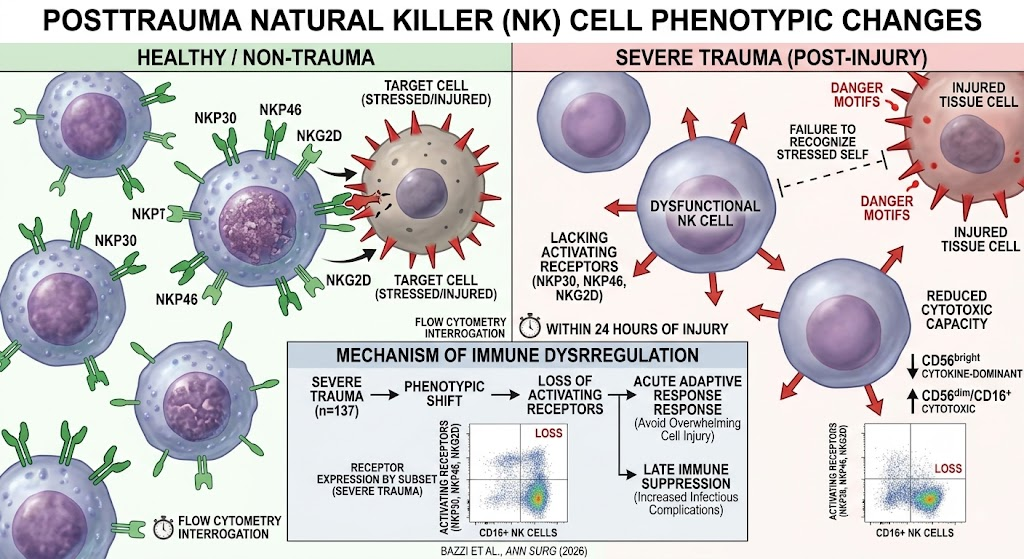
• Severe trauma induces a phenotypic shift in natural killer (NK) cells toward a mature, cytotoxic profile.
• Despite increased maturity, NK cells show loss of key activating receptors (NKP30, NKP46, NKG2D) after major injury.
• Loss of activating receptors may contribute to immune suppression and increased infection risk posttrauma.
• This study reveals a potential mechanism underlying trauma-induced immune dysfunction.
Study Background
Trauma remains a leading cause of morbidity and mortality worldwide, with immune dysregulation playing a central role in adverse outcomes. Posttrauma immune responses are paradoxical; patients exhibit both systemic inflammatory responses and profound immunosuppression, rendering them susceptible to infections and sepsis. The balance between innate immune activation and suppression after trauma is poorly understood. Natural killer (NK) cells are key innate lymphocytes involved in recognizing and eliminating stressed, infected, or transformed cells through activating and inhibitory receptors. Understanding NK cell dynamics and receptor expression after trauma could elucidate mechanisms contributing to posttrauma immune dysfunction and guide therapeutic interventions.
Study Design
This observational study enrolled adult patients admitted with trauma (n = 137) and a control group with nontrauma conditions (n = 45). Peripheral blood was collected within 24 hours post-injury. Using multiparameter flow cytometry, NK cell subsets were analyzed for phenotype and receptor expression markers. Maturation and functional markers included CD16, CD56, and CD57, distinguishing cytokine-producing versus cytotoxic NK cell populations. Activating receptors assessed were NKP30, NKP46, and NKG2D, which detect stress-induced ligands on damaged cells. Inhibitory receptors KIR2DL1 and KIR2DL2 were also interrogated to understand regulatory balances. Patient injury severity was stratified to compare mild and severe trauma impacts on NK cell profiles.
Key Findings
Analysis demonstrated that trauma led to a shift from cytokine-dominant, less mature CD56bright NK cells toward mature, cytotoxic CD56dim, CD16 positive cells, consistent with activation and potential for target cell lysis. This maturation shift was more pronounced in patients with severe injuries. However, paradoxically, despite phenotypic maturity, severely injured patients’ NK cells exhibited a significant loss of activating receptors NKP30, NKP46, and NKG2D on cytotoxic NK cells. These receptors are critical for recognizing stress ligands on injured or infected cells and mediating cytotoxic responses.
The loss of these activating receptors was not compensated by altered expression of inhibitory receptors KIR2DL1 and KIR2DL2, suggesting a net reduction in NK cell activation potential. This functional decoupling indicates that although NK cells mature phenotypically post-trauma, their ability to detect and respond to damaged or infected cells is impaired in severe trauma.
These findings provide a mechanistic link to clinical observations of immune suppression after major trauma, with a potential window where NK cells become less effective in clearing infections despite increased cytotoxic differentiation. This may contribute to the timing and development of infectious complications.
Expert Commentary
These data underscore the complex interplay between trauma severity and innate immunity, specifically implicating NK cell receptor modulation in immune dysregulation. The observed dissociation between maturation status and activating receptor expression expands understanding of posttrauma immunosuppression beyond traditional paradigms focused on cytokines and T cell exhaustion. Potentially, the acute loss of activating receptors could function adaptively to prevent excessive tissue damage from an overactive NK cell response immediately after trauma. However, the persistence of such receptor loss may predispose patients to secondary infections by blunting effective immune surveillance.
Research limitations include the cross-sectional nature of blood sampling within 24 hours of injury without longitudinal follow-up to assess receptor recovery kinetics and clinical correlation with infection outcomes. Further studies should evaluate the functional consequences of this receptor loss in vitro and explore therapeutic approaches to restore NK cell functionality selectively after trauma.
Conclusion
This investigation reveals that severe trauma induces profound phenotypic alterations in NK cells with a counterintuitive loss of critical activating receptors. This altered NK cell state provides insight into the dual phenomena of systemic inflammation and global immune suppression in trauma patients. Addressing NK cell receptor loss and functional impairment may represent a novel therapeutic avenue to reduce infectious complications and improve outcomes in survivors of major trauma.
Funding and Registration
Details on funding sources and clinical trial registration were not provided in the source abstract. Further inquiry is recommended for transparency and replication.
Reference:
Bazzi N, Stempora L, Hensman H, Quinones PM, Negron IR, Krynychka K, Gelbard RB, Grey SF, Schobel SA, Elster E, Fernandez-Moure J, Kirk AD. Natural Killer Cell Phenotypic Changes and Activating Receptor Loss Posttrauma. Ann Surg. 2026 Aug 10. doi: 10.1097/SLA.0000000000007197. Epub ahead of print. PMID: 42572148.
This article was created using several editorial tools, including AI, as part of the process. Human editors reviewed this content before publication.