We use cookies

Our website uses essential cookies and, with your consent, additional cookies to measure performance and improve our services. Cookie Policy.

You can change your choice at any time.

MMedXYNews
HomeVideos
MedXY AI/MedXY News/Section: Gastroenterology

Fecal Microbiota Transplantation: A Promising Therapy for Steroid-Refractory Acute Graft-Versus-Host Disease

MedXY Editorial Team•Aug 27, 2026•Gastroenterology
gut microbiomesteroid-refractoryhematopoietic stem cell transplantationfecal microbiota transplantation
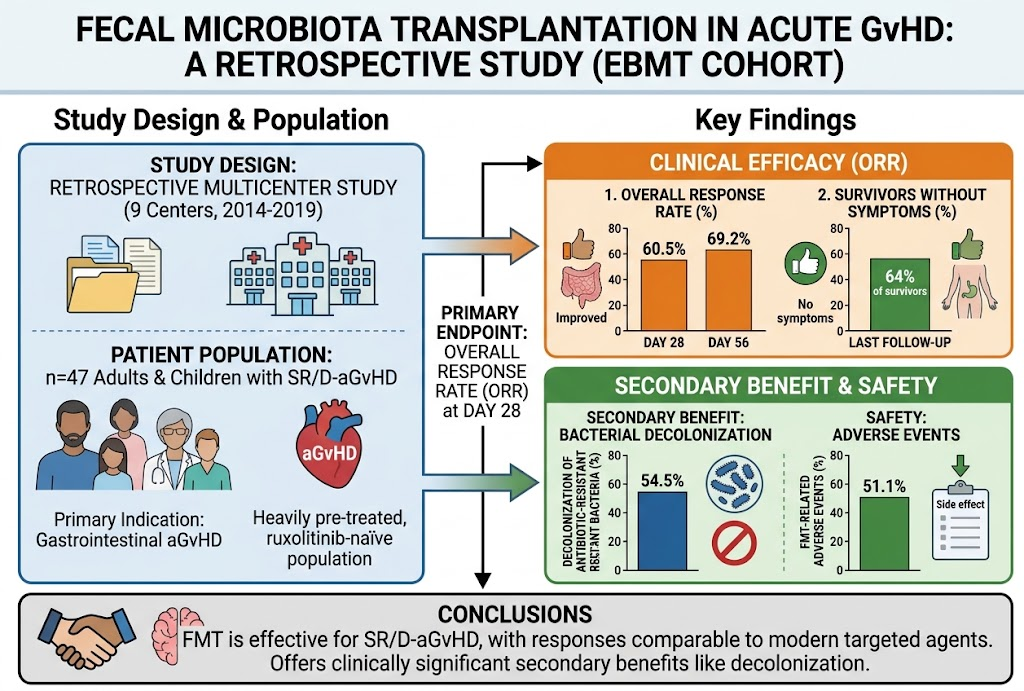
Highlight

  • Fecal microbiota transplantation (FMT) showed a 60.5% overall response rate at day 28 in steroid-refractory acute graft-versus-host disease (aGvHD) patients.
  • GI involvement was the primary indication for FMT, addressing gut dysbiosis linked to aGvHD pathophysiology.
  • More than half of patients experienced related adverse events, yet no unexpected safety signals emerged.
  • Significant secondary benefit included a 54.5% decolonization rate of antibiotic-resistant bacteria.

Study Background

MedXY registered readers

Sign in free to continue reading

Create or use your MedXY account to unlock the complete article.

This article was created using several editorial tools, including AI, as part of the process. Human editors reviewed this content before publication.

Related articles

Open language-specific specialty feeds and department pages.

Impact of Conditioning Regimens on Pregnancy Outcomes in Female Survivors of Childhood and Adolescent Acute Leukemia: HSCT versus Conventional ChemotherapyThis multicenter study reveals that total-body irradiation (TBI) conditioning before hematopoietic stem cell transplantation severely compromises pregnancy outcomes compared to alkylating agents or conventional chemotherapy in female survivSep 12, 2026Early Childhood Exposure to Crohn’s Disease-Affected Siblings: Implications for Gut Microbiome and Disease SusceptibilityChildhood exposure to siblings with Crohn’s disease significantly raises disease risk, linked to distinct gut microbiome changes that may drive disease onset through immune modulation.Aug 28, 2026Reassessing Total Body Irradiation in Young Children with ALL: Long-Term Safety and OutcomesA French longitudinal study finds no increased long-term complications or compromised quality of life in children under 4 years undergoing TBI-based HSCT for acute lymphoblastic leukemia, challenging prior age restrictions.Aug 25, 2026
Loading comments...
MedXY briefing

Get the free newsletter

Evidence-led clinical news, trends, and analysis—delivered to your inbox.

Ask MedXY AI

Most popular

Intimate Health
Five Benefits for Women Continuing Sexual Activity After Menopause
Intimate Health
Why Some Women Have a Strong Sex Drive—And Why Men Shouldn't Worry About It
Nursing & care
How often should a couple have sex?
Intimate Health
Classic Intimacy Recommendations: How to Help Women Reach Orgasm and Enjoy Mutual Pleasure
Intimate Health
What Makes a Woman "Physiologically Addicted" Is Never Money, But These Two Relationship Qualities
© 2026 MedXY
Contact usAbout usPrivacy PolicyMedXY story
Fecal Short-Chain Fatty Acids in Mother-Infant Dyads: No Direct Link to Islet Autoimmunity Development
A longitudinal study shows no association between fecal short-chain fatty acid levels during pregnancy and early childhood with the progression to islet autoimmunity in children at risk for type 1 diabetes.
Aug 25, 2026
Ovarian Tissue Cryopreservation After Hematopoietic Stem Cell Transplantation: A Viable Fertility Preservation Strategy in Selected FemalesThis study evaluates ovarian tissue cryopreservation (OTC) feasibility in girls and young women post-hematopoietic stem cell transplantation (HSCT), demonstrating OTC as a potential fertility salvage option despite reduced ovarian reserve aAug 20, 2026
Metabolic Regulation of Human Hematopoietic Stem and Progenitor Cell Regeneration by l-Carnitine: Mechanistic Insights and Therapeutic ImplicationsThis review synthesizes evidence revealing l-carnitine’s pivotal role in human hematopoietic stem and progenitor cell regeneration via fatty acid oxidation, highlighting metabolic profiling advances and translational potential for regAug 12, 2026