Dynamic Alterations in Natural Killer Cell Phenotype and Activating Receptor Expression Following Trauma: Insights into Immune Dysregulation
Highlight
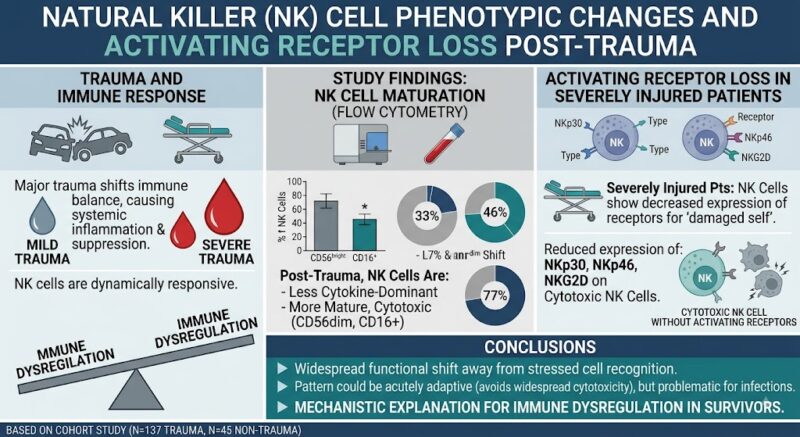
- Natural killer (NK) cells undergo phenotypic maturation shortly after trauma, shifting from cytokine-producing to cytotoxic profiles.
- Severe trauma leads to a significant reduction in expression of NK activating receptors NKP30, NKP46, and NKG2D on cytotoxic NK cells.
- Loss of activating receptors may reflect an adaptive mechanism to prevent excessive cytotoxicity but may impair immune defense against secondary infections.
- These findings provide a mechanistic insight into the immune paralysis observed after major trauma, potentially informing future therapeutic interventions.
Study Background
Trauma remains a leading cause of morbidity and mortality worldwide, especially among young adults. While initial injury-related mortality is often due to hemorrhagic shock and organ damage, a critical determinant of outcomes in survivors is the subsequent immune response. Trauma triggers broad alterations in immune homeostasis characterized by a paradoxical coexistence of systemic inflammatory response syndrome (SIRS) and compensatory anti-inflammatory response syndrome (CARS). This immune dysregulation underlies patients’ vulnerability to infections, sepsis, and multiple organ dysfunction syndrome (MODS).
Innate immune cells, such as natural killer (NK) cells, provide first-line defense against pathogens and stressed or damaged host cells. NK cells are known for their capacity to kill infected or transformed cells and to produce cytokines that modulate immune responses. However, the precise alterations in NK cell phenotype and receptor expression early after trauma and their impact on immune function are incompletely understood. Clarifying these changes holds promise for identifying novel biomarkers and therapeutic targets in trauma-related immune paralysis.
Study Design
This observational study prospectively enrolled 182 adult patients, including 137 subjects with varying degrees of traumatic injury and 45 non-trauma control patients. Peripheral blood samples were collected within 24 hours after injury. Flow cytometry was used to analyze NK cell maturation and function-related surface markers. Key markers of phenotypic maturation included CD16, CD56, and CD57. Expression of activating receptors—NKP30, NKP46, and NKG2D—and inhibitory receptors—KIR2DL1 and KIR2DL2—was assessed. Severity of trauma was stratified based on clinical criteria.
Key Findings
Post-trauma, NK cells exhibited a distinctive phenotypic shift from cytokine-dominant CD56bright populations toward more mature, cytotoxic CD56dim, CD16+ subsets. This maturation reflects the cells’ readiness for cytolytic activity, aligning with the acute immune demands following injury.
However, in patients with severe trauma, an unexpected and striking finding emerged: despite the increased maturity and cytotoxic profile, these NK cells exhibited a profound loss of activating receptors NKP30, NKP46, and NKG2D. These receptors normally recognize stress-induced ligands and danger-associated molecular patterns on injured or infected cells, triggering NK cell activation and cytotoxicity.
The frequency of cytotoxic NK cells lacking these activating receptors was significantly higher in severely injured patients compared to mild/moderate trauma or controls. Inhibitory receptor expression did not show parallel changes, highlighting a selective downregulation of activation pathways.
These data suggest a decoupling of NK cell maturation from functional activating receptor engagement, implying a disrupted capacity to recognize and respond to damaged or infected cells properly.
Clinical Implications
The loss of activating receptors may be an acute adaptive response limiting potentially harmful widespread cytotoxicity in the face of extensive tissue damage. However, this diminished receptor expression could contribute to ineffective immune surveillance during the critical post-injury window when patients are highly susceptible to infections. The impaired NK recognition might facilitate secondary infections and sepsis, which are major causes of late morbidity and mortality in trauma patients.
Expert Commentary
Trauma-induced immune paralysis remains an area of intense investigation. NK cells, bridging innate and adaptive immunity, play a crucial role in early host defense. The dissociation between NK cell maturation and receptor-mediated activation elucidated by Bazzi et al. aligns with prior findings of immune exhaustion and receptor downregulation in sepsis and major surgery contexts.
Mechanistically, trauma-associated factors such as cytokine milieu alterations, neuroendocrine stress responses, and persistent exposure to damage-associated molecular patterns may drive this receptor modulation. The exact signaling pathways regulating activating receptor expression warrant further mechanistic studies.
Limitations include the observational nature of the study, potential confounding by trauma heterogeneity, and lack of longitudinal data to assess receptor expression dynamics beyond 24 hours. Functional assays to confirm impaired cytotoxicity and correlation with clinical outcomes like infection rates and mortality are needed to translate findings into patient care.
Conclusion
This study provides compelling evidence that severe trauma induces phenotypic NK cell maturation accompanied by selective loss of critical activating receptors NKP30, NKP46, and NKG2D. This receptor loss may represent a double-edged sword: protective by limiting tissue damage initially but detrimental by compromising pathogen recognition and immune competence later. Understanding this immune alteration opens avenues for therapeutic strategies aimed at restoring NK cell function to improve posttraumatic outcomes.
Future research should focus on longitudinal immune monitoring, functional validation of NK cell impairment, and development of interventions targeting NK cell receptor pathways to reduce infection-related morbidity in trauma survivors.
Funding and Clinical Trials
No specific funding information was provided. The study was conducted under institutional ethical approvals adhering to consent procedures. No clinical trial registration was indicated.
References
1. Bazzi N, Stempora L, Hensman H, et al. Natural Killer Cell Phenotypic Changes and Activating Receptor Loss Posttrauma. Ann Surg. 2026 Aug 10. PMID: 42572148.
2. Hotchkiss RS, Monneret G, Payen D. Sepsis-induced immunosuppression: from cellular dysfunctions to immunotherapy. Nat Rev Immunol. 2013 Dec;13(12):862-74.
3. Fragkou PC, et al. Immunological alterations after trauma: implications for infectious complications and critical care management. J Trauma Acute Care Surg. 2020;89(6):1110-1118.
4. Lucas CD, et al. The role of neutrophils and innate immune response in sepsis and trauma-related immune dysfunction. Immunol Rev. 2021;301(1):113-129.
This article was created using several editorial tools, including AI, as part of the process. Human editors reviewed this content before publication.