Divergent Metabolic Impacts of Ketogenic Versus Free-Sugar-Restricted Diets: Insights from a 12-Week Randomized Controlled Trial
Highlights
- Low free-sugar or carbohydrate intake reduces body fat but not energy expenditure
- Restricting sugar lowers LDL-C with minimal impact on metabolism or gut microbiome
- Four weeks of a ketogenic diet increases atherogenic lipoprotein profile
- The ketogenic diet alters gut microbial beta diversity and skeletal muscle phenotype
Study Background
Metabolic diseases, particularly obesity, type 2 diabetes, and dyslipidemia, represent significant global health challenges. Dietary interventions remain a cornerstone of both prevention and management. The ketogenic diet—characterized by severe carbohydrate restriction and high fat intake—has gained popularity for rapid weight loss and metabolic modulation. Separately, limiting free (added) sugars is widely advocated by public health agencies to combat obesity and cardiovascular risk. However, the comparative effects of these two strategies on energy balance, metabolic health, and the gut microbiome remain incompletely characterized, particularly in healthy adults. Clarifying these effects is crucial to inform dietary recommendations and personalized nutrition strategies.
Study Design
This was a single-center, randomized controlled trial (RCT) conducted in healthy adult volunteers. Participants (n not specified in the summary, see original publication for details) were randomized into three groups for 12 weeks:
- Ketogenic diet (restricting overall carbohydrates to induce nutritional ketosis)
- Free-sugar-restricted diet (limiting only free/added sugars, not total carbohydrate)
- Control group (habitual diet)
Key endpoints included changes in body composition (fat mass), energy expenditure (resting and total), glucose tolerance (oral glucose tolerance test), lipid profiles (including LDL cholesterol, apolipoprotein B), skeletal muscle markers (PDK4, AMPK, GLUT4), inflammatory markers (C-reactive protein), postprandial metabolites (glycerol), and gut microbiome composition (beta diversity).
Key Findings
Energy Intake and Fat Mass Reduction
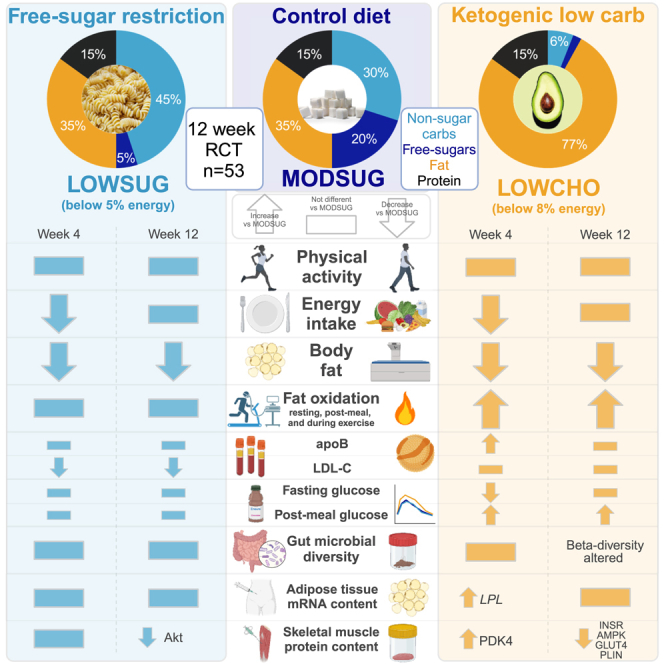
Both the ketogenic and free-sugar-restricted diets led to reduced energy intake and significant fat mass loss over 12 weeks, without compensatory reductions in energy expenditure or physical activity. This suggests that both approaches are effective for caloric deficit and fat loss in healthy adults.

Glucose Tolerance and Metabolic Markers
A pronounced divergence was observed in metabolic adaptations:
– Free-sugar restriction had minimal impact on glucose metabolism or the gut microbiome but resulted in a modest reduction in LDL cholesterol—an established cardiovascular risk factor.
– Ketogenic diet impaired glucose tolerance (reduced ability to manage an oral glucose load), increased skeletal muscle pyruvate dehydrogenase kinase 4 (PDK4, a marker of reduced glucose oxidation), and downregulated proteins critical for muscle glucose uptake and metabolism (AMPK, GLUT4). By week 4, there were reductions in fasting glucose and increases in apolipoprotein B (ApoB, a marker of atherogenic lipoproteins), C-reactive protein (CRP, an inflammatory marker), and postprandial glycerol (reflecting altered substrate metabolism). However, these effects attenuated by week 12, despite maintained nutritional ketosis, indicating possible metabolic adaptation over time.
Lipid Profiles
– The ketogenic diet acutely increased ApoB and LDL cholesterol—potentially elevating atherogenic risk—while free-sugar restriction selectively decreased LDL cholesterol without affecting other lipoproteins.
– Notably, the observed lipid changes with the ketogenic diet were transient, and the long-term clinical implications require further study, especially given the partial normalization by week 12.
Skeletal Muscle and Peripheral Tissue Phenotype
– Ketogenic diet induced a shift in skeletal muscle phenotype toward decreased glucose utilization, as evidenced by increased PDK4 and reduced AMPK and GLUT4. Such changes suggest a metabolic rerouting favoring fat oxidation over glucose metabolism, consistent with a ketogenic state.
– These adaptations were not observed with free-sugar restriction, highlighting the specificity of whole-carbohydrate exclusion versus free-sugar limitation.
Gut Microbiome
– Free-sugar restriction had minimal impact on gut microbial diversity or composition.
– The ketogenic diet significantly altered gut microbial beta diversity by week 12, indicating a distinct and possibly adaptation-related shift in the gut ecosystem. The clinical significance of these changes is not fully elucidated but may have implications for host metabolism and inflammation.
| Parameter | Ketogenic Diet | Free-Sugar Restriction | Control |
|---|---|---|---|
| Fat Mass Reduction | Yes | Yes | No |
| Energy Expenditure | No change | No change | No change |
| Glucose Tolerance | Decreased | No change | No change |
| LDL Cholesterol | Increased (early) | Decreased | No change |
| Gut Microbiome Diversity | Altered | No change | No change |
Expert Commentary
This rigorously conducted RCT provides valuable mechanistic insights into the metabolic consequences of carbohydrate and sugar restriction in healthy adults. The observation that both dietary strategies reduce fat mass without compensatory decreases in physical activity or energy expenditure aligns with the principle of energy balance. However, the distinct effects of the ketogenic diet—particularly the transient impairment in glucose tolerance, unfavorable early lipid changes, and profound gut microbiome shifts—underscore the complex and dynamic nature of metabolic adaptation. The attenuation of adverse metabolic effects by week 12 suggests potential for physiological adaptation, but the long-term clinical implications remain uncertain.
Notably, the reduction in LDL cholesterol with free-sugar restriction, without negative effects on glucose metabolism or the microbiome, may favor this approach for cardiovascular risk reduction in select populations. The ketogenic diet’s impact on peripheral tissue phenotype (e.g., skeletal muscle metabolism) may be relevant for athletes or specific metabolic disease states but warrants caution in broader clinical application, especially for those with underlying dysglycemia or cardiovascular risk.
Limitations of the study include the relatively short duration (12 weeks), healthy non-obese population, and lack of long-term outcome assessment. Additional research in individuals with metabolic syndrome, diabetes, or established cardiovascular disease is needed to determine generalizability and safety.
Conclusion
This RCT demonstrates that while both ketogenic and free-sugar-restricted diets effectively reduce fat mass in healthy adults, only the ketogenic diet exerts significant effects on glucose tolerance, lipid metabolism, skeletal muscle phenotype, and the gut microbiome. The transient nature of some changes with the ketogenic diet highlights the importance of adaptation and duration in dietary interventions. Free-sugar restriction appears metabolically safer and may confer cardiovascular benefits without unintended metabolic or microbial disruption. Personalization of dietary advice should consider individual metabolic risk profiles and the divergent effects of these popular dietary strategies.
References
Hengist A, Davies RG, Walhin JP, Buniam J, Merrell LH, Rogers L, Bradshaw L, Moreno-Cabañas A, Rogers PJ, Brunstrom JM, Hodson L, van Loon LJC, Barton W, O’Donovan C, Crispie F, O’Sullivan O, Cotter PD, Proctor K, Betts JA, Koumanov F, Thompson D, Gonzalez JT. Ketogenic diet but not free-sugar restriction alters glucose tolerance, lipid metabolism, peripheral tissue phenotype, and gut microbiome: RCT. Cell Rep Med. 2024 Aug 20;5(8):101667. doi: 10.1016/j.xcrm.2024.101667 IF: 10.6 Q1 .
This article was created using several editorial tools, including AI, as part of the process. Human editors reviewed this content before publication.