We use cookies

Our website uses essential cookies and, with your consent, additional cookies to measure performance and improve our services. Cookie Policy.

You can change your choice at any time.

MMedXYNews
HomeVideos
MedXY AI/MedXY News/Section: Diabetes & Endocrinology

Discontinuous Peripheral Punctate Echogenic Foci: A Novel Ultrasound Marker Highly Suggestive of Papillary Thyroid Carcinoma
MedXY Editorial Team•Aug 13, 2026•Diabetes & Endocrinology
echogenic fociBướu giáp đơn thùyPapillary Thyroid Carcinomaultrasound

Highlight

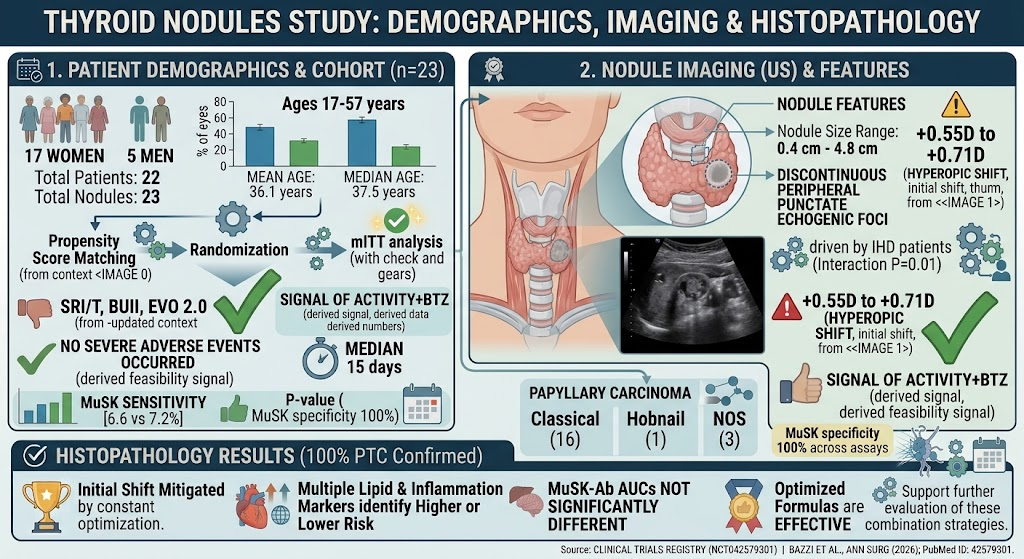
This retrospective multicenter case series identified a previously undescribed ultrasound pattern—discontinuous peripheral punctate echogenic foci (DPEF)—in thyroid nodules. All nodules exhibiting this pattern were confirmed histopathologically as papillary thyroid carcinoma (PTC). This novel sonographic feature may enhance malignancy risk stratification and warrants broader recognition among thyroid imaging specialists.

Study Background

MedXY registered readers

Sign in free to continue reading

Create or use your MedXY account to unlock the complete article.

This article was created using several editorial tools, including AI, as part of the process. Human editors reviewed this content before publication.

Related articles

Open language-specific specialty feeds and department pages.

Imaging-Guided Classification and Diagnostic Pathways for Appendiceal Abscesses: Practical Takeaways from the 2025 Italian ConsensusA clear, imaging-centered framework for diagnosing and stratifying appendiceal abscesses—introducing anatomotopographic localization, the Jeffrey radiological grading, and pathway-based imaging recommendations to harmonize practice.Sep 15, 2026TERT Promoter Variants and Age: Refining Prognostic Precision in Papillary Thyroid CarcinomaThis analysis reveals that TERT promoter mutations, increasingly prevalent with age, better predict poor outcomes in papillary thyroid carcinoma than age alone, offering enhanced risk stratification for clinical management.Aug 23, 2026Normal Late-Third Trimester Ultrasound Does Not Rule Out Adverse Outcomes, Retrospective Cohort Study FindsIn a large retrospective cohort, most stillbirths and composite adverse outcomes occurred among pregnancies with a normal ultrasound at 35–36 weeks, despite high detection of severe small-for-gestational-age infants.Aug 18, 2026
Loading comments...
MedXY briefing

Get the free newsletter

Evidence-led clinical news, trends, and analysis—delivered to your inbox.

Ask MedXY AI

Most popular

Intimate Health
Five Benefits for Women Continuing Sexual Activity After Menopause
Intimate Health
Why Some Women Have a Strong Sex Drive—And Why Men Shouldn't Worry About It
Nursing & care
How often should a couple have sex?
Intimate Health
Classic Intimacy Recommendations: How to Help Women Reach Orgasm and Enjoy Mutual Pleasure
Intimate Health
What Makes a Woman "Physiologically Addicted" Is Never Money, But These Two Relationship Qualities
© 2026 MedXY
Contact usAbout usPrivacy PolicyMedXY story
Cesarean Scar Pregnancy Continued Beyond the First Trimester Carries High Risks of Pregnancy Loss, Placenta Accreta Spectrum, and Hysterectomy
International registry data show that expectant management of live cesarean scar ectopic pregnancy is frequently followed by second-trimester loss, placenta accreta spectrum, and peripartum hysterectomy, with first-trimester ultrasound mark
Aug 18, 2026
Detectable Antithyroglobulin Antibodies Above the Assay LOQ Signal Higher Recurrence Risk in Papillary Thyroid Carcinoma Despite Undetectable ThyroglobulinIn papillary thyroid carcinoma treated with thyroidectomy and RAI, TgAb levels above the assay’s limit of quantification identified patients with higher long-term recurrence risk despite undetectable serum thyroglobulin.Jun 3, 2026
Non-contrast abbreviated MRI shows superior accuracy to ultrasound for hepatocellular carcinoma surveillance in cirrhosis: interim prospective trial resultsA prospective trial found that non-contrast abbreviated MRI detected hepatocellular carcinoma in cirrhotic patients far better than ultrasound, with most MRI-detected tumors found at an early, potentially curable stage.May 13, 2026