Antiseizure Medication Use During Pregnancy: Implications for Fetal Growth from the EURAP Registry
Highlight
- Prenatal antiseizure medication exposure, especially polytherapy, is associated with increased risk of poor fetal growth including small for gestational age (SGA) and low birthweight.
- The risk of reduced birthweight varies significantly across individual antiseizure monotherapies, with topiramate and phenobarbital linked to the greatest decreases.
- Combination therapies further decrease birthweight centiles, emphasizing the dose and polypharmacy-associated risks.
- Findings highlight the critical importance of individualized treatment planning and preconception counseling for women with epilepsy.
Study Background
Epilepsy affects a substantial population of women of reproductive age. Managing epilepsy during pregnancy is a complex clinical challenge due to the need to balance seizure control with fetal safety. Poor fetal growth, indicated by parameters such as low birthweight and small for gestational age (SGA), is a major contributor to perinatal morbidity and mortality and is implicated in long-term adverse health outcomes. While antiseizure medications (ASMs) are essential for seizure management, certain ASMs have been associated with teratogenic effects. However, the risk profile related specifically to fetal growth metrics has been less thoroughly examined. This study aims to elucidate the relationship between prenatal ASM exposure—both monotherapy and polytherapy—and fetal growth outcomes, leveraging a large, international prospective cohort from the EURAP registry.
Study Design
This prospective observational cohort study analyzed data from singleton live births of women aged 14 to 55 years with epilepsy, enrolled at any stage of pregnancy in the EURAP international registry from June 1999 to November 2023. The cohort comprised 15,893 offspring exposed prenatally to ASMs, partitioned into 12,911 exposed to monotherapy and 2,982 exposed to polytherapy. Follow-up data were collected each trimester and at delivery.
Primary and secondary outcomes included birthweight centile, small for gestational age (SGA, birthweight <10th centile), severe SGA (birthweight <3rd centile), and low birthweight (<2500 g). Multivariable models adjusted for a broad spectrum of maternal, clinical, and demographic confounders assessed associations between different ASM regimens and fetal growth indicators.
Key Findings
Effect of ASM Polytherapy Versus Monotherapy
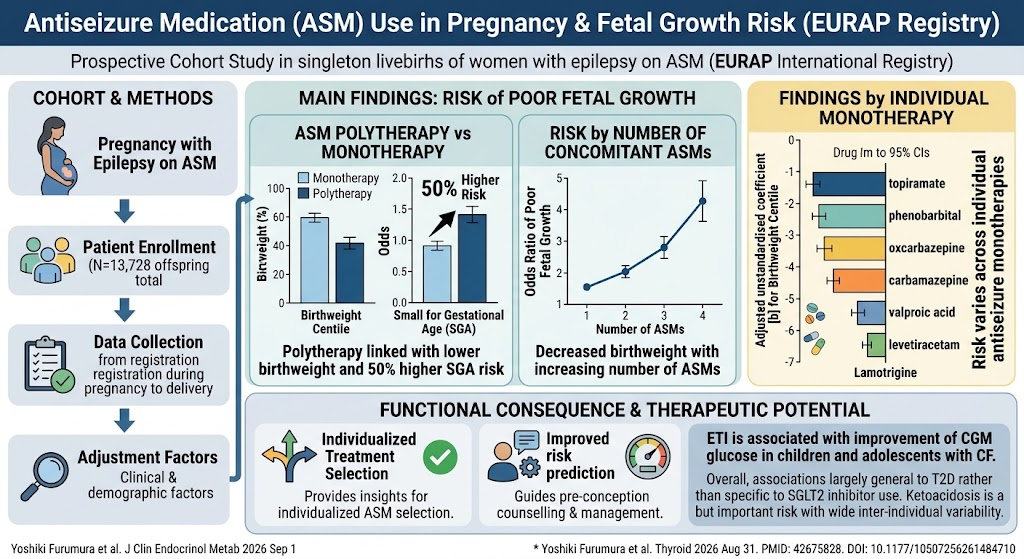
Compared to monotherapy, polytherapy exposure was associated with significantly lower birthweight centiles (adjusted coefficient -2.74, 95% CI -4.22 to -1.26). Offspring exposed to polytherapy had approximately 50% increased odds of being SGA (adjusted odds ratio [OR] 1.48), severe SGA (OR 1.49), and low birthweight (OR 1.50). Moreover, the decline in birthweight centile intensified with the number of concomitant ASMs used, notably a 14.18 percentile decrease with four ASMs relative to monotherapy.
Monotherapy-Specific Effects
Significant variability in birthweight centile was observed among different ASMs. Relative to lamotrigine, the following monotherapies were associated with decreasing birthweight centiles (adjusted coefficients): topiramate (-11.93), phenobarbital (-8.08), oxcarbazepine (-5.10), carbamazepine (-3.15), valproic acid (-2.54), and levetiracetam (-2.51). These results indicate that certain ASMs, particularly topiramate and phenobarbital, carry a higher risk of poor fetal growth.
Effects of ASM Combinations
Among specific ASM combinations, carbamazepine plus levetiracetam was associated with a lower birthweight centile compared to lamotrigine monotherapy (adjusted coefficient -6.27). In contrast, lamotrigine combined with levetiracetam or valproic acid did not show significant differences in birthweight compared to lamotrigine monotherapy, suggesting some combinations may not exacerbate growth risks.
Expert Commentary
This large, prospective multinational study robustly reinforces the clinical imperative to carefully consider ASM selection during pregnancy. The clear dose-response relationship between the number of ASMs and fetal growth impairment provides mechanistic plausibility, likely due to additive or synergistic pharmacologic effects impacting placental function or fetal nutrition. Furthermore, the differential impact of specific ASMs guides clinicians towards safer treatment choices, with lamotrigine demonstrating the most favorable profile. Nevertheless, individualized seizure control remains paramount, and abrupt ASM discontinuation is contraindicated. These findings complement known teratogenic and neurodevelopmental risks, underscoring poor fetal growth as an additional key adverse outcome to factor into risk-benefit assessments.
Limitations include potential residual confounding despite comprehensive adjustment, and the observational design precludes establishing causality. Additionally, subgroup sizes for certain ASM combinations, such as four-drug regimens, were small, limiting definitive conclusions. Ongoing research should explore pharmacokinetic mechanisms and long-term child health outcomes.
Conclusion
In summary, antenatal antiseizure medication exposure is significantly associated with poor fetal growth outcomes, with risks escalating from monotherapy to polytherapy and differing substantially across specific ASMs. These findings advocate for enhanced preconception counseling and individualized therapeutic strategies to optimize both maternal seizure control and fetal development. Clinicians should prioritize monotherapy when feasible, favor ASMs with lower associated fetal growth risks such as lamotrigine, and carefully consider combination regimens. Integrating fetal growth risk assessment into clinical decision-making may improve perinatal outcomes among women with epilepsy.
Funding
Supported by Brain Australia, Neurological Foundation of New Zealand, Norman Beischer Medical Research Foundation, and Weary Dunlop Medical Research Foundation.
References
- Perucca P, Malpas CB, Berry-Noronha A, et al. Antiseizure medication use in pregnancy and the risk of poor fetal growth in the EURAP international registry: a prospective cohort study. Lancet Neurol. 2026 Sep;25(9):840-851. doi:10.1016/S1474-4422(26)00233-6.
- Tomson T, Battino D, Bonizzoni E, et al. Dose-dependent teratogenicity of valproate in mono- and polytherapy during pregnancy: Joint EURAP and North American AED pregnancy registries. Epilepsia. 2011 Mar;52(1):58-65. doi:10.1111/j.1528-1167.2010.02754.x.
- Holmes LB, Baker MW, Christensen J, et al. Risk of major malformations in offspring exposed to carbamazepine: a meta-analysis. Epilepsia. 2008 Jul;49(7):1171-1177. doi:10.1111/j.1528-1167.2008.01575.x.
This article was created using several editorial tools, including AI, as part of the process. Human editors reviewed this content before publication.