Highlight
Proximity to water pollutant-emitting industrial facilities is associated with increased risk of incident progressive supranuclear palsy (PSP).
Exposure to heavy metals, pesticides, organic, and inorganic pollutants contributes to risk elevation.
The risk relationship is distance-dependent, decreasing with distance from pollutant sources, and duration-dependent, with longer residential exposure conferring higher risk.
Findings support a potential environmental etiology in PSP pathogenesis, highlighting implications for public health and preventive strategies.
Background
Progressive supranuclear palsy (PSP) is a rare, fatal neurodegenerative disorder characterized by parkinsonism, postural instability, vertical gaze palsy, and cognitive impairment. It is classified as a primary tauopathy due to the accumulation of abnormal tau protein aggregates in neurons and glia. PSP pathogenesis remains poorly understood, and there is no disease-modifying therapy. Environmental factors, particularly toxin exposure, have been proposed as contributing to PSP risk, but epidemiological evidence has been limited and inconclusive.
Waterborne pollutants represent a significant environmental hazard due to industrial emissions of heavy metals, pesticides, and organic and inorganic chemical compounds. The potential link between proximity to pollutant-emitting facilities and neurological diseases warrants investigation, as contaminants may bioaccumulate and disrupt neuronal pathways critical to tauopathy development. This study by Zhao et al. analyzes data from the UK Biobank to elucidate associations between residential proximity to water pollutant-emitting industrial facilities and subsequent diagnosis of incident PSP.
Study Design
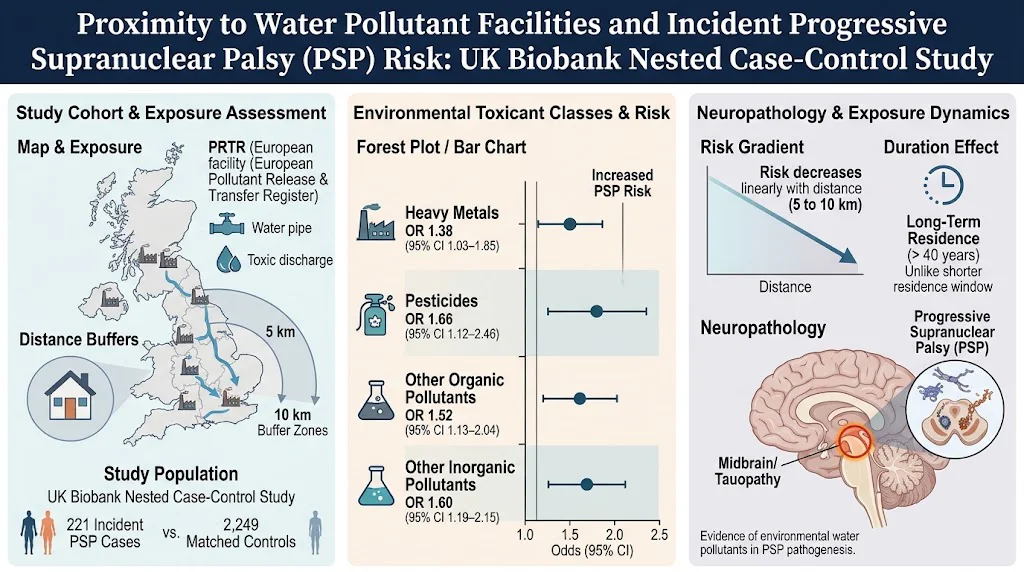
The authors performed a nested case-control study within the UK Biobank, a large prospective cohort of over 500,000 participants aged 40–69 years at recruitment. Incident PSP cases were identified during follow-up, with 221 new diagnoses confirmed. Each case was matched with approximately ten age- and sex-matched controls (n=2,249). Baseline residential addresses were geocoded and linked to facilities listed in the European Pollutant Release and Transfer Register (PRTR) from 2007, focusing on industrial sites emitting water pollutants.
Exposures were classified based on emission types: heavy metals, pesticides, other organic pollutants, and other inorganic pollutants. Proximity was analyzed as a continuous variable and by distance categories (e.g., within 5 km, 5–10 km). Duration of residence at the baseline address was examined to assess cumulative exposure effects. The primary endpoint was incident PSP diagnosis during follow-up. Conditional logistic regression models adjusted for relevant confounders assessed the associations between exposures and PSP risk, with multiple testing corrections applied.
Key Findings
The study found statistically significant associations between residential proximity to pollutant-emitting facilities and increased PSP risk across all pollutant categories examined. Specifically:
Heavy metals: Residents living near facilities emitting heavy metals had a 38% higher risk of PSP (OR 1.38; 95% CI 1.03–1.85).
Pesticides: Proximity to pesticide-emitting facilities showed the strongest association with a 66% increased risk (OR 1.66; 95% CI 1.12–2.46).
Other organic pollutants: Increased risk by 52% (OR 1.52; 95% CI 1.13–2.04).
Other inorganic pollutants: Increased risk by 60% (OR 1.60; 95% CI 1.19–2.15).
Notably, PSP risk decreased linearly as distance from pollutant sources increased beyond 5 km, with risk normalization beyond 10 km. This supports a dose-response relationship regarding environmental exposure. Furthermore, longer residential duration (>40 years) at baseline addresses correlated with heightened risk for heavy metals as well as organic and inorganic pollutants, emphasizing cumulative exposure effects. Shorter residence windows showed weaker or no significant associations.
The study’s robust methodology minimizes recall bias and incorporates comprehensive pollutant registration data. However, limitations include lack of individual-level exposure measurements, potential unmeasured confounding from socioeconomic or lifestyle factors, and the observational design, precluding causal inference.
Expert Commentary
These findings add compelling evidence toward environmental toxins in PSP pathogenesis, expanding beyond genetic susceptibility models. The demonstrated associations with diverse pollutant classes highlight the likely multifactorial and complex etiology of PSP. Pesticides, in particular, have been implicated in other neurodegenerative disorders like Parkinson’s disease, reinforcing plausibility. The distance- and duration-dependent effects observed align with toxicokinetic principles of exposure, bioaccumulation, and neurotoxicity.
Mechanistically, heavy metals such as manganese and pesticides can induce oxidative stress, mitochondrial dysfunction, and disrupt protein homeostasis, potentially accelerating tau aggregation and neurodegeneration. These pathways warrant further experimental verification. From a public health perspective, this study underscores the importance of regulatory measures to limit environmental contamination near residential areas and the critical need for surveillance of waterborne pollutants.
Future research should aim to integrate biomonitoring data, genetic susceptibility profiling, and longitudinal clinical assessments to better elucidate causal pathways. Interdisciplinary efforts bridging environmental science, neurology, and epidemiology will be pivotal in translating these findings into prevention and early intervention strategies.
Conclusion
This nested case-control analysis within the UK Biobank provides Class III evidence that residential proximity to water pollutant-emitting industrial facilities is associated with an elevated risk of incident PSP. Risk is influenced by pollutant type, exposure duration, and distance from emission sources, supporting an environmental contribution to PSP etiology. These insights have implications for disease prevention, policy development, and research priorities to address this debilitating neurodegenerative disorder.
Funding and Clinical Trials
The study was supported by institutional funding sources referenced in the original publication. There are no registered clinical trials associated with this epidemiological study.
References
Zhao CW, Stephen CD, Dale ML, et al. Proximity to Water Pollutant Facilities and Risk of Incident Progressive Supranuclear Palsy: Nested Case-Control Study of the UK Biobank. Neurology. 2026;107(10):e218750. PMID: 42950187.
Höglinger GU, Respondek G, Stamelou M, et al. Clinical diagnosis of progressive supranuclear palsy: The Movement Disorder Society criteria. Mov Disord. 2017;32(6):853-864.
Litvan I, Mangone CA, McKee AC. Environmental and genetic risk factors for progressive supranuclear palsy and other tauopathies. Neuropathol Appl Neurobiol. 2014;40(4):247-268.
Costello S, Cockburn M, Bronstein J, Zhang X, Ritz B. Parkinson’s disease and residential exposure to maneb and paraquat from agricultural applications in the Central Valley of California. Am J Epidemiol. 2009;169(8):919-926.