Antidepressant Continuation During Pregnancy and Its Impact on Postpartum Depression Risk Across Diverse Populations
Highlights
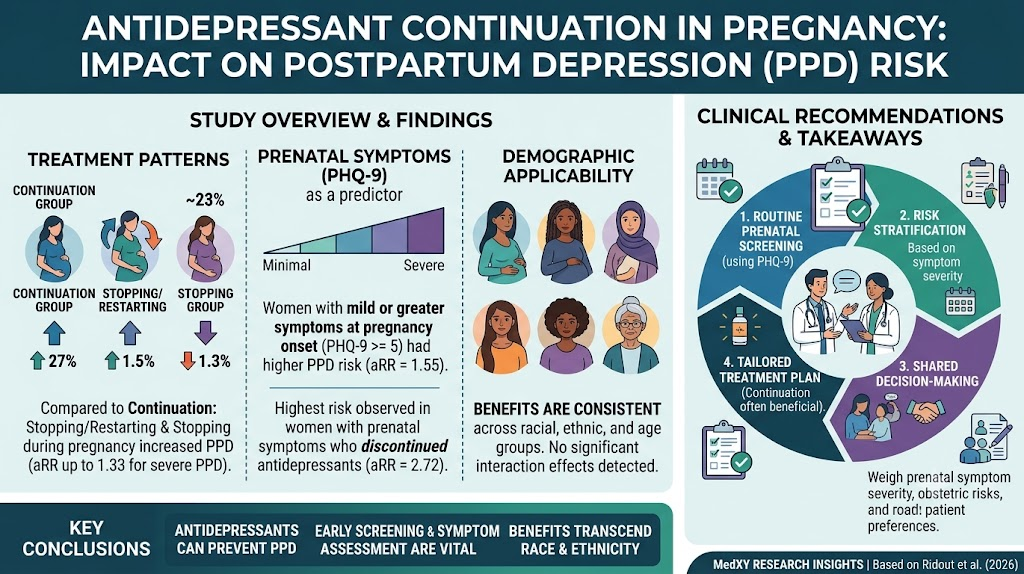
Continuing antidepressant medications during pregnancy is associated with a reduced risk of postpartum depression compared to stopping or intermittent use.
Severity of depressive symptoms at pregnancy onset strongly predicts postpartum depression risk, emphasizing the importance of early screening.
Risk reduction benefits of antidepressant continuation do not significantly differ across racial, ethnic, or age groups, supporting broad clinical applicability.
Shared decision-making informed by prenatal depressive symptom severity is crucial to optimize maternal mental health outcomes.
Background
Postpartum depression (PPD) affects approximately one in seven women in the United States and represents a major public health concern due to its adverse impact on maternal and infant well-being. Antidepressant medications are recommended during pregnancy for select patients with a history of depressive disorders by obstetric and psychiatric professional societies. However, the use of antidepressants during pregnancy remains controversial, partially due to concerns regarding fetal safety and the complex balance of maternal mental health benefits versus potential risks. Importantly, prior evidence has not conclusively established whether continuation of antidepressant therapy throughout pregnancy effectively prevents PPD or if cessation may increase risk. Additionally, disparities in maternal mental health outcomes among racial and ethnic groups raise questions regarding differential antidepressant effectiveness and adherence patterns within diverse populations.
Key Content
Evidence from a Large Retrospective Cohort Study
The landmark retrospective cohort study by Ridout et al. (2026) examined postpartum depression risk in a large, racially and ethnically diverse cohort of 6,552 women with depressive disorders who were treated with antidepressants prior to pregnancy. Patients were categorized into three groups based on antidepressant medication refill history: continuation throughout pregnancy, stopping then restarting, and stopping during pregnancy altogether.
Postpartum depression was assessed via International Classification of Diseases diagnostic codes or Patient Health Questionnaire-9 (PHQ-9) scores ≥10 within one year postpartum, categorizing severity from mild to severe.
Key findings included:
Overall, 37.7% of the cohort developed postpartum depression.
Both stopping and stopping-then-restarting antidepressant groups had significantly increased adjusted relative risks (aRR) of PPD compared to the continuation group; aRR ranged from 1.14 (95% CI: 1.05–1.24) for moderate-severe PPD to 1.33 (95% CI: 1.09–1.62) for severe PPD in the stopping group.
Women exhibiting at least mild depressive symptoms on initial prenatal screening (PHQ-9 ≥5) had higher PPD risk (aRR=1.55; 95% CI: 1.45–1.65).
The highest risk was observed in women with prenatal depressive symptoms who discontinued antidepressants (aRR=2.72; 95% CI: 1.94–3.82) compared to those with minimal symptoms who continued therapy.
No significant interaction effects were detected by race, ethnicity, or age, indicating consistent antidepressant continuation benefits across demographic groups.
Related Literature on Pharmacologic and Maternal Factors Affecting PPD
Several supplementary studies contextualize the Ridout et al. findings:
Antiseizure Medications and PPD Risk: A 2025 prospective observational study by Hardy et al. compared postpartum depression rates among pregnant patients with epilepsy on lamotrigine versus levetiracetam monotherapy. PPD incidence (~12%) did not significantly differ by antiseizure medication class despite their distinct neuropsychiatric profiles, though higher PPD risk correlated with antidepressant use in pregnancy and non-white race, paralleling mental health disparities noted in broader perinatal populations.
Maternal Comorbidities and Perinatal Depression: A 2009 retrospective cohort analysis illustrated nearly doubled odds of perinatal depression among women with either prepregnancy or gestational diabetes, underlying the importance of comorbid medical conditions in modulating depression risk and complicating management strategies during pregnancy and postpartum.
Safety Considerations – Postpartum Hemorrhage: A 2017 matched cohort study highlighted increased risk of postpartum hemorrhage associated with serotonergic and other psychopharmacologic medications, underscoring the need to balance maternal mental health treatment benefits against obstetric risks.
Therapeutic and Clinical Implications
This synthesis supports current guideline consensus that continuation of antidepressant therapy during pregnancy can confer protective benefits against postpartum depression, particularly in women with baseline depressive symptoms. It highlights the critical role of routine prenatal depression screening using validated instruments such as the PHQ-9, which informs tailored risk stratification and therapeutic decision-making. Importantly, the consistent beneficial association across races and ethnicities suggests equitable efficacy of antidepressant continuation, mitigating concerns about differential treatment effects across populations.
Clinicians should incorporate personalized, shared decision-making that weighs the severity of antenatal depressive symptoms, potential obstetric risks, and patient preferences. Continuous monitoring throughout pregnancy and postpartum is vital to identify emergent symptoms and adapt treatment accordingly. Additionally, awareness of comorbid conditions such as diabetes that amplify depression risk can prompt enhanced surveillance and multidisciplinary support.
Expert Commentary
The Ridout et al. study provides robust real-world evidence from a sizable, diverse cohort, addressing a critical gap concerning antidepressant management during pregnancy. The methodology — including exclusion of bipolar disorder, psychotic, and active substance use disorders — strengthens internal validity by focusing on unipolar depression treated with antidepressants.
The absence of effect modification by race or ethnicity is particularly noteworthy given persistent maternal health disparities, suggesting that pharmacologic antidepressant benefits transcend sociocultural differences. However, nuanced factors such as social determinants of health, adherence patterns, and healthcare access were not the primary focus and remain areas for further investigation.
While the association between medication discontinuation and increased PPD risk aligns with biological plausibility based on neurotransmitter modulation, observational study designs cannot exclude residual confounding or indication bias. Also, safety concerns noted in related studies, such as increased postpartum hemorrhage risk with serotonergic agents, necessitate cautious balancing of risks and benefits.
Emerging data on other psychotropic agents and their obstetric effects could further refine perinatal psychopharmacology guidelines. Future research should include randomized controlled trials assessing both maternal and fetal outcomes, stratified by demographic and clinical variables, to inform optimized individualized treatment pathways.
Conclusion
Evidence indicates that continuation of antidepressant medication during pregnancy is associated with a lower risk of developing postpartum depression across diverse racial and ethnic groups. Severity of prenatal depressive symptoms is a critical predictor of postpartum outcomes and should guide clinical decision-making. Clinicians are encouraged to implement systematic prenatal depression screening and engage in collaborative treatment discussions to optimize mental health in perinatal care. Continued interdisciplinary research is needed to elucidate mechanisms, safety profiles, and personalized management strategies in this complex population.
References
Ridout KK, Eswarappa C, Alavi M, et al. Antidepressant continuation in pregnancy and postpartum depression risk across racial and ethnic groups. Am J Obstet Gynecol. 2026 Jul 31;S0002-9378(26)00398-4. doi:10.1016/j.ajog.2026.07.031. PMID:42537893.
Hardy EP, et al. Comparative analysis of postpartum depression incidence in patients with epilepsy on levetiracetam or lamotrigine monotherapy during pregnancy. Epilepsy Behav. 2025 Oct;171:110599. doi:10.1016/j.yebeh.2025.110599. PMID:40684519.
Khalifeh H, et al. Increased postpartum haemorrhage, the possible relation with serotonergic and other psychopharmacological drugs: a matched cohort study. BMC Pregnancy Childbirth. 2017 Jun 2;17(1):166. doi:10.1186/s12884-017-1334-4. PMID:28577352.
Rubin DJ, et al. Association between diabetes and perinatal depression among low-income mothers. JAMA. 2009 Feb 25;301(8):842-7. doi:10.1001/jama.2009.201. PMID:19244191.
This article was created using several editorial tools, including AI, as part of the process. Human editors reviewed this content before publication.