Balancing Maternal Mental Health and Fetal Safety: Insights on Depression and SSRI Use During Pregnancy
Introduction
Major depressive disorder (MDD) during pregnancy poses substantial risks to maternal well-being and perinatal outcomes. Selective serotonin reuptake inhibitors (SSRIs) are among the most commonly prescribed antidepressants during pregnancy, yet the decision to use them remains complex due to potential risks and benefits to both mother and fetus. This article synthesizes current evidence and explores how clinical care can best prioritize maternal mental health while addressing fetal safety concerns.
Highlight
- Approximately 5% to 6% of pregnant individuals in the United States are treated with SSRIs, primarily for MDD, which affects about 12% of this population.
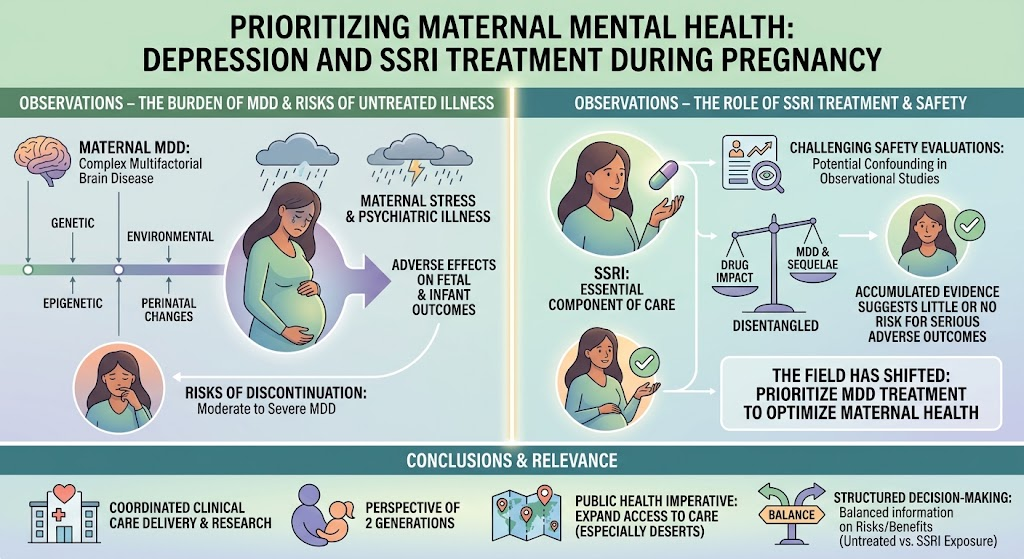
- MDD is a multifactorial brain disease intensified by perinatal factors, with untreated depression linked to adverse maternal and infant outcomes.
- Though early studies focused on risks associated with SSRI use during pregnancy, emerging evidence suggests low risk of serious adverse outcomes when confounding factors are accounted for.
- Expanding access to integrated psychiatric and obstetric care, especially in underserved areas, is critical for improving maternal and neonatal health.
Background: The Disease Burden of Perinatal Depression
Perinatal depression, encompassing depression during pregnancy and the postpartum period, affects roughly one in eight to one in ten women globally. Within the United States, MDD prevalence in pregnancy is estimated at 12%. Depression in this critical period contributes significantly to maternal morbidity and mortality, largely through increased risk of suicide and adverse behaviors including poor nutrition and substance use. Moreover, maternal depression is associated with negative fetal effects—including preterm birth, low birth weight, and impaired neurodevelopment—impacting child outcomes well beyond infancy.
Study Design Considerations and Challenges in SSRI Research
Most data analyzing SSRI safety in pregnancy derive from observational cohort and case-control studies rather than randomized controlled trials, due to ethical constraints. This creates challenges, chiefly confounding by indication; the underlying MDD itself may contribute to adverse pregnancy outcomes independently of treatment. Consequently, disentangling effects of the medication from those of maternal depression and comorbidities demands rigorous epidemiologic methods and comprehensive adjustment for confounders.
Key Findings and Clinical Implications
Evidence indicates that untreated moderate to severe MDD during pregnancy is associated with substantial risk, including poor prenatal care engagement, increased obstetric complications, and higher perinatal mortality. SSRIs, as a cornerstone of pharmacologic treatment, reduce depressive symptoms and improve maternal function.
Early concerns linked SSRIs to risks such as congenital malformations, persistent pulmonary hypertension of the newborn, and neonatal adaptation syndrome. However, refined analyses that control for depression severity and other confounders demonstrate that any excess risk is small and not clinically prohibitive for many women. For instance, the absolute risk increase for major congenital malformations is minimal.
Importantly, discontinuation of SSRIs has been associated with relapse of depression and adverse maternal outcomes. Psychological distress and increased stress hormone levels during untreated MDD episodes can adversely influence fetal brain development and birth outcomes.
Given these data, treatment decisions should not rely solely on fears of medication risks but rather incorporate a balanced evaluation of the risks posed by untreated maternal depression. A shared decision-making process is recommended, providing pregnant individuals with clear information on potential maternal and fetal risks and benefits.
Expert Commentary and Guidelines
Current psychiatric and obstetric guidelines endorse individualized risk-benefit assessments. Experts emphasize that SSRIs should not be withheld categorically from pregnant women requiring pharmacologic intervention. Instead, multidisciplinary teams involving psychiatrists, obstetricians, and pediatricians should collaborate to optimize care pathways.
Transient neonatal symptoms following SSRI exposure warrant monitoring but rarely necessitate long-term interventions. Longitudinal studies continue to investigate subtle neurodevelopmental outcomes, though conclusive evidence of significant harm remains lacking.
Moreover, social determinants and access disparities play crucial roles; women in psychiatric and maternity care deserts face amplified risks. Health systems should prioritize expanding mental health services integrated with prenatal care.
Conclusion
Managing depression during pregnancy requires a nuanced strategy prioritizing maternal mental health to safeguard two generations—the mother and her offspring. While SSRIs carry some risks, these are generally outweighed by the harms of untreated or undertreated depression. Coordinated care, expanded access, and shared decision-making are key pillars for improving outcomes. Future research should focus on refining risk stratification, optimizing nonpharmacologic and pharmacologic interventions, and enhancing support infrastructure.
Funding and Clinicaltrials.gov
The referenced article did not specify funding sources or ongoing clinical trial registrations directly. Continued investigation in this field is often supported by national health institutes and psychiatric research foundations.
References
1. Wisner KL, Oberlander TF, Osborne LM, Huybrechts KF. Depression and SSRI Treatment During Pregnancy-Prioritizing Maternal Mental Health. JAMA Psychiatry. 2026 Aug 12;PMID: 42584886.
2. Andrade SE, Raebel MA, Brown J, et al. Use of antidepressant medications during pregnancy: a multisite study. Am J Obstet Gynecol. 2008;198(2):194.e1-5.
3. Yonkers KA, Vigod S, Ross LE. Diagnosis, pathophysiology, and management of mood disorders in pregnant and postpartum women. Focus (Am Psychiatr Publ). 2011;9(4):369-384.
4. Molenaar NM, Brouwer ME, Neef C, et al. The risk of congenital malformations in children exposed to selective serotonin reuptake inhibitors during pregnancy: a systematic review and meta-analysis. Clin Ther. 2021;43(7):1136-1149.
5. American College of Obstetricians and Gynecologists. ACOG Practice Bulletin No. 92: Use of psychiatric medications during pregnancy and lactation. Obstet Gynecol. 2008;111(4):1001-1020.
This article was created using several editorial tools, including AI, as part of the process. Human editors reviewed this content before publication.