Study Background and Disease Burden
Heart failure with reduced ejection fraction (HFrEF) remains a major global health challenge characterized by impaired cardiac contractility and frequent clinical deterioration. Patients experience persistent symptoms, repeated hospitalizations, and elevated mortality risk, contributing to substantial healthcare burden and reduced quality of life. Despite advances in guideline-directed medical therapy (GDMT), event rates remain high, necessitating novel therapeutic options.
Vericiguat is an emerging soluble guanylate cyclase (sGC) stimulator that enhances the nitric oxide (NO)-sGC-cyclic guanosine monophosphate (cGMP) signaling pathway. This cascade plays a critical role in cardiovascular homeostasis, promoting vasodilation, reducing cardiac remodeling, and improving myocardial function. Previous pivotal studies, such as the VICTORIA trial, demonstrated vericiguat’s benefit in HFrEF patients with recent worsening heart failure events, notably reducing the composite of cardiovascular death or heart failure hospitalization.
However, the efficacy of vericiguat in a stable HFrEF population without recent decompensation has been unclear, as most prior trials focused on higher-risk cohorts with recent heart failure exacerbation. Addressing this gap, the VICTOR trial was designed to evaluate vericiguat in patients with chronic, stable HFrEF, aiming to discern if benefits observed in unstable patients extend to those without recent clinical deterioration.
Study Design
The VICTOR trial was a randomized, double-blind, placebo-controlled, phase III multicenter study conducted across 482 centers in 36 countries globally. It enrolled adult patients (≥18 years) with chronic HFrEF defined by a left ventricular ejection fraction (LVEF) ≤40%. Key inclusion criteria mandated clinical stability, requiring the absence of heart failure hospitalization within the previous six months and no intravenous diuretic use in the preceding three months, capturing a population with relatively lower short-term risk of acute decompensation.
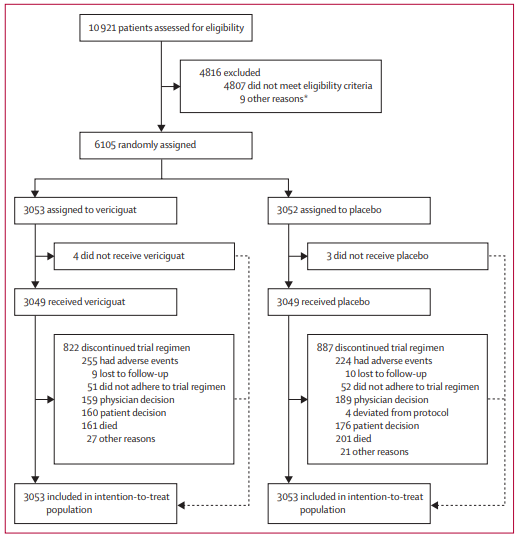
Participants were randomized 1:1 to receive either oral vericiguat (target dose of 10 mg daily) or placebo. The primary endpoint was a composite of cardiovascular death or first heart failure hospitalization. Secondary endpoints included individual components of the primary outcome, all-cause mortality, and safety assessments. The analysis followed the intention-to-treat principle with all randomized patients receiving at least one dose considered for safety.
Key Findings
Between November 2021 and December 2023, 10,921 patients were screened, and 6,105 were included in the final analysis (vericiguat n=3,053; placebo n=3,052). Baseline characteristics showed a median age of 68 years, 23.6% female, predominantly White ethnicity (64.4%), and nearly half (47.5%) without history of prior heart failure hospitalization. Median follow-up duration was 18.5 months.
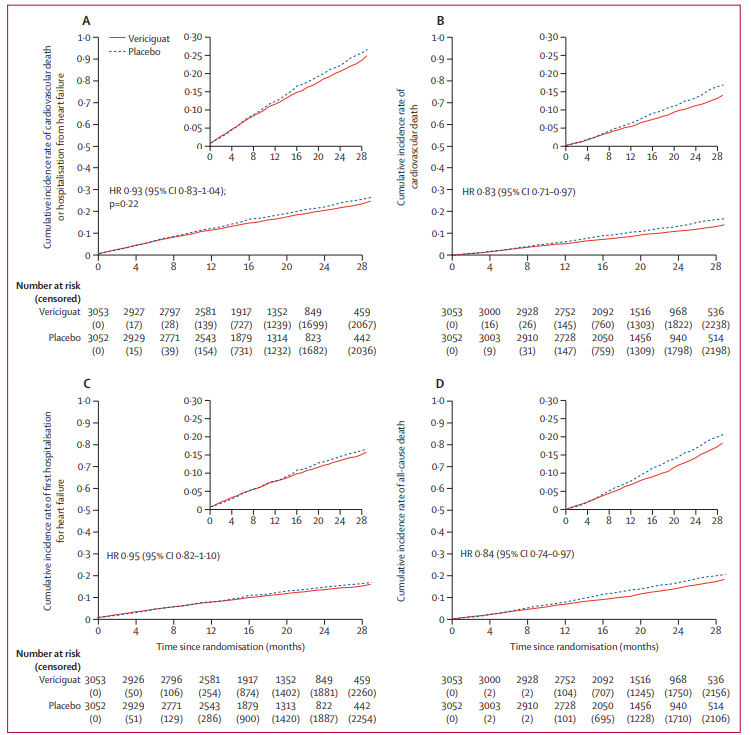
The primary composite endpoint occurred in 18.0% of patients in the vericiguat group versus 19.1% in the placebo group, yielding a hazard ratio (HR) of 0.93 (95% confidence interval [CI] 0.83–1.04; p=0.22), indicating no statistically significant difference. Examination of individual components revealed divergent effects: cardiovascular mortality was significantly reduced with vericiguat (9.6% vs. 11.3%; HR 0.83, 95% CI 0.71–0.97), whereas heart failure hospitalization rates were similar between groups (11.4% vs. 11.9%; HR 0.95, 95% CI 0.82–1.10).
All-cause mortality was also significantly lower in the vericiguat arm (12.3% vs. 14.4%; HR 0.84, 95% CI 0.74–0.97), underscoring a consistent mortality benefit beyond cardiovascular causes. Safety profiles were comparable between groups, although symptomatic hypotension was more common with vericiguat (11.3%) versus placebo (9.2%). Serious adverse events occurred in 23.5% of vericiguat-treated patients and 24.6% of placebo-treated patients.
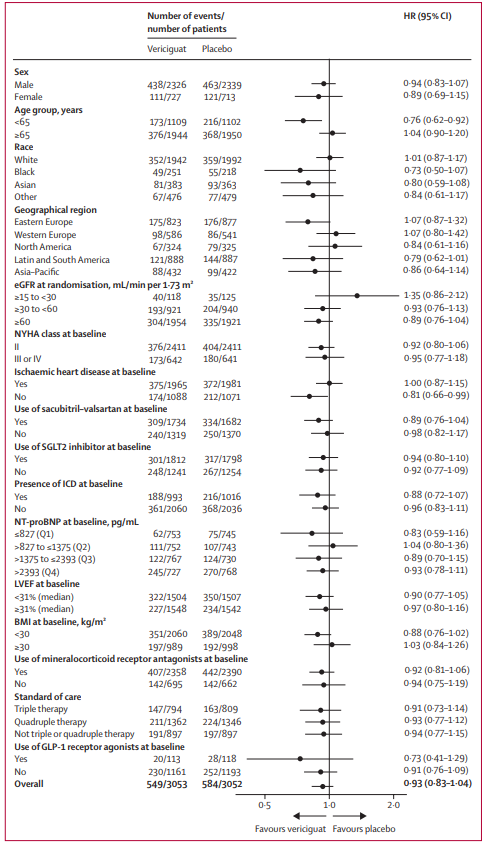
Subgroup analyses indicated the mortality benefits were consistent across major prespecified subgroups, including age, sex, baseline ejection fraction, and geographic region, suggesting broad applicability within the stable HFrEF population assessed.
Expert Commentary
The VICTOR trial provides pivotal insights into vericiguat’s role in stable chronic HFrEF patients who lack recent clinical worsening. While the failure to meet the primary composite endpoint may initially seem disappointing, the significant reductions in cardiovascular and all-cause mortality provide a compelling rationale for considering vericiguat as part of the therapeutic armamentarium focused on life prolongation.
These findings suggest that vericiguat’s primary contribution in this population may lie more in modulating disease progression and mortality risk rather than preventing heart failure hospitalizations, which were largely unchanged. This contrasts with previous studies in sicker cohorts where hospitalization risk was reduced, highlighting the heterogeneity of response based on patient risk and disease activity.
Biologically, vericiguat’s enhancement of the NO-sGC-cGMP pathway may confer cardioprotective effects such as improved myocardial energetics and reduced fibrosis, potentially explaining mortality benefit independent of acute decompensation episodes. Clinicians should carefully weigh the risk–benefit profile, particularly monitoring for symptomatic hypotension, and consider individualized patient risk to optimize therapeutic outcomes.
Limitations include the relatively low event rate in this stable population, which may have limited the power to detect differences in hospitalization rates. Additionally, longer follow-up may be needed to assess sustained benefit and safety.
Conclusion
The VICTOR trial delineates a nuanced clinical role for vericiguat in stable HFrEF patients without recent worsening events, demonstrating that while the primary composite endpoint was not significantly reduced, vericiguat effectively decreases cardiovascular and all-cause mortality. These results underscore the importance of tailoring heart failure therapies according to patient stability and risk profiles.
Future research should focus on identifying biomarkers or clinical features predicting optimal responders to vericiguat and elucidating mechanistic pathways underlying its mortality benefit. In clinical practice, vericiguat may serve as a valuable adjunct to GDMT in stable HFrEF patients, particularly in those at continued risk of fatal cardiovascular events despite stability.
References
Butler J, McMullan CJ, Anstrom KJ, et al. Vericiguat in patients with chronic heart failure and reduced ejection fraction (VICTOR): a double-blind, placebo-controlled, randomised, phase 3 trial. Lancet. Published online August 29, 2025. doi:10.1016/S0140-6736(25)01665-4 IF: 88.5 Q1
Armstrong PW, Pieske B, Anstrom KJ, et al. Vericiguat in patients with heart failure and reduced ejection fraction. N Engl J Med. 2020;382(20):1883-1893.
McMurray JJ, Packer M, Desai AS, et al. Angiotensin–neprilysin inhibition versus enalapril in heart failure. N Engl J Med. 2014;371(11):993-1004.