Upadacitinib for Severe Alopecia Areata in Adults and Adolescents: Evidence from Two Phase 3 UP-AA Randomized Clinical Trials
Highlights
- Upadacitinib, a selective Janus kinase 1 (JAK1) inhibitor, significantly reduced hair loss severity in adults and adolescents with severe alopecia areata (AA) in two parallel phase 3 trials.
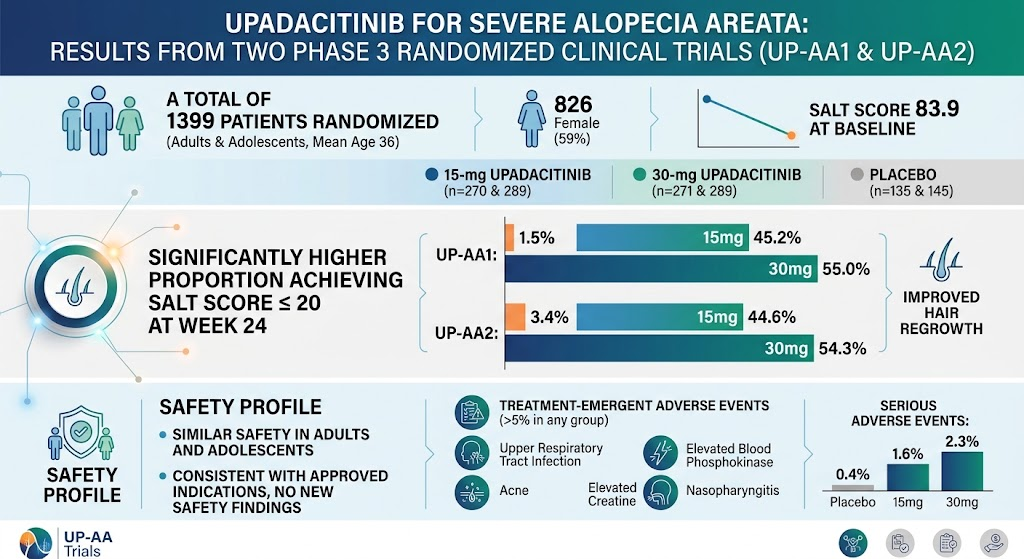
- The 24-week placebo-controlled periods demonstrated robust efficacy with over 44% to 55% of patients achieving a SALT score ≤20 with upadacitinib, versus less than 4% with placebo.
- Safety profiles were consistent across doses (15 mg and 30 mg daily) and age groups, with no new safety signals observed compared to other JAK inhibitors.
- These results fulfill an unmet clinical need in AA, particularly for adolescents, with upadacitinib representing a promising oral systemic therapy option.
Background
Alopecia areata (AA) is a chronic, immune-mediated disorder causing nonscarring hair loss. It affects approximately 2% of the population, with potentially profound psychological and quality of life impacts. Severe disease, defined by a Severity of Alopecia Tool (SALT) score ≥50, has historically lacked efficacious systemic therapies with acceptable safety, especially in adolescent patients. While ritlecitinib offers an approved option for adolescents, limitations in efficacy and safety necessitate exploration of additional systemic therapies.
JAK inhibitors have emerged as a novel therapeutic class for AA by modulating immune pathways critical to disease pathogenesis. Selective JAK1 inhibition by upadacitinib may offer potent efficacy while potentially reducing off-target effects observed with less selective JAK inhibitors.
Key Content
Evidence from Two Parallel Phase 3 Randomized Clinical Trials (UP-AA1 and UP-AA2)
These global, replicate phase 3 trials evaluated upadacitinib efficacy and safety in 1399 patients aged 12 to <64 years with severe AA (mean baseline SALT ~84). Both trials followed an identical design including a 24-week double-blind placebo-controlled treatment period followed by a 28-week blinded extension.
Patients were randomized 2:2:1 to once daily oral upadacitinib 15 mg, 30 mg, or placebo. The primary endpoint was achievement of SALT ≤20 (at least 80% scalp hair coverage) at week 24, with multiple secondary endpoints including eyebrow/eyelash regrowth and quality of life measures.
Efficacy Outcomes
– Both doses of upadacitinib significantly outperformed placebo in achieving SALT ≤20 at week 24 across both trials: 45.2% and 44.6% (15 mg), 55.0% and 54.3% (30 mg) vs 1.5% and 3.4% (placebo).
– Improvements were evident from as early as week 4, sustained through week 24.
– Higher proportions of patients also reached stringent endpoints such as SALT ≤10 and complete hair regrowth (SALT=0) compared to placebo.
– Clinician-reported outcomes reflected significant regrowth of eyebrows and eyelashes.
– Patient global impression scores indicated that most perceived much or moderate improvement by week 24.
Safety Profile
– Treatment-emergent adverse events were generally mild to moderate; common adverse events included upper respiratory tract infections, acne, elevated creatine phosphokinase, and nasopharyngitis.
– Serious adverse events occurred infrequently and were similar across doses: 1.6% (15 mg), 2.3% (30 mg), and 0.4% (placebo).
– No new safety signals emerged compared to established profiles of upadacitinib in other approved indications.
– Safety outcomes were consistent in both adolescents and adults.
Supporting Evidence from Real-World and Pediatric Data
– A 4.5-year retrospective cohort study of JAK inhibitors including upadacitinib reported favorable safety in AA and atopic dermatitis patients, with manageable metabolic and infection-related adverse events.
– Systematic reviews underscore promise for JAK inhibitors like upadacitinib as effective and tolerable treatments in pediatric dermatology, with ongoing phase 3 trials supporting regulatory expansion.
Expert Commentary
These phase 3 trials represent pivotal evidence establishing upadacitinib as a highly effective oral systemic therapy for severe AA, with significant hair regrowth and improvement in patient-centered outcomes achieved rapidly and maintained over time. The robust replicate design enhances confidence in reproducibility.
The selective JAK1 inhibition by upadacitinib may offer a favorable balance between efficacy and safety, although long-term surveillance remains important given theoretical risks associated with JAK inhibition such as infections and malignancies.
Clinicians should consider these data in the context of individual patient profiles, weighing benefits of rapid hair regrowth against rare serious adverse events. The inclusion of adolescents in these trials addresses a critical treatment void in this younger population.
Integration with existing therapies such as ritlecitinib and baricitinib will require individualized therapeutic decisions and further head-to-head studies.
Conclusion
Upadacitinib demonstrates a positive benefit-risk profile for adults and adolescents with severe alopecia areata, offering rapid and substantial hair regrowth and meaningful quality of life improvements. These two large phase 3 trials lay the groundwork for its potential regulatory approval and incorporation into treatment guidelines, fulfilling an unmet medical need in this difficult-to-treat population.
Future research should focus on longer-term safety, comparative effectiveness with other JAK inhibitors, and optimization of treatment duration and dosing strategies to maximize patient outcomes.
References
- Mostaghimi A, Gooderham MJ, Lynde C, et al. Upadacitinib for Severe Alopecia Areata in Adults and Adolescents: Two Phase 3 UP-AA Randomized Clinical Trials. JAMA Dermatol. 2026 Aug 12:e262853. doi:10.1001/jamadermatol.2026.2853. PMID: 42584887
- Esposito M, Galimberti M, Anzengruber F, et al. JAK Inhibitor Safety in Atopic Dermatitis and Alopecia Areata: A 4.5-Year Real-World Retrospective Cohort Study. Dermatol Ther (Heidelb). 2026 Jul 25. doi:10.1007/s13555-026-01867-y. PMID: 42501252
- Smith S, Ramanan AV, O’Neill JL. Emerging Treatments for Dermatologic Diseases in Children and Adolescents: Systematic Review of Biologics and Small Molecule Inhibitors. Inflammopharmacology. 2025;33(4):1617-1672. doi:10.1007/s10787-025-01675-4. PMID: 40042725
- Jones C, Nguyen T, Lee C. Biologics and Small Molecule Targeted Therapies for Pediatric Dermatologic Conditions: A Narrative Review. Children (Basel). 2024 Jul 25;11(8):892. doi:10.3390/children11080892. PMID: 39201826
This article was created using several editorial tools, including AI, as part of the process. Human editors reviewed this content before publication.