We use cookies

Our website uses essential cookies and, with your consent, additional cookies to measure performance and improve our services. Cookie Policy.

You can change your choice at any time.

MMedXYNews
HomeVideos
MedXY AI/MedXY News/Section: Cardiology

Unveiling Heart Failure with Preserved Ejection Fraction in Adults with Congenital Heart Disease: Prevalence, Characteristics, and Clinical Challenges

MedXY Editorial Team•Aug 12, 2026•Cardiology
congenital heart diseaseHFpEFcardiovascular hospitalizationSGLT2 inhibitorsAdult congenital heart disease
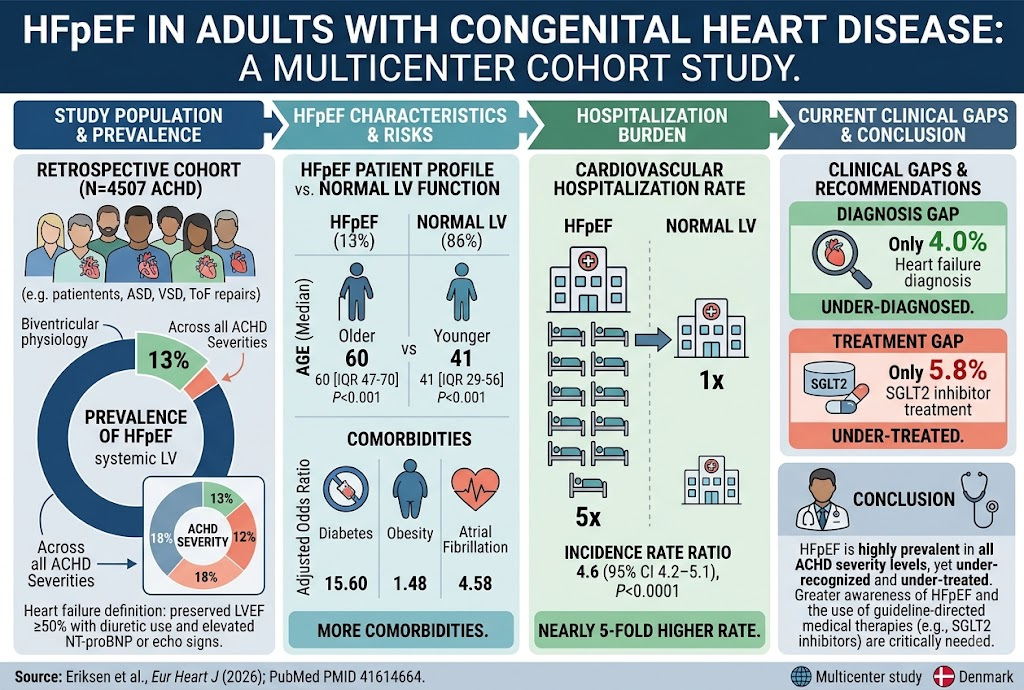
Highlight

Heart failure with preserved ejection fraction (HFpEF) is highly prevalent in adults with congenital heart disease (ACHD), affecting 13% of patients regardless of ACHD severity. Patients with HFpEF are older, with more comorbidities such as diabetes, obesity, and atrial fibrillation, and experience significantly higher cardiovascular hospitalization rates. Despite these risks, diagnosis rates are low, and use of guideline-recommended therapies like sodium-glucose cotransporter 2 (SGLT2) inhibitors remains limited.

Study Background

MedXY registered readers

Sign in free to continue reading

Create or use your MedXY account to unlock the complete article.

This article was created using several editorial tools, including AI, as part of the process. Human editors reviewed this content before publication.

Related articles

Open language-specific specialty feeds and department pages.

SGLT2 Inhibitors Enhance Recovery After Endovascular Thrombectomy in Diabetic Stroke Patients: A Multicenter Retrospective StudySGLT2 inhibitors administered after endovascular thrombectomy in diabetic stroke patients significantly improve 3-month functional outcomes, suggesting a promising adjunctive therapy for poststroke diabetes management.Sep 18, 2026Heart Failure in Portuguese Adults Aged 50 and Above: Insights from the PORTHOS Study on Prevalence and Predominant PhenotypesThe PORTHOS study reveals a 16.5% prevalence of heart failure among Portuguese adults aged 50+, with HFpEF constituting over 90% of cases, mostly undiagnosed, highlighting the need for enhanced screening strategies in aging populations.Sep 15, 2026Advancing Prognostic Precision in HFpEF: The LIFE-Preserved Risk Prediction ModelThe LIFE-Preserved model accurately predicts short-term and lifetime risks of heart failure hospitalization or cardiovascular death in HFpEF patients, enabling tailored clinical risk stratification and improved management.Sep 11, 2026
Loading comments...
MedXY briefing

Get the free newsletter

Evidence-led clinical news, trends, and analysis—delivered to your inbox.

Ask MedXY AI

Most popular

Intimate Health
Five Benefits for Women Continuing Sexual Activity After Menopause
Intimate Health
Why Some Women Have a Strong Sex Drive—And Why Men Shouldn't Worry About It
Nursing & care
How often should a couple have sex?
Intimate Health
Classic Intimacy Recommendations: How to Help Women Reach Orgasm and Enjoy Mutual Pleasure
Intimate Health
What Makes a Woman "Physiologically Addicted" Is Never Money, But These Two Relationship Qualities
© 2026 MedXY
Contact usAbout usPrivacy PolicyMedXY story
Ketoacidosis Risk with SGLT2 Inhibitors in Type 2 Diabetes: Insights from a Scandinavian Cohort Study
A large Scandinavian study reveals that ketoacidosis risk during SGLT2 inhibitor therapy in type 2 diabetes varies by patient factors and persists beyond early treatment, highlighting the need for ongoing risk assessment and management stra
Sep 5, 2026
Enhanced Outcomes with Combined Intrahepatic and Periduodenal Lymphatic Embolization in Congenital Heart Disease-associated Protein-Losing EnteropathyCombined intrahepatic and periduodenal lymphatic embolization significantly improves protein balance and remission duration in congenital heart disease patients with protein-losing enteropathy compared to intrahepatic embolization alone, ofAug 28, 2026
Unveiling the Role of Myeloid Cells in Right Ventricular Dysfunction in HFpEF via Sterile InflammationThis article explores how myeloid cell expansion drives right ventricular dysfunction in HFpEF through sterile inflammation, highlighting translational insights from murine models and human studies.Aug 22, 2026