We use cookies

Our website uses essential cookies and, with your consent, additional cookies to measure performance and improve our services. Cookie Policy.

You can change your choice at any time.

MMedXYNews
HomeVideos
MedXY AI/MedXY News/Section: Cardiology

Unraveling Right Ventricular Failure in PH-HFpEF: Integrative Insights from Vascular Mechanics and Transcriptomics
MedXY Editorial Team•Aug 25, 2026•Cardiology
Huyết Áp PhổiRight Ventricular Failuremyocardial transcriptomicsPH-HFpEFvascular remodeling

Highlight

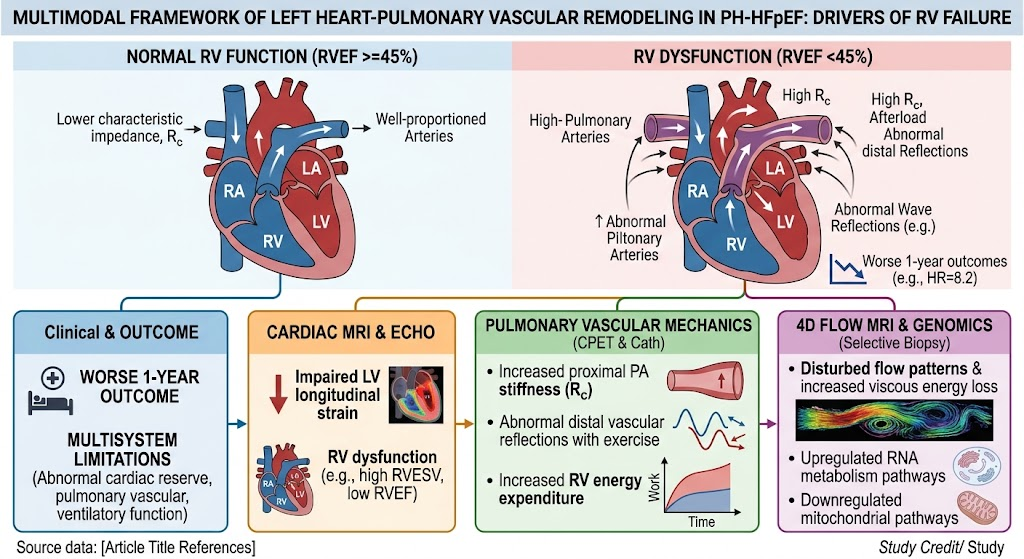
1. Right ventricular (RV) dysfunction in PH-HFpEF portends significantly poorer one-year clinical outcomes.
2. Advanced pulmonary vascular mechanics indicate segmental remodeling with increased arterial stiffness and abnormal wave reflections.
3. Four-dimensional flow MRI reveals perturbed blood flow and energy inefficiencies in left heart-pulmonary circulation.
4. Myocardial transcriptomics via long-read RNA sequencing highlights mitochondrial dysfunction and novel cardiac gene isoform alterations linked to RV failure.

Study Background

MedXY registered readers

Sign in free to continue reading

Create or use your MedXY account to unlock the complete article.

This article was created using several editorial tools, including AI, as part of the process. Human editors reviewed this content before publication.

Related articles

Open language-specific specialty feeds and department pages.

Refining Right Ventricular Assessment in Pulmonary Hypertension: Impact of Postprocessing Techniques on Cardiac MRI MetricsThis study examines how cardiac MRI postprocessing methods, including trabeculation exclusion and pulmonary artery flow measurement sites, significantly influence right ventricular volume and function assessment in pulmonary hypertension paSep 17, 2026Distinct Lipid Metabolic Profiles Unveil Pathophysiological Differences Between Postcapillary and Combined Pre- and Postcapillary Pulmonary HypertensionThis study reveals unique fatty acid and oxylipin metabolic signatures that differentiate isolated postcapillary pulmonary hypertension from combined pre- and postcapillary PH, highlighting potential biomarkers and therapeutic targets.Sep 15, 2026Unveiling PUS7’s Role in Pulmonary Hypertension: A Novel Epigenetic Driver of Vascular RemodelingThis article explores how PUS7-induced pseudouridylation of TGFBI mRNA promotes pulmonary hypertension via epigenetic regulation, revealing promising new therapeutic targets.Sep 5, 2026
Loading comments...
MedXY briefing

Get the free newsletter

Evidence-led clinical news, trends, and analysis—delivered to your inbox.

Ask MedXY AI

Most popular

Intimate Health
Five Benefits for Women Continuing Sexual Activity After Menopause
Intimate Health
Why Some Women Have a Strong Sex Drive—And Why Men Shouldn't Worry About It
Nursing & care
How often should a couple have sex?
Intimate Health
Classic Intimacy Recommendations: How to Help Women Reach Orgasm and Enjoy Mutual Pleasure
Intimate Health
What Makes a Woman "Physiologically Addicted" Is Never Money, But These Two Relationship Qualities
© 2026 MedXY
Contact usAbout usPrivacy PolicyMedXY story
Validating the Venous Excess Ultrasound Score (VExUS) for Right Atrial Pressure Assessment in Pulmonary Hypertension: A Multicenter Study
This multicenter study validates the Venous Excess Ultrasound Score (VExUS) as a highly accurate, noninvasive tool to predict right atrial pressure in patients evaluated for pulmonary hypertension, outperforming isolated echocardiographic m
Sep 3, 2026
Pulmonary Artery Stiffness and Right Ventricular Function: A Superior Predictor of Mortality in Mild Pulmonary HypertensionThis study reveals that pulmonary artery stiffness and right ventricular function parameters independently predict mortality better than pulmonary vascular resistance in mild pulmonary hypertension, supporting their role in early disease riAug 28, 2026
Hypoxia-Induced BACH1 Elevation Drives Pulmonary Hypertension via Activation of TGFBR2/SMAD SignalingBACH1 stabilization under hypoxia promotes pulmonary hypertension by enhancing TGFBR2/SMAD pathway activity in pulmonary artery smooth muscle cells, suggesting BACH1 as a promising therapeutic target for PH.Jul 15, 2026