Highlight
Delays in initiating appropriate antifungal therapy after hypotension onset increase mortality risks in Candida septic shock.
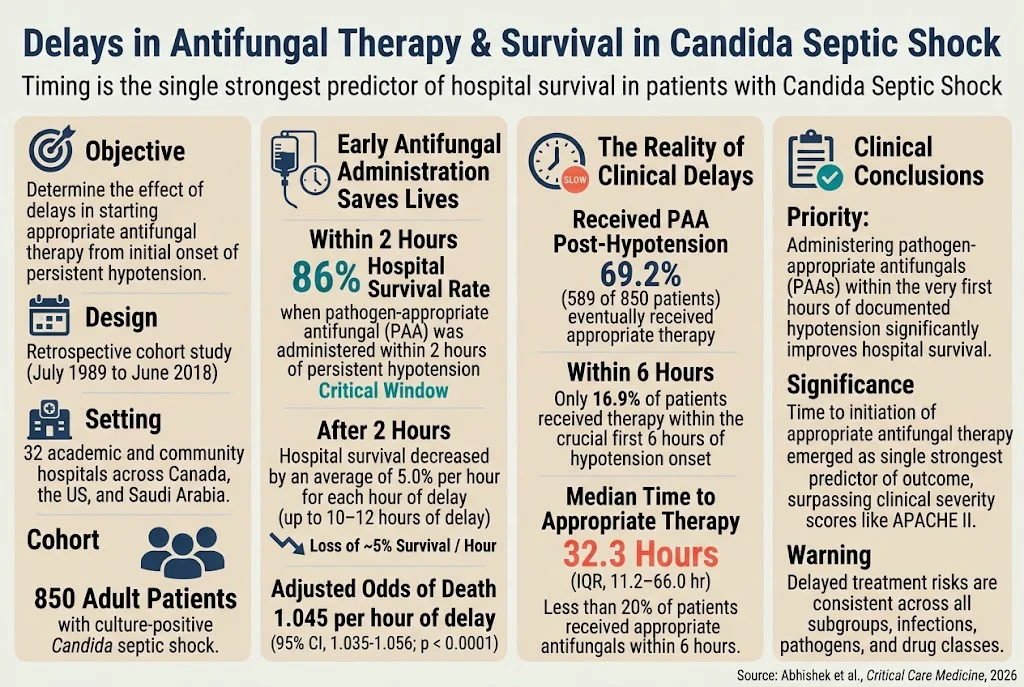
Each hour of delay corresponds to a 4.5% increase in odds of death.
Administering pathogen-appropriate antifungals within 2 hours of persistent hypotension onset yields an 86% survival rate.
Despite clear mortality benefits, only 16.9% of patients receive therapy within 6 hours, indicating a critical gap in clinical practice.
Study Background
Candida septic shock is a severe systemic infection caused by Candida species leading to persistent hypotension despite adequate fluid resuscitation and requiring vasopressor support. It is associated with high mortality rates ranging from 40% to 60%, largely due to delayed diagnosis and treatment. Rapid administration of appropriate antifungal therapy is considered crucial, but the precise timing from hypotension onset to therapy initiation and its impact on survival has not been quantitatively elucidated in a large multicenter cohort until this study. Understanding this timing is vital to optimize clinical interventions and improve patient outcomes in critical care settings.
Study Design
This retrospective cohort study analyzed 850 adult patients with culture-positive Candida septic shock admitted between July 1989 and June 2018 across 32 academic and community hospitals in Canada, the United States, and Saudi Arabia. Inclusion criteria included adults with documented persistent hypotension and confirmed Candida bloodstream infections. No interventions were applied as this was an observational study. The primary exposure was the time delay from the onset of persistent hypotension (initial documentation) to initiation of pathogen-appropriate antifungal (PAA) therapy. The primary endpoint was hospital survival.
Key Findings
Out of 850 patients, 589 (69.2%) received appropriate antifungal therapy after onset of persistent hypotension. The median time to appropriate antifungal therapy was 32.3 hours (interquartile range 11.2–66.0 hours). Notably, only 16.9% of patients received therapy within 6 hours after hypotension onset.
A strong, statistically significant association was observed between the delay in antifungal administration and hospital mortality. The adjusted odds ratio (OR) for death increased by 1.045 per hour of delay (95% CI 1.035-1.056; p < 0.0001), reflecting a 4.5% increase in odds of death for each hour without appropriate treatment.
Survival probability was highest if appropriate antifungal therapy was administered within 2 hours of hypotension onset, reaching 86%. Beyond this window, hospital survival progressively declined by about 5% per hour of delay up to 10-12 hours post-onset. After this period, survival plateaued at a low level.
Multivariate analysis adjusting for severity of illness (Acute Physiology and Chronic Health Evaluation II score), epidemiological factors, and therapeutic variables identified time to antifungal therapy as the most potent predictor of survival.
Sensitivity analyses across subpopulations including various Candida species, infection sources, and antifungal classes confirmed the consistent detrimental effect of treatment delays.
Expert Commentary
This large, multicenter cohort analysis highlights the paramount importance of rapid initiation of appropriate antifungal therapy in patients with Candida septic shock accompanied by persistent hypotension. The strength of the association and its consistency across subgroups underscore the biological plausibility that early fungal clearance mitigates ongoing circulatory collapse and organ dysfunction.
These findings align with established sepsis principles where early antimicrobial administration substantially influences outcomes. However, fungal sepsis is often underrecognized or diagnosed late, contributing to prolonged delays documented here.
Challenges remain in early Candida identification and in selecting the optimal antifungal empirically before culture confirmation. The study underscores the need for improved diagnostic stewardship, rapid fungal detection technologies, and increased clinician awareness to facilitate timely therapy initiation.
Limitations include the retrospective design and potential confounding, although careful multivariate adjustment was performed. Practice patterns evolved over the nearly three decades of data collection, possibly influencing some variability. Yet, the robust association suggests genuine clinical impact of treatment delays.
Conclusion
The study establishes delay from persistent hypotension onset to appropriate antifungal therapy as the critical determinant of hospital survival in Candida septic shock. Nearly fivefold mortality increase per 12-hour delay highlights an urgent clinical priority to deliver pathogen-directed antifungal agents within the initial hours of shock.
Improving timely recognition and antifungal delivery in critically ill patients can translate into substantial survival gains. Future research should focus on implementing rapid diagnostics and protocols that streamline early treatment initiation, ultimately reducing mortality from this devastating fungal infection.
Funding and Clinical Trials
No specific interventions or funding sources were indicated for this retrospective analysis. The study utilized the Cooperative Antimicrobial Therapy of Septic Shock (CATSS) database.
References
1. Abhishek A, Mashhadiagha G, Ramezani A, et al. Delay From Hypotension Onset to Appropriate Antifungal Therapy Initiation Is the Critical Determinant of Outcome in Candida Septic Shock. Crit Care Med. 2026 Oct 21. PMID: 42904906.
2. Pappas PG, Kauffman CA, Andes DR, et al. Clinical Practice Guideline for the Management of Candidiasis: 2016 Update by the Infectious Diseases Society of America. Clin Infect Dis. 2016;62(4):e1-e50.
3. Kollef MH, Powell D, Neely M, et al. Inadequate antimicrobial treatment of infections: A risk factor for hospital mortality among critically ill patients. Chest. 1999;115(2):462-474.