Time-Restricted Eating in Adults With Type 1 Diabetes: Safety and Glycemic Benefits Without Significant Weight Loss
Highlight
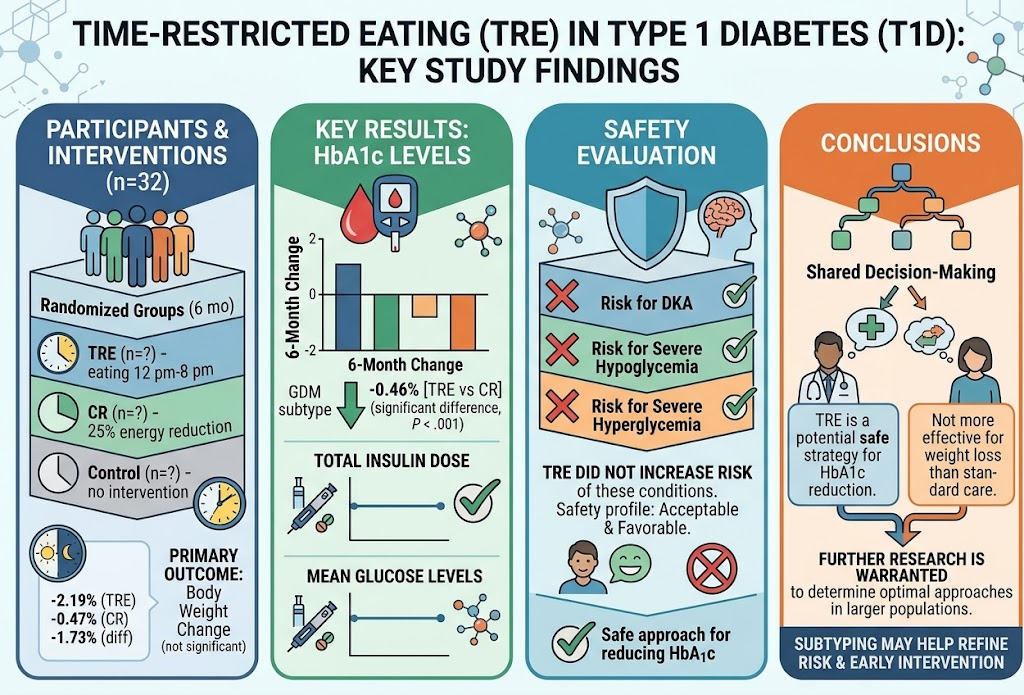
- Time-restricted eating (TRE) over 6 months is safe in adults with type 1 diabetes (T1D) who are overweight or obese.
- TRE significantly reduces HbA1c compared to daily calorie restriction, suggesting improved glycemic control.
- No significant differences in body weight change were observed between TRE, calorie restriction, and control groups.
- TRE does not increase risks of diabetic ketoacidosis, severe hypoglycemia, or severe hyperglycemia in this population.
Study Background
Overweight and obesity are common comorbidities in adults with type 1 diabetes (T1D), contributing to increased cardiovascular risk and complicating glycemic management. Effective weight loss strategies are needed to mitigate these risks. Time-restricted eating (TRE), which confines daily food intake to a limited time window without deliberate calorie counting, has emerged as a potential approach to promote weight loss and improve metabolic health. However, the safety and efficacy of TRE in T1D patients have not been thoroughly investigated, particularly given their unique risk profile for hypoglycemia and ketoacidosis. This study addresses an important clinical gap by rigorously evaluating TRE’s impact on body weight, glycemic control, and safety outcomes in adults with T1D and overweight or obesity.
Study Design
This was a 6-month randomized controlled trial involving 32 adults with T1D and overweight or obesity. Participants were randomized into three groups: (1) an 8-hour TRE group, instructed to consume all meals between 12:00 p.m. and 8:00 p.m. without calorie counting; (2) a daily calorie restriction (CR) group aiming for 25% energy reduction; and (3) a no-intervention control group. The primary endpoint was percent change in body weight at 6 months. Secondary endpoints included HbA1c levels, total insulin dose, mean glucose levels, and adverse events such as diabetic ketoacidosis (DKA) and severe hypoglycemia or hyperglycemia.
Key Findings
By 6 months, participants in the TRE group experienced a modest but non-significant body weight reduction of -2.19% (95% CI: -5.70 to 1.31) relative to baseline. Similarly, the CR group showed a -0.47% change (95% CI: -4.72 to 3.78), and neither intervention differed significantly from the control, nor from each other in terms of weight loss.
Importantly, the TRE group demonstrated a statistically significant reduction in HbA1c compared to the CR group, with a between-group difference of -0.46% (95% CI: -0.80 to -0.12), suggesting improved long-term glycemic control despite comparable insulin dosing and mean glucose levels.
Safety outcomes were reassuring: TRE did not increase incidences of DKA, severe hypoglycemia, or severe hyperglycemia compared with controls, addressing a common concern about prolonging fasting times in T1D.
These results indicate that TRE is a safe nutritional intervention in T1D adults with overweight or obesity, conferring glycemic benefits without added adverse events, although it may not offer a clear advantage over calorie restriction for weight loss.
Expert Commentary
The study by Runchey et al. contributes valuable evidence on the role of TRE in T1D, a population often excluded from intermittent fasting trials due to safety concerns. The glycemic improvement observed with TRE, independent of weight loss, raises interesting questions about the metabolic effects of meal timing modulation beyond calorie reduction. Potential mechanisms include circadian rhythm alignment affecting insulin sensitivity and glucose metabolism. However, the sample size was limited, and adherence to TRE, as well as qualitative effects on lifestyle and energy balance, were not deeply explored.
Moreover, the lack of significant weight loss could reflect the challenges of weight management in T1D and variability in individual behavior. Larger trials with longer follow-up and comprehensive metabolic phenotyping are needed to confirm these findings and elucidate mechanisms.
Clinicians should consider individual patient preferences, potential barriers, and close glucose monitoring when advising TRE in T1D. Importantly, safety data here support cautious adoption under medical supervision.
Conclusion
In adults with T1D and overweight or obesity, time-restricted eating over six months is a safe dietary intervention associated with modest glycemic improvement, as indicated by reduced HbA1c, but does not appear to produce superior weight loss compared with calorie restriction or no intervention. These findings support TRE as a viable option for enhancing glycemic control without increasing risk for severe metabolic complications. Future research should focus on optimizing TRE protocols tailored to T1D, exploring long-term effects, and understanding the metabolic pathways involved.
Funding and Registration
The trial was supported by [information not provided in the abstract]. Trial registration details were not included but can be accessed via PubMed PMID: 42606524.
References
Runchey MC, Corapi S, Pavlou V, et al. Efficacy and Safety of Time-Restricted Eating in Adults With Type 1 Diabetes: A Randomized Controlled Trial. Diabetes Care. Published August 17, 2026. PMID: 42606524.
This article was created using several editorial tools, including AI, as part of the process. Human editors reviewed this content before publication.