Highlight
This 10-year prospective cohort study investigated surgical management of peri-implantitis combining deproteinised bovine bone mineral with 10% collagen (DBBMC), enamel matrix derivative (EMD), and doxycycline powder for implant surface decontamination and defect fill. Key findings demonstrate a high implant survival rate (96.6%) and significant improvements in probing depths and bone levels with stable clinical outcomes over a decade. Individualised supportive peri-implant therapy (SPIT) played a critical role in long-term maintenance and adjunctive antibiotic use.
Study Background
Peri-implantitis is a chronic inflammatory condition affecting dental implants characterized by progressive alveolar bone loss and peri-implant soft tissue inflammation. It poses a significant challenge in implant dentistry due to its potential to compromise implant survival and patient quality of life. Despite various treatment modalities, long-term outcomes following surgical therapy remain under-evaluated. There remains an unmet clinical need for evidence-based protocols combining regenerative biomaterials with antimicrobial adjuncts to optimize peri-implantitis management and implant longevity.
Study Design
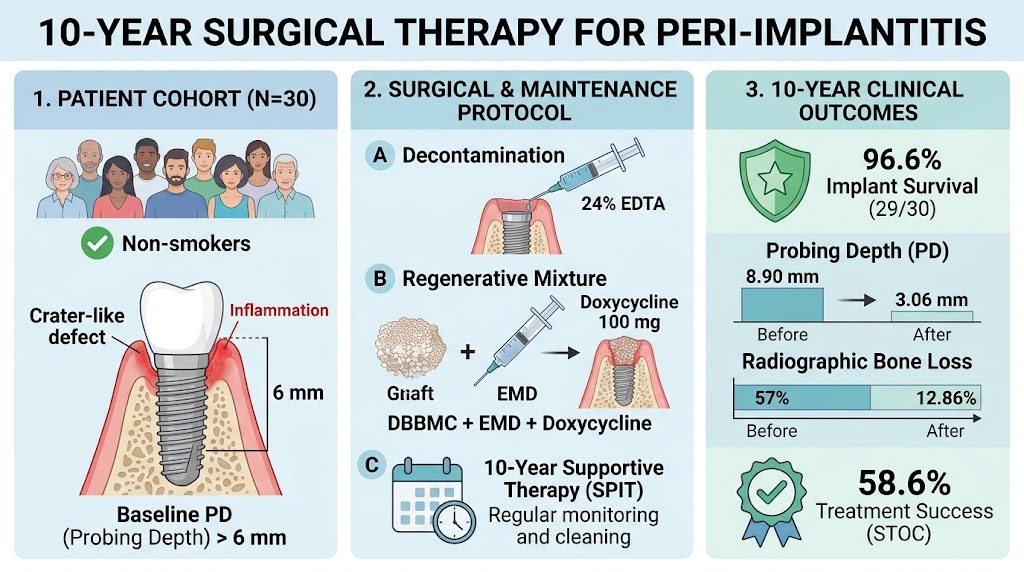
This investigation performed was a prospective cohort study involving 30 systemically healthy, non-smoking patients (mean age 44.9 ± 11 years; 64% female) who were periodontally stable and each presented with a single dental implant diagnosed with peri-implantitis. Inclusion criteria comprised evidence of disease at implants in function for at least 2 years, probing depth >6 mm, bleeding on probing, and ≥20% radiographic bone loss.
The surgical protocol included implant surface decontamination with 24% ethylenediaminetetraacetic acid (EDTA), followed by defect augmentation using a mixture of DBBMC (deproteinised bovine bone mineral with 10% collagen), enamel matrix derivative (EMD), and doxycycline powder. To maintain long-term stability, patients underwent individualized supportive peri-implant therapy (SPIT) entailing clinical monitoring, professional cleaning, and antimicrobial interventions as needed over 10 years.
Key Findings
The primary endpoint of implant survival at 10 years was achieved in 29 of 30 implants, resulting in a survival rate of 96.6%. Clinical parameters demonstrated significant improvement: mean probing depth decreased substantially from 8.90 ± 1.9 mm at baseline to 3.06 ± 0.98 mm at final follow-up (p < 0.001). Correspondingly, mean radiographic bone loss reduced markedly from 57% ± 16.5% baseline levels to 13% ± 2.5% at 10 years, indicating substantial defect bone fill and stabilization.
Supportive therapy effectively sustained these outcomes, although 12 implants required adjunctive systemic azithromycin therapy during SPIT to manage recurrent inflammation. A successful treatment outcome criterion (SOTC) was met in 58% of implants, defined by probing depth <5 mm, no bone loss exceeding 10% from baseline, absence of bleeding on probing or suppuration, and limited recession (<0.5 mm anterior or <1.5 mm posterior implants).
Adverse events were minimal, and no implant failures were directly related to the intervention. These results underscore the efficacy of combining surgical decontamination, regenerative biomaterials, adjunctive local and systemic antibiotics, and personalized maintenance protocols for sustainable peri-implant health.
Expert Commentary
These findings contribute valuable long-term evidence supporting the integration of deproteinised bovine bone mineral with collagen, enamel matrix derivative, and doxycycline in the surgical treatment of peri-implantitis. The use of 24% EDTA for implant surface detoxification is well-founded in biofilm disruption literature, while DBBMC and EMD promote osteoconduction and regeneration of peri-implant bone defects.
The adjunctive application of doxycycline powder locally targets residual microbial biofilms, bolstered by systemic azithromycin when indicated during SPIT, highlighting a multimodal antimicrobial strategy. The study uniquely emphasizes the crucial role of stringent long-term supportive therapy tailored to individual risk profiles to ensure implant stability and prevent disease recurrence.
Limitations include the single-center design and lack of a randomized control group, which may affect generalizability. However, the rigorous 10-year follow-up period adds significant weight to the durability of clinical outcomes. Future studies could explore comparative effectiveness with other regenerative materials and antimicrobial regimens.
Conclusion
This prospective cohort study demonstrates that surgical management of peri-implantitis employing DBBMC, enamel matrix derivative, and doxycycline combined with personalized supportive peri-implant therapy achieves high long-term implant survival and significant improvements in clinical and radiographic parameters. These results advocate for incorporating regenerative biomaterials and targeted antimicrobials within comprehensive treatment protocols to sustainably restore peri-implant health. Ongoing patient-specific maintenance remains vital to prevent recurrence and maximize implant longevity.
Funding and Clinical Trials
The study did not specify external funding sources. No clinical trial registration information was provided.
References
Mercado F, Ivanovski S. Surgical Therapy for Peri-Implantitis Using Deproteinised Bovine Bone Mineral With 10% Collagen, Enamel Matrix Derivative and Doxycycline: A Prospective Cohort 10-Year Implant Study. J Clin Periodontol. 2026 Oct;53(10):1575-1584. doi: 10.1111/jcpe.70175. Epub 2026 Jul 23. PMID: 42492913; PMCID: PMC13581473.