Highlights
Large-scale prospective data reveals procedure-specific postoperative pain trajectories after dental interventions using mobile health technology.
Multiple dental procedures and surgical periodontal interventions confer the highest risk of moderate-to-severe postoperative pain and functional interference.
Opioid use decreases substantially within the first postoperative week, with most patients managing pain through nonopioid analgesics.
Findings support tailored patient counseling and the development of procedure-specific nonopioid pain management protocols promoting opioid stewardship.
Background
Postoperative pain management remains a critical component of dental care to ensure patient comfort, optimize recovery, and minimize adverse medication-related effects. Despite advances in analgesic strategies, comprehensive patient-reported outcomes related to postoperative pain intensity, functional interference, and analgesic consumption across diverse dental procedures in real-world settings have been limited. The opioid crisis further underscores the importance of understanding pain trajectories to inform opioid prescribing practices and promote nonopioid alternatives in dentistry. The National Dental Practice-Based Research Network (PBRN) observational study utilized a mobile health (mHealth) platform to prospectively capture extensive patient-reported data on postoperative pain and analgesic use across multiple dental specialties, providing valuable insights into procedure-specific pain and recovery profiles.
Key Content
Study Design and Patient Population
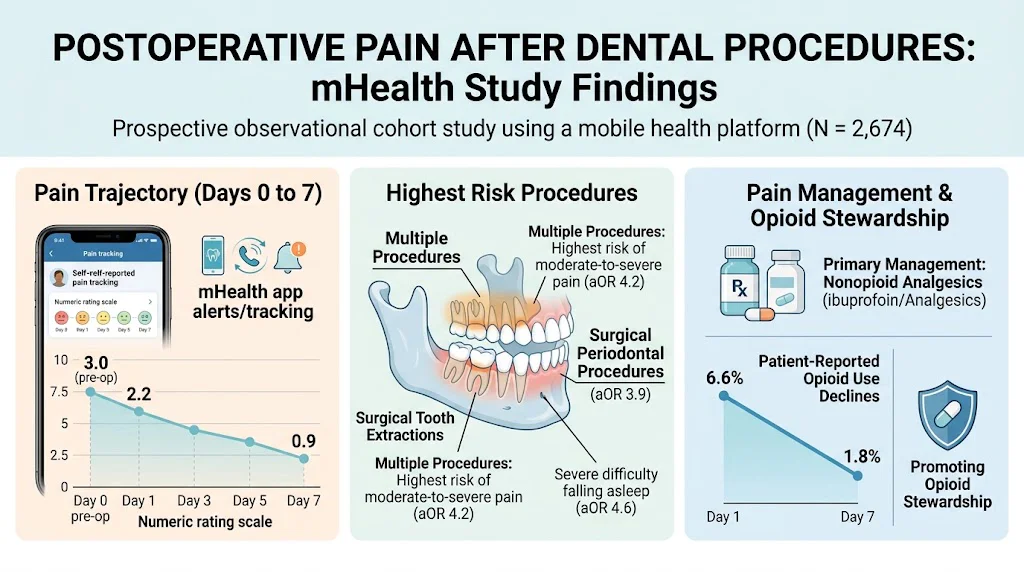
This prospective cohort study enrolled 2,674 adults (mean age 49.8 years, 55.6% female) from a multicenter US dental PBRN encompassing diverse practice settings. Participants undergoing endodontics, periodontal surgery, oral surgery, implant dentistry, or multiple procedures concurrently reported pain intensity and functional interference via a mobile application on days 0 (preoperative baseline), 1, 3, 5, and 7 post-procedure. Patient-reported medication use, including opioids and nonopioids, was also collected.
Postoperative Pain Intensity Trajectories
Pain intensity was measured using a validated numerical rating scale (0 = no pain, 10 = worst imaginable pain). Mean pain scores decreased steadily over the first postoperative week, from 3.0 preoperatively (day 0) to 2.2 on day 1 and 0.9 on day 7. Notably, pain trajectories varied significantly by procedure type. Multiple procedures performed at a single visit were associated with the highest odds of moderate pain (adjusted odds ratio [aOR] 4.2; 95% CI 2.1–8.5; P < .01). Surgical periodontal procedures also posed a high risk for moderate pain (aOR 3.9; 95% CI 1.9–8.2; P < .01), while endodontics and implant dentistry generally elicited lower pain intensity.
Functional Interference and Sleep Disturbance
Functional interference, including difficulties with daily activities and sleep, paralleled pain intensity trends. Participants undergoing multiple procedures reported the greatest odds of severe difficulty falling asleep (aOR 4.6; 95% CI 1.7–11.9; P < .01). These findings highlight the impact of dental surgical complexity on postoperative quality of life.
Analgesic Use and Opioid Stewardship
Patient-reported opioid use decreased sharply from 6.6% on day 1 to 1.8% by day 7 post-procedure. The majority of pain was managed effectively with nonopioid analgesics such as NSAIDs and acetaminophen. This observed reduction in opioid use supports the feasibility of opioid-sparing pain management protocols tailored to procedure-specific pain profiles.
Comparison with Prior Literature
Previous smaller studies and clinical trials mainly focused on isolated procedures and often relied on clinician-reported outcomes. This PBRN study stands out by leveraging mHealth tools to longitudinally capture patient-centric data across diverse dental procedures and settings. Earlier systematic reviews have similarly noted greater postoperative pain after surgical extractions and periodontal surgery, but lacked extensive real-world data on functional impairment and analgesic consumption trajectories. Guidelines by the American Dental Association advocate for multimodal nonopioid analgesic approaches; these findings provide contemporary empirical support for such recommendations in routine practice.
Expert Commentary
This large-scale study offers robust, generalizable insights into postoperative pain dynamics after dental interventions. The use of mobile health technology enables real-time, patient-reported outcomes capturing individual variation and temporal resolution beyond traditional approaches. The data compellingly demonstrate that dental pain is not uniform and that procedure type and number critically influence pain severity and recovery.
The finding that multiple procedures performed concurrently significantly increase pain and sleep disturbance warrants careful preoperative counseling and consideration of staged treatments when feasible. Moreover, the predominant use of nonopioid analgesics and steep decline in opioid use underscore the potential for optimized opioid stewardship without compromising pain control.
Mechanistically, surgical trauma from periodontal and oral surgeries likely triggers heightened inflammatory responses and nociceptor sensitization, accounting for increased pain and functional interference. Understanding these biological pathways can guide adjunctive therapies such as corticosteroids or localized analgesics to further improve outcomes.
Limitations include the potential for selection bias inherent in app-based reporting and lack of standardization in analgesic regimens. Future research should explore integration of patient genetic, psychosocial, and pharmacologic factors to personalize pain management. Additionally, expanded use of patient-centered digital tools can facilitate broader surveillance and quality improvement initiatives.
Conclusion
The National Dental PBRN observational study using a mobile health platform elucidates detailed postoperative pain and functional interference trajectories across common dental procedures. Surgical tooth extractions and multiple concurrent procedures confer the highest risk of moderate-to-severe pain and sleep disturbance. Importantly, most patients effectively manage pain with nonopioid analgesics, supporting opioid stewardship efforts.
These findings enable evidence-based patient counseling regarding expected pain courses and inform the development of procedure-specific, multimodal pain management protocols that minimize opioid reliance while optimizing patient comfort and functional recovery. Future directions include leveraging digital health technologies to personalize analgesic strategies and expand data-driven quality initiatives in dental care.
References
Walji MF, Yansane AI, Tungare S, et al. Postoperative pain after dental procedures: The National Dental Practice-Based Research Network observational study using a mobile health platform. J Am Dent Assoc. 2026;157(10):1162-1173.e6. doi:10.1016/j.adaj.2026.05.007. PMID: 42142092
American Dental Association. ADA Statement on Prescribing Opioids for Dental Pain. 2022.
da Silva MA, do Carmo MG, Secaf M, et al. Non-opioid analgesics for postoperative dental pain: A systematic review and meta-analysis. J Oral Rehabil. 2020;47(11):1403-1414. doi:10.1111/joor.13077. PMID: 32883192
Moore PA, Ziegler KM, Lipman RD, et al. Benefits and harms associated with analgesic medications used in the management of acute dental pain: An overview of systematic reviews. J Am Dent Assoc. 2018;149(4):256-265.e3. doi:10.1016/j.adaj.2017.12.018. PMID: 29655974
Chang PC, Cleveland J, Gibbs JL, et al. Patient-Reported Outcomes and Pain Management Following Third Molar Extractions: A Systematic Review. Oral Surg Oral Med Oral Pathol Oral Radiol. 2021;131(1):19-27. doi:10.1016/j.oooo.2020.07.009. PMID: 32905353