Highlight
Surgical therapy success for peri-implantitis correlates with increased microbial network connectivity and centrality of commensal species.
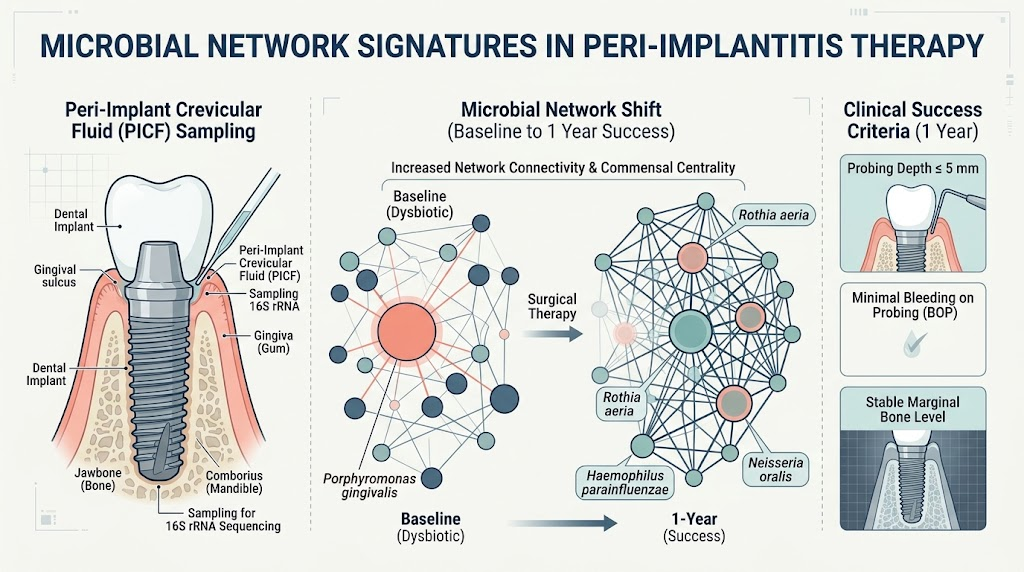
Significant shifts in microbial composition occurred over one year in successful cases, notably increases in Rothia aeria, Haemophilus parainfluenzae, and Neisseria oralis.
Network analysis identified a Porphyromonas gingivalis-associated module enriched with high-centrality commensals at baseline, suggesting potential microbial interactions predictive of clinical outcomes.
Study Background
Peri-implantitis is a prevalent inflammatory condition characterized by progressive bone loss around dental implants, which can ultimately compromise implant stability and function. It represents a significant clinical challenge due to its multifactorial etiology and the limited predictability of current treatment modalities. The microbial biofilm around implants plays a pivotal role in pathogenesis, but the complexity of microbial community interactions and their contribution to treatment outcomes remains incompletely understood. Understanding microbial network signatures offers an innovative approach to deciphering these complex biofilms, potentially leading to improved prognostic markers and therapeutic strategies to enhance peri-implantitis management.
Study Design
This investigation is a secondary analysis nested within a 1-year randomized controlled trial comprising 28 patients, each with one peri-implantitis-affected implant. Patients underwent surgical intervention for peri-implantitis, and outcomes were evaluated over 12 months. Based on a composite clinical endpoint—probing depth ≤ 5 mm, minimal bleeding on probing, and absence of further marginal bone loss—implants were retrospectively classified as successful (n=10) or non-successful (n=18). Peri-implant crevicular fluid samples were collected at baseline, 3, 6, and 12 months post-treatment and subjected to 16S rRNA gene sequencing to characterize the microbial communities.
Key Findings
A significant shift in microbial composition from baseline to one year was observed exclusively within the successful group, indicating dynamic microbial changes in response to surgical therapy (p=0.001). This shift was marked by increased relative abundance of typically commensal bacteria, including Rothia aeria (p=0.048), Haemophilus parainfluenzae (p=0.033), and Neisseria oralis (p=0.025). These species are generally associated with oral health and may contribute to an ecological environment unfavorable for periopathogens.
Network analyses unveiled that at baseline, the successful group harbored a distinct microbial module associated with Porphyromonas gingivalis—a recognized periopathogen—but characterized by high centrality commensals. This suggests that the microbial community structure rather than single pathogen presence might influence treatment success. One year post-treatment, the successful group exhibited significantly higher network edge density (p=0.005) and connectivity (p=0.018), reflecting a more cohesive and potentially stable microbial ecosystem.
Correlation analyses further revealed significant negative associations at one year between P. gingivalis and commensal species such as H. parainfluenzae, various Streptococcus species, and Veillonella taxa (p<0.05). This antagonistic relationship suggests that commensal-dominated microbial networks may suppress pathogen persistence, contributing to favorable clinical outcomes.
No adverse events related to the surgical procedures or microbiological sampling were reported, indicating safety and feasibility of such longitudinal microbiome monitoring.
Expert Commentary
This exploratory study leverages microbial network analyses to identify biofilm community characteristics predictive of peri-implantitis treatment outcomes. The findings support the concept that not only the presence of periopathogens but their ecological interactions within the microbial community critically determine clinical trajectories. The enrichment of high-centrality commensals in successful cases implies a protective role of these bacteria, possibly through competitive inhibition or modulation of host immune responses.
However, the study’s small cohort size and secondary analysis nature call for cautious interpretation. Larger, prospective studies are necessary to validate microbial network signatures as robust biomarkers. Additionally, integrating host immune parameters and functional microbiome assessments might provide deeper mechanistic insights.
Current guidelines recognize the importance of microbial control in peri-implantitis management but lack specific recommendations based on microbial community structure. The present findings could pave the way for adjunctive microbiome-directed therapies, such as targeted probiotics or ecological modulation strategies, to enhance treatment efficacy.
Conclusion
This study provides preliminary evidence that peri-implantitis surgical therapy success is associated with increased microbial network connectivity and dominance of commensal species, which may antagonize key pathogens like P. gingivalis. These microbial network signatures represent promising biomarkers for predicting and potentially modulating treatment outcomes. Future research should focus on validating these findings in larger populations and exploring mechanistic underpinnings to inform precision periodontal implant care.
Funding and Clinical Trial Registration
This research was registered under the Korean Clinical Research Information Service with the number KCT0007900. Funding sources were not specified in the analyzed publication.
References
1. Park SH, Kim DM, Im S, et al. Microbial Network Signatures Associated With Outcomes of Peri-Implantitis Therapy. Journal of Clinical Periodontology. 2026; — PMID: 42860247.
2. Derks J, Håkansson J, Wennström JL, Tomasi C, Berglundh T. Effectiveness of surgical therapy on peri-implantitis: 6-month results. J Clin Periodontol. 2016;43(4):312-9.
3. Bartold PM, Van Dyke TE. An appraisal of the role of specific bacteria in the initial pathogenesis of periodontitis. J Clin Periodontol. 2019;46(1):6-11.
4. Socransky SS, Haffajee AD. Microbial Mechanisms in the Pathogenesis of Periodontal Diseases. Periodontol 2000. 1992;5:51-63.