Study Background
The global demographic shift toward an aging population has brought increased attention to the oral health challenges faced by older adults, particularly those who are dependent on others for daily care. Compared to earlier generations, individuals over 65 years exhibit substantially greater oral health needs due to natural tooth retention, comorbidities, polypharmacy effects, and functional impairments. Poor oral health in this group not only impacts quality of life but also exacerbates systemic health risks such as malnutrition, aspiration pneumonia, and cardiovascular disease. Despite these concerns, oral healthcare for dependent older adults often remains deprioritized within healthcare systems, and there is a paucity of data regarding stakeholder perceptions that could inform service improvement.
Study Design
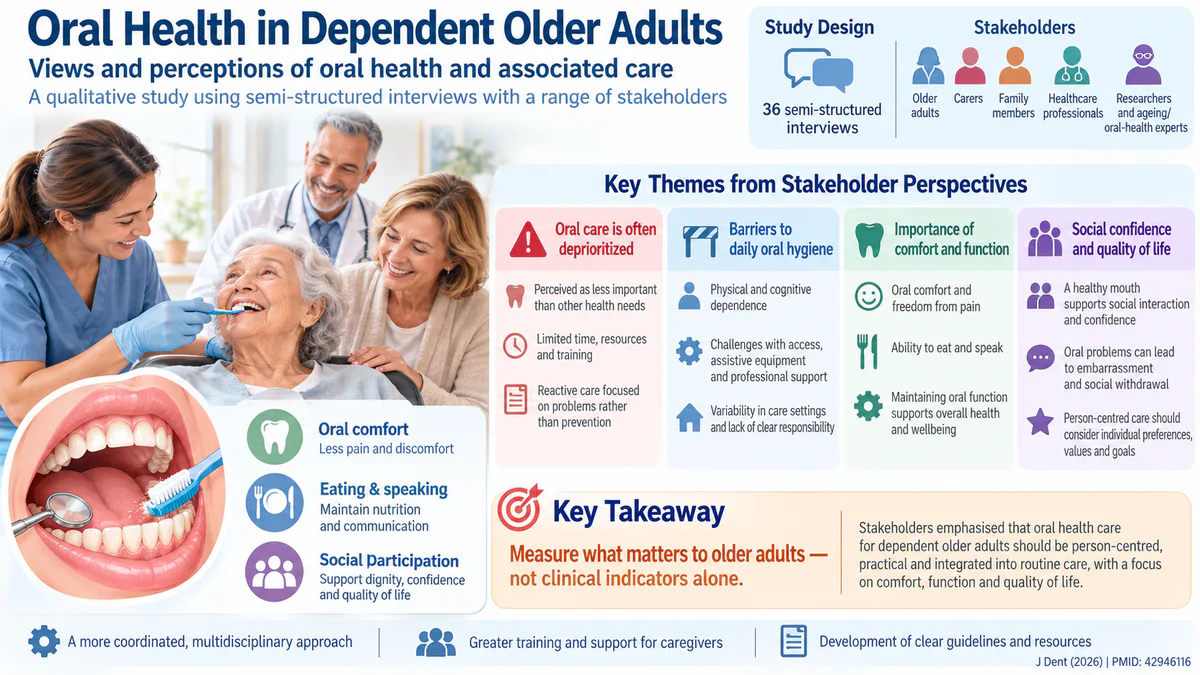
This qualitative study employed semi-structured interviews to investigate the views and perceptions of a wide range of stakeholders on oral health among dependent older adults. Participants included dependent older adults themselves, family members, care assistants, healthcare professionals, researchers, and experts specializing in aging and/or oral health. The interview topic guide was developed to explore experiences, current oral health services, consequences of poor oral health, and areas for improvement. Interviews were recorded and transcribed verbatim, followed by thematic analysis to identify recurrent themes and divergences.
Key Findings
Thirty-six interviews yielded rich qualitative data revealing six primary themes:
1. Experiences of oral health: Dependent older adults described varied oral health challenges, emphasizing discomfort, difficulty eating, and social embarrassment from poor oral conditions. These subjective experiences shaped their perceived oral health status.
2. Current oral health services: Participants uniformly reported that existing dental care services inadequately address the needs of dependent older adults. Barriers included limited access, insufficient training among care assistants to perform oral hygiene, and under-recognition of oral health importance within care settings.
3. Consequences of poor oral health: Stakeholders acknowledged that neglecting oral health leads to pain, nutritional deficits, impaired communication, and diminished social participation, significantly compromising overall wellbeing.
4. Improvements required: Calls were made for enhanced oral health education for care assistants, integration of oral care into routine daily assistance, better coordination between dental and general health services, and tailored interventions that consider cognitive and physical limitations in dependent older adults.
5. Oral health outcomes important to dependent older adults: Older adults valued subjective metrics such as oral comfort, functional ability to chew and speak, and the ability to socialize without embarrassment more than traditional clinical indices like plaque scores or decayed, missing, and filled teeth (DMFT) counts.
6. Attitudes toward oral hygiene practice: Across all groups, there was recognition that care assistants often showed reluctance or lacked confidence in performing oral hygiene tasks, a barrier that undermines consistent oral care standards.
These findings indicate a consensus on the need to realign oral health priorities for dependent older adults by emphasizing patient-centered outcomes and improving care assistant engagement.
Expert Commentary
The study highlights a critical disconnect between clinical oral health assessments traditionally used in research and the lived experiences and priorities of dependent older adults. Current evidence-based guidelines advocate for holistic care approaches for older adults, yet implementation remains limited. Experts emphasize that training frontline caregivers in oral hygiene techniques and promoting multidisciplinary collaboration, including dental professionals and geriatric care teams, are essential steps toward closing this gap. Furthermore, measuring patient-reported oral health outcomes alongside clinical indicators could transform service evaluation and policy development that better addresses quality of life.
The study’s qualitative design allows for in-depth insight but may limit generalizability to diverse cultural or healthcare settings. Further quantitative research could validate and expand on these themes, linking subjective outcomes to measurable health indicators.
Conclusion
This qualitative investigation underscores a shared recognition among stakeholders that oral health in dependent older adults is undervalued and underserved. The discrepancy between clinically focused oral health measures and the subjective, functional outcomes valued by older adults themselves calls for reformed service models and research frameworks. By centering patient-important outcomes such as oral comfort, function, and social participation, future oral health services can better support dependent older adults’ overall health and wellbeing. Enhancing training and support for care assistants to confidently deliver oral hygiene care is a pivotal priority. This study lays groundwork for developing more person-centered oral health services aligned with the real-world needs of this vulnerable population.
Funding and ClinicalTrials.gov
The original study did not note specific funding or clinical trial registration.
References
1. McMullan J, Watson S, Brocklehurst P, et al. Views and perceptions of oral health and associated care in dependent older adults: semi structured interviews with a range of stakeholders. J Dent. 2026 Oct 27:107131. PMID: 42946116.
2. Kossioni AE, Goukos D. Oral health and quality of life in elderly nursing home residents: a narrative review. Gerodontology. 2021;38(3):145-156.
3. Chalmers JM. Oral hygiene care for residents with dementia: a literature review. J Adv Nurs. 2000;32(3): 647-663.
4. World Health Organization. Oral health: action plan for older adults. WHO; 2020.
5. Gerritsen AE, Allen PF, Witter DJ, Bronkhorst EM, Creugers NH. Tooth loss and oral health-related quality of life: a systematic review and meta-analysis. Health Qual Life Outcomes. 2010;8:126.