Structured Telehealth Community Health Worker-Clinician Feedback and Diabetes Outcomes: A Randomized Clinical Trial
Introduction
Diabetes mellitus, particularly type 2 diabetes, poses a significant health burden worldwide, disproportionately affecting underserved and low-income populations. Managing this chronic condition effectively requires comprehensive approaches that integrate patient education, continuous monitoring, and coordinated clinical care. Community health workers (CHWs) have emerged as valuable allies in bridging healthcare gaps, especially in resource-limited settings. Despite the proven benefits of CHWs, scalable strategies that effectively integrate them into clinical workflows remain scarce. This trial evaluates a novel intervention that combines telementored CHWs with a structured feedback loop between participants, CHWs, and clinicians to improve diabetes outcomes in low-income Hispanic adults.
Study Design and Setting
This 12-month randomized clinical trial was conducted from September 2023 to April 2025 across three geographically and institutionally diverse community clinics in Texas. The participant pool included uninsured, low-income White Hispanic adults with type 2 diabetes, identified through electronic clinic databases. The randomized design assigned participants in a 1:1 ratio to either the intervention group or a control group receiving usual care. Data analysis was performed from May to July 2025.
Intervention Components
The intervention group benefited from a multidimensional program delivered by CHWs, consisting of:
1. Group Diabetes Education: Interactive sessions that covered essential disease knowledge, lifestyle modifications, and self-care practices.
2. Individualized Telehealth Coaching: Using telecommunication technology, CHWs provided personalized support and education tailored to each participant’s needs, facilitating real-time glucose management and medication adherence.
3. Structured Participant-CHW-Clinician Feedback Loop: This novel component enabled direct communication between participants, CHWs, and clinicians. It aimed to promptly address participant concerns, optimize treatment plans, manage medication refills, and enhance care coordination.
The control group continued receiving standard care, including quarterly clinician visits and access to multidisciplinary and social services as needed.
Outcomes Measured
The primary outcome measured was the change in hemoglobin A1c (HbA1c) levels from baseline to 12 months, a crucial indicator reflecting average blood glucose control over the preceding two to three months. Secondary outcomes included changes in lipid profiles (total cholesterol and LDL cholesterol), adherence to American Diabetes Association (ADA) clinical guidelines—specifically foot exams and urine microalbumin screening—and metrics tracking participant recruitment, intervention fidelity, and resolution of issues raised via the feedback loop.
Results
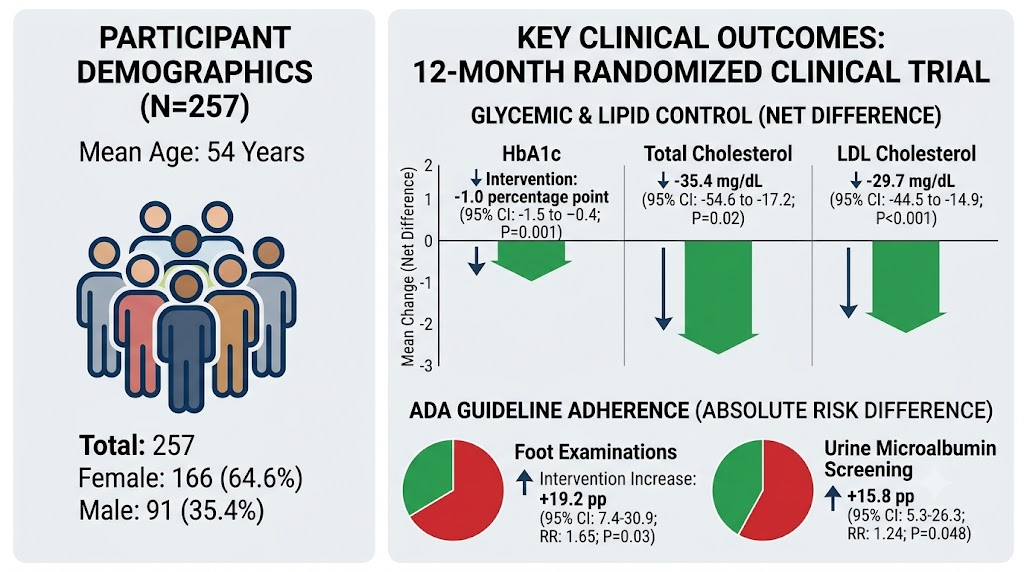
The analysis included 257 participants with a mean age of 54 years; 64.6% were female. The intervention group (129 participants) experienced significant improvements compared to the 128 participants in the control group:
– HbA1c decreased by a net difference of 1.0 percentage point (95% CI: -1.5 to -0.4; P = .001) in the intervention group.
– Total cholesterol levels dropped by an average of 35.4 mg/dL (95% CI: -54.6 to -17.2 mg/dL; P = .02).
– LDL cholesterol levels fell by 29.7 mg/dL (95% CI: -44.5 to -14.9 mg/dL; P < .001).
Moreover, the intervention enhanced adherence to ADA guidelines:
– Foot examinations increased by an absolute risk (AR) of 19.2 percentage points (95% CI: 7.4–30.9; relative risk [RR]: 1.65; P = .03).
– Urine microalbumin screening rose by an AR of 15.8 percentage points (95% CI: 5.3–26.3; RR: 1.24; P = .048).
Importantly, CHWs used the feedback loop to address 87.2% of participant concerns (490 issues), covering medication refills, glucose control advice, and access to care. This close communication facilitated timely problem-solving and reinforced patient engagement.
Discussion
This trial provides strong evidence that integrating CHWs through telehealth and a structured feedback system can significantly improve glycemic control and lipid profiles among low-income Hispanic adults with type 2 diabetes. Key factors likely contributing to these improvements include enhanced patient education, personalized telehealth coaching, and efficient communication between patients, CHWs, and clinicians, which reduced fragmentation of care.
The intervention also improved adherence to recommended diabetes screenings critical to preventing complications, indicating a successful increase in preventive care measures within the population.
Furthermore, the program revealed deficiencies in usual care practices, highlighting the need for scalable models to address social determinants of health and strengthen chronic disease management in underserved communities.
Clinical Implications and Future Directions
The findings underscore the value of implementing telehealth-enabled CHW programs linked via structured communication pathways to clinicians. Healthcare systems serving similar underserved populations might consider adopting such models to enhance diabetes care and other chronic disease management.
Future research may explore long-term outcomes beyond 12 months, cost-effectiveness analyses, and adaptations for other chronic conditions or demographic groups. Additionally, addressing barriers to telehealth access and expanding CHW training programs could further optimize implementation scalability.
Conclusion
This randomized clinical trial demonstrates that a multidimensional telehealth-supported CHW intervention with a structured patient-provider feedback loop significantly improves diabetes-related clinical outcomes and guideline adherence in low-income Hispanic adults. By reducing care fragmentation and enhancing communication, such scalable interventions have the potential to shift the landscape of chronic disease management in resource-limited settings.
Trial Registration
ClinicalTrials.gov Identifier: NCT04835493
References
Vaughan EM, Yu X, Amspoker AB, Naik AD, Balasubramanyam A, Johnston CA, Ballantyne CM, Virani SS, Brown HS, Mena K, Porterfield LR. Structured Telehealth Community Health Worker-Clinician Feedback and Diabetes Outcomes: A Randomized Clinical Trial. JAMA Intern Med. 2026 Aug 1;186(8):1012-1021. PMID: 42258200.
This article was created using several editorial tools, including AI, as part of the process. Human editors reviewed this content before publication.